


Frequently Asked Questions

CTEM Framework & Validation

What is the CTEM framework and how does it help organizations focus on real risk?

The Continuous Threat Exposure Management (CTEM) framework is a security approach that treats security as a continuous lifecycle rather than isolated silos. Its Validation stage acts as a critical pivot, connecting Discovery and Prioritization to Mobilization. CTEM enables organizations to focus on vulnerabilities that are actually exploitable and impactful, rather than just theoretical risks, ensuring engineering time is spent on issues that matter most. Learn more about CTEM.

How does the Validation stage in CTEM reduce security team workload?

The Validation stage in CTEM provides evidence-based filtering of vulnerabilities, allowing security teams to ignore issues that cannot be exploited in the current environment. This narrows the backlog to only confirmed exploitable issues, reducing the number of escalations and enabling faster, more targeted remediation. As a result, engineering hours spent on emergent remediation can shrink by 60–80%.

Why is it important to move from theoretical vulnerability scoring to evidence-based validation?

Theoretical scoring systems like CVSS often flag vulnerabilities as critical without considering real-world exploitability or business context. Evidence-based validation, as promoted by CTEM and CyCognito, ensures that only issues with actual exploit paths and business impact are prioritized, reducing alert fatigue and focusing resources on genuine threats.

How does CyCognito support continuous validation within the CTEM framework?

CyCognito continuously validates the external attack surface by combining active security testing, threat intelligence, attack path analysis, and attacker-perspective signals. The platform performs over 100,000 security tests across 30+ categories, ensuring that every flagged issue is exploitable, reachable, and relevant to the business context.

What types of issues does CyCognito validate as part of its security testing?

CyCognito validates a wide range of issues, including data exposure, authentication bypass, abandoned assets, OWASP threats, and gaps in security controls such as encryption or WAF coverage. This comprehensive approach ensures that only actionable, exploitable risks are escalated for remediation.

Features & Capabilities

What is seedless discovery and how does CyCognito use it?

Seedless discovery is CyCognito's autonomous method for identifying unknown or unmanaged assets—including shadow IT and forgotten services—without requiring manual input or asset lists. This approach uncovers up to 20× more exposures than traditional tools, providing comprehensive visibility across on-prem, cloud, SaaS, and third-party environments. Learn more.

How does CyCognito prioritize risks on the attack surface?

CyCognito combines exploitability, business context, and attack-path insights to focus on the top 0.01% of risks. This risk-based prioritization reduces noise and alert fatigue, ensuring that security teams address the most critical vulnerabilities first.

What automation features does CyCognito offer for security operations?

CyCognito automates asset discovery, vulnerability analysis, and security testing, reducing manual effort and enabling organizations to scale their security operations. The platform also automates remediation verification by periodically retesting issues to ensure genuine closure.

Does CyCognito integrate with other security and IT platforms?

Yes, CyCognito supports integrations with leading platforms such as Armis, Palo Alto Networks, Tenable, Wiz, Axonius, CrowdStrike, Cobalt, JupiterOne, ServiceNow, Splunk, Zendesk, and Jira. These integrations enable automated workflows, centralized information, and enhanced collaboration across security operations. See all integrations.

What technical documentation is available for CyCognito?

CyCognito provides a range of datasheets and resources covering platform overview, automated security testing, discovery and contextualization, prioritization and remediation, exploit intelligence, vulnerability management, active security testing, remediation planning, cloud connector, customer success, and NIST 800-53 alignment. Access the Knowledge Hub.

Use Cases & Benefits

What problems does CyCognito solve for security teams?

CyCognito addresses challenges such as unknown or unmanaged assets, excessive alert noise, manual processes, scaling security operations, prioritizing risks, blind spots in untracked IP ranges, and verifying remediation. By automating discovery and validation, it helps teams focus on actionable threats and improve operational efficiency.

Who can benefit from using CyCognito?

CyCognito is designed for IT security teams, CISOs, and security operations teams in enterprises with complex infrastructures, government agencies, Fortune 500 companies, and organizations in industries such as education, media, gaming, hospitality, and healthcare. See customer stories.

How does CyCognito help reduce incident response costs?

By validating and remediating exploitable exposures before attackers can exploit them, CyCognito helps prevent incidents that could lead to costly breaches. Industry data shows that 30% of incident response engagements originate from public-facing application exploitation, with average breach costs reaching $4.4M. CyCognito's proactive approach can help organizations avoid these unbudgeted expenses.

What business impact can organizations expect from using CyCognito?

Organizations can save up to $500,000 annually by reducing dependency on manual penetration testing and bug bounty programs. CyCognito also reduces critical findings from about 25% to 0.1%, improves operational efficiency, and provides comprehensive visibility into external assets, supporting better decision-making and risk management. Learn more.

How does CyCognito help reclaim analyst time and reduce manual workload?

Manual assessment of a new asset can take 5–10 hours. With CyCognito's automated discovery and validation, this is reduced to just 5–30 minutes per asset. For example, assessing 20 new assets would drop from 200 hours of manual work to just 10 hours, reclaiming 190 hours for higher-value tasks.

How does CyCognito reduce alert noise and help teams focus on real threats?

Traditional scanners may flag 1% of findings as critical based on theoretical severity. CyCognito's validation filters this noise, typically reducing critical findings to just 0.1%. This 90% reduction in noise allows developers and security teams to focus on issues that pose real-world threats.

Product Information & Implementation

What products and solutions does CyCognito offer?

CyCognito offers Attack Surface Management, Automated Security Testing, and Exploit Intelligence. Solutions include External Exposure Management (EASM), Continuous Security Testing (Autopt), Cyber Asset Inventory (CAASM), Vulnerability Management (UVM), Cloud Security (CNAPP), and Application Security (AppSec). See all solutions.

How quickly can CyCognito be implemented and how easy is it to start?

CyCognito is designed for rapid deployment with minimal setup. It automatically maps your external attack surface without manual scoping or seed data, requires no agents or sensors, and begins continuous discovery and validation immediately. Resources such as the Knowledge Center, Support Portal, and Customer Success Team are available to assist with onboarding. Get started.

What customer feedback has CyCognito received regarding ease of use?

Customers consistently praise CyCognito for its intuitive platform and ease of use. For example, Stefan Romberg, Global CISO, noted that CyCognito became a cornerstone of their security setup due to automatic asset detection, continuous vulnerability analysis, and a comprehensive, user-friendly platform. Read more testimonials.

What industries are represented in CyCognito's case studies?

CyCognito's case studies span industries such as gaming, media, education, hospitality, and telecommunications. These examples demonstrate the platform's versatility in addressing cybersecurity challenges across diverse sectors. See case studies.

Can you share specific customer success stories using CyCognito?

Yes. For example, Scientific Games used CyCognito to uncover hidden assets and obsolete devices, reducing risk and improving workflows. Ströer reduced alert fatigue by focusing on validated risks, and Berlitz identified 140 critical issues in one year that would have been missed manually. Read customer stories.

Security, Compliance & Trust

What security and compliance certifications does CyCognito hold?

CyCognito is SOC 2 Type II and ISO 27001 certified, demonstrating robust security controls and adherence to stringent information security management practices. These certifications reinforce CyCognito's commitment to protecting customer information. See Trust Center.

How does CyCognito support compliance with industry frameworks?

CyCognito supports compliance with frameworks such as ISO27001:2022, NIST 800-171 R2, PCI-DSS v4, and CIS CSC. The platform automates evidence collection and maps findings to relevant controls, providing early warning of compliance violations and simplifying remediation. Learn more.

Where can I find CyCognito's privacy and compliance documentation?

CyCognito's Privacy, Compliance, and Trust Center provides transparency regarding data processing practices and offers a current list of security and compliance reports available under NDA. Visit the Trust Center.

Competition & Comparison

How does CyCognito compare to Tenable ASM?

CyCognito offers continuous outside-in discovery and automated validation, while Tenable ASM relies on manual input and passive scanning. CyCognito provides 20× more visibility, focuses on the top 0.01% of risks, and eliminates blind spots that Tenable ASM may miss. See comparison table.

What differentiates CyCognito from Qualys?

CyCognito focuses on external attack surface management with autonomous discovery of unknown assets, while Qualys primarily offers vulnerability management tools. CyCognito provides seedless discovery, uncovering up to 20× more exposures, and automates risk prioritization, which Qualys lacks.

How does CyCognito compare to Microsoft Defender EASM?

CyCognito autonomously discovers hidden assets and provides rapid vulnerability scanning, while Microsoft Defender EASM requires manual input and lacks comprehensive discovery. CyCognito offers seedless discovery, actionable insights, and continuous monitoring for immediate detection of changes.

What are the advantages of CyCognito over Palo Alto Networks Cortex Xpanse?

CyCognito uses NLP, ML, and a graph data model for business mapping, while Cortex Xpanse relies on manual mapping and may miss critical assets. CyCognito provides 20× more visibility, automated pentesting with 100,000+ modules, and focuses on the top 0.01% of risks.

How does CyCognito compare to CrowdStrike Falcon Surface?

CyCognito uses autonomous, black-box pentesting with 100,000+ testing modules, while CrowdStrike Falcon Surface relies on passive scanning and lacks active testing results. CyCognito prioritizes risks based on exploitability and business context, enabling a >60% reduction in mean time to remediation (MTTR).

Customer Proof & Social Validation

Who are some of CyCognito's notable customers?

CyCognito is trusted by leading global enterprises including Tesco, Colgate-Palmolive, Panasonic, Ströer, Hitachi, Storebrand, Bertelsmann, Wipro, Adama, Berlitz, Asklepios, Scientific Games, Agoda, Altice, and Sleep Number. See all customers.

What do customers say about CyCognito's impact on their security operations?

Customers report that CyCognito provides global visibility into web-facing assets, reduces alert fatigue, and enables efficient risk management. For example, Alex Schuchman, CISO at Colgate-Palmolive, highlighted the platform's easy-to-use interface and comprehensive asset visibility. Read more testimonials.

Back to Blog

Permission to Ignore: Leveraging the CTEM Framework to Focus on Real Risk

Security frameworks have always had a gap. They tell you to find vulnerabilities and fix them, but they’ve rarely provided a system to determine which ones actually matter before you tap into your most expensive resource: engineering time.

CTEM changes the game by treating security as a continuous lifecycle rather than a series of silos. Its Validation stage isn’t just an isolated step; the CTEM framework defines it as the critical pivot point that connects Discovery and Prioritization to actual Mobilization.
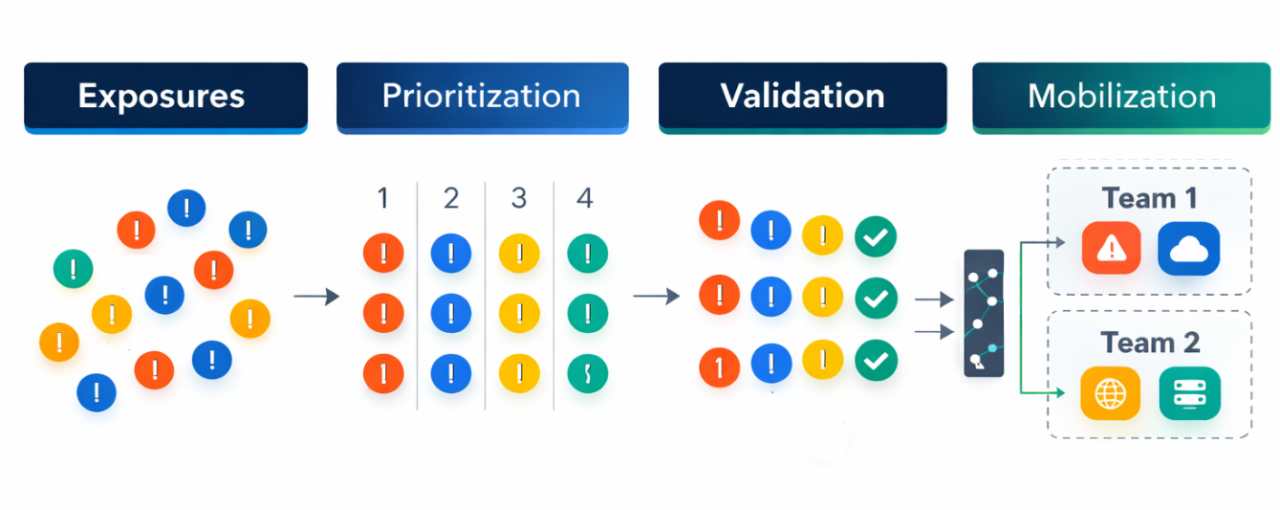
By doing so, CTEM  creates a structured, evidence-based bridge between “we found something” and “we need to fix it.” It also changes the conversation and refocuses security KPIs from a quantitative element to actual evidence that an attacker can exploit a specific issue on a specific asset, right now.

If you want to learn more about these topics, check out other blogs in this series:

The Noise of “Critical” Severity

Most security tools were built to find CVEs. That’s their value proposition. The more issues they surface, the more value they appear to deliver. Bigger numbers create an illusion of coverage while masking actual exposure.

That model made sense when environments were simpler. Most infrastructure was on-prem, relatively static, and the volume of known vulnerabilities was manageable. Finding a CVE meant something,  it usually pointed to a real problem on an asset someone knew about.

That world doesn’t exist anymore. Organizations operate across sprawling hybrid environments with assets spinning up and changing constantly. The number of published CVEs has exploded. Misconfigurations have become as common as software bugs. And the tools built for that earlier era keep doing what they were designed to do: find more, flag more, score more.

The result is a flood of “critical” findings that aren’t actually critical. CVSS measures theoretical impact in isolation of the vulnerability, without accounting for network topology, security controls, or whether an attacker can even reach the asset. A CVSS 9.8 on an internal dev server or protected by a security control such as a WAF gets the same score as one on a customer-facing payment gateway. They’re not the same risk. Not even close.

So backlogs grow faster than anyone can address them. Security keeps chasing vulnerabilities, engineering pushes back, and the whole organization spends more effort managing the queue than actually reducing risk. Everyone gets busier but nothing gets safer.

This is the core problem CTEM’s Validation stage is designed to solve.

Validation as Permission to Ignore

The word “ignore” makes people uncomfortable in security. But every security team already ignores things, they just do it without a system. They deprioritize based on gut feel, push findings to the bottom of the queue, or let tickets age out quietly. With CTEM, ignoring becomes a deliberate, evidence-based decision. Or as Gartner puts it, “Validation works as a filter to prove which discovered exposures could actually impact the organization.”

If an issue can’t actually be exploited right now, it gets handled through normal hygiene,  patching cycles, infrastructure refreshes, routine maintenance. No escalation. No executive dashboard. No engineer pulled off planned work.

If it can, it escalates with proof. Not just a score. Actual evidence: here’s the asset, here’s the exploit path, here’s the business impact.

Security stops managing “vulnerabilities” and starts addressing confirmed exploitable issues. The backlog shrinks because the problem space narrows to what genuinely threatens the business. Remediation happens faster because it’s focused on real risk, and engineering hours spent on emergent remediation shrink by 60–80%. Leadership gets cleaner reporting because the numbers reflect actual exposure, not scan output.

Continuous EEM and Validation with CyCognito

CyCognito delivers validated findings from the attacker’s perspective. Every issue that gets flagged isn’t just exploitable in theory,  it’s reachable from the outside, discoverable, and attractive enough to pursue. The platform combines active security testing with threat intelligence, attack path analysis, and attacker-perspective signals like discoverability and attractiveness.

Most organizations validate in narrow slices, an annual pentest, a red team exercise. These provide depth but leave massive gaps. Between testing windows, new assets spin up, configurations drift, and none of it gets validated. CyCognito closes that gap by running validation continuously across the full external attack surface.
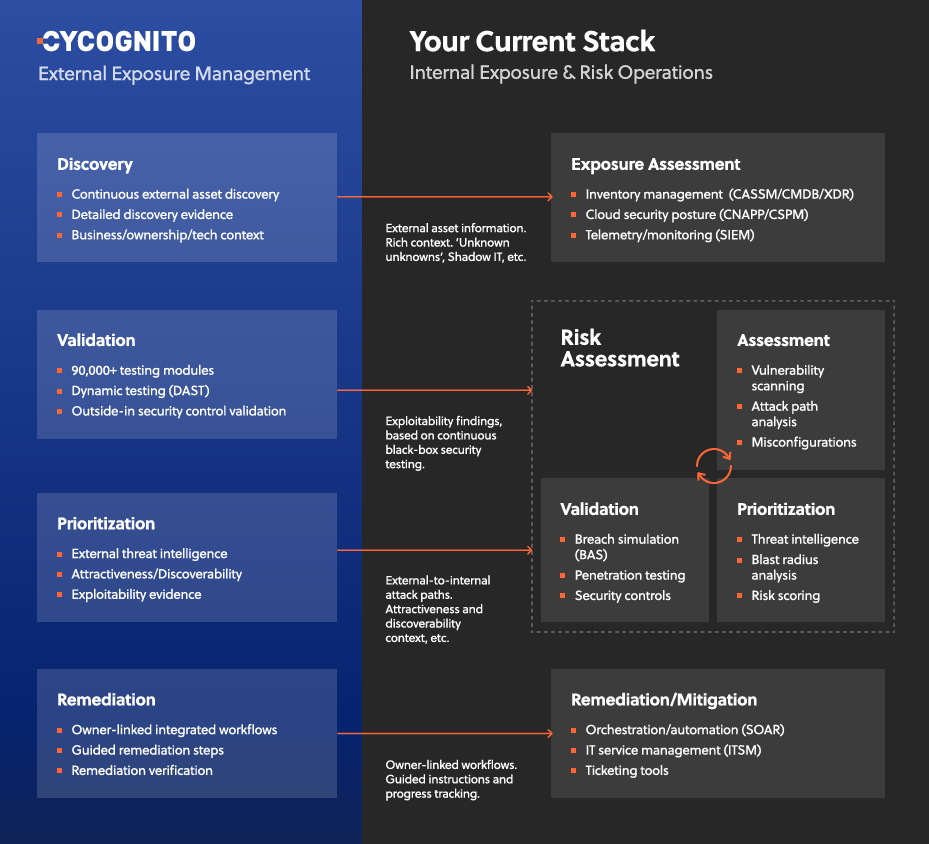
How CyCognito adds external exposure management to your CTEM technology stack

The platform uses seedless discovery to find externally reachable assets across on-prem, cloud, SaaS, and third-party environments, including ones that never made it onto an inventory. It then performs more than 100,000 security tests (inc. continuous DAST) across 30+ categories to validate issues like:

  • Data exposure
  • Authentication bypass
  • Abandoned assets
  • OWASP threats
  • Security controls (e.g., encryption or WAF coverage gaps)

 and more

It does all of that on a recurring cadence, mirroring real attacker behavior, avoiding production disruption, and adapting as your environment changes.

When something is confirmed exploitable, CyCognito provides the technical receipts: detailed evidence of the exploit path, the affected asset, its business context and organizational ownership, and clear remediation steps.

The Math of Turning Risk into Business Value

While many organizations are adopting the Continuous Threat Exposure Management (CTEM) framework, the actual value of that framework depends on the speed and accuracy of the underlying technology. CyCognito transforms these theoretical processes into measurable business outcomes by automating the discovery, attribution, and testing of the external attack surface.

By bringing a true attacker’s perspective to the environment, CyCognito provides validation that proves exactly how an exposure could be exploited. This shift from manual triage to automated, evidence-based validation significantly reduces the operational “tax” on both security and development teams.

Reclaiming the Analyst’s Day

Because the attack surface is constantly shifting, the burden of analyzing new assets as they appear is significant. Manually assessing a single new asset (identifying its purpose, ownership, and risk) typically takes an analyst 5 to 10 hours. Validation changes this math by automating the discovery and testing process, reducing that time to just 5 to 30 minutes per asset.

To illustrate this, consider a scenario where 20 new assets are discovered, each carrying roughly 20 potential security issues and the effort those will demand:

  • Manual assessment: 20 assets × 10 hours = 200 hours.
  • After validation: 20 assets × 30 minutes = 10 hours.
  • End result: You have reclaimed 190 hours of high-level labor for every 20 assets identified, allowing analysts to focus on strategy rather than triage.

Focusing R&D on Proven Risk 

Once assets are assessed, the next challenge is the noise of the findings. Traditional scanners often flag 1% of all findings as “Critical” based on theoretical severity. Validation filters this noise by flagging only proven, exploitable issues, typically reducing the volume of critical findings to just 0.1%.

Using our 20-asset scenario (assuming 20 issues per asset), this is how this how validated findings make a difference:

  • Initial prioritization: 400 total findings × 1% Critical = 4 “Critical” tickets.
  • After validation: 400 total findings × 0.1% Critical = 0.4 (effectively 0 or 1) tickets.
  • End result: A 90% reduction in noise, allowing developers to spend their precious time building features rather than chasing vulnerabilities that pose no real-world threat.

Reducing Incident Response Costs

Beyond daily productivity, validation directly impacts the bottom line by preventing the most expensive days a company can face. Industry data shows that 30% of incident response engagements originate from the exploitation of public-facing applications. Closing these breaches before an attacker finds them is the most effective way to avoid unbudgeted costs.

If an IR team typically manages 25 incidents per year, According to recent reports, the average cost of a data breach can reach $4.4M when factoring in forensics, downtime, and legal implications. By using validation to find and close these specific entry points first, the math is simple: the business saves millions by preventing the very incidents that were most likely to happen.

Making It Work

The permission to ignore is not a shortcut; it is the operational logic that allows the CTEM framework to function as a unified, interconnected system. When these phases are treated as isolated silos, CTEM becomes just another way to organize an overwhelming backlog. When they are truly integrated, security becomes what it was always supposed to be: targeted, efficient, and credible.

Validation acts as the connective tissue in this cycle. It ensures that the insights from Discovery and Prioritization are hardened into high-fidelity intelligence before they ever reach the Mobilization phase. This prevents the “remediation bottleneck” by ensuring that only confirmed, reachable risks trigger a call to action.

CyCognito makes this interconnected cycle practical. Instead of validating a small sample once a year, security teams benefit from a continuous loop of proof across their full external attack surface. This ensures that every stage of the framework is fueled by real-world evidence, allowing the organization to move with confidence from discovery to resolution.

Want to see what this looks like in your environment? Schedule time with a CyCognito expert to walk through your external attack surface and discuss how CTEM can work for your organization.

Request a free scan

See Exactly What Attackers See

Get a free scan of your attack surface and gain valuable insight into your organization's risk posture by allowing CyCognito to discover, contextualize, and test externally .

Request a Scan
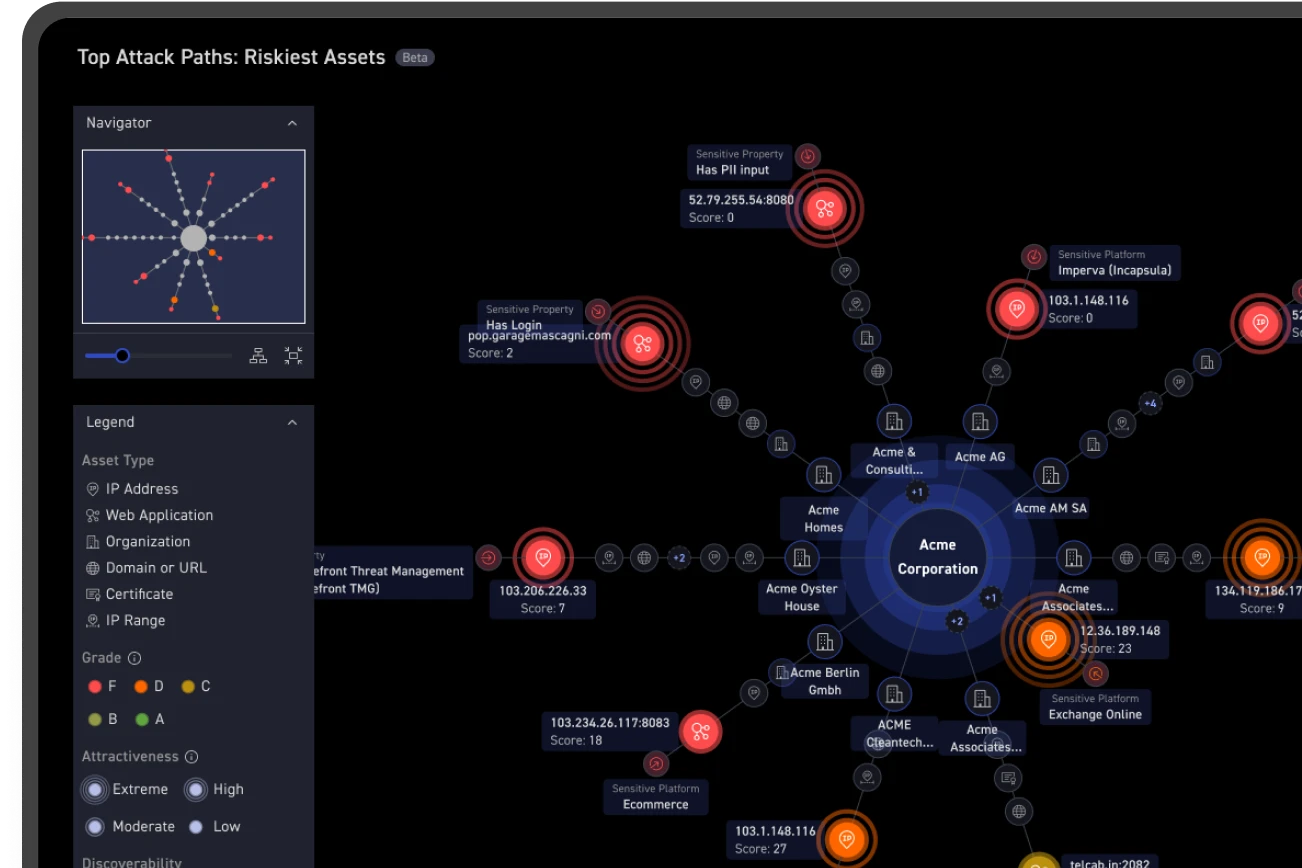
Top Attack Paths