
What is CVE-2026-53721?
CVE-2026-53721 is a route-rule middleware bypass in Nuxt, the open-source web development framework for Vue.js. It stems from a case-sensitivity mismatch between vue-router and the framework’s routeRules matcher, which lets an attacker reach a protected route by varying the casing of the request path.
The vulnerability carries a CVSS v4.0 base score of 8.8 (High). Exploitation is pre-authentication and requires no user interaction. An attacker only needs to be able to send HTTP requests to the application.
The mechanism is a matching inconsistency. Nuxt looks up the rules for the current navigation by calling getRouteRules({ path: to.path }). The compiled routeRules matcher and vue-router normalize the request path differently with respect to case. A request such as /Admin can therefore be routed by vue-router to the same handler as /admin, while the routeRules matcher fails to recognize it as a match and skips the rule that should have applied.
The practical impact depends on what those route rules enforce. Teams use routeRules to set redirects, security headers, caching behavior, and access patterns on specific paths. When the matcher is bypassed, those controls silently do not run for the crafted path, exposing routes that were assumed to be governed by a rule.
What assets are affected by CVE-2026-53721?
The flaw affects Nuxt 3.11.0 up to but not including 3.21.7, and Nuxt 4.0.0 up to but not including 4.4.7. Applications built on these versions that rely on routeRules for path-level controls are in scope.
In practice, an affected asset is an internet-facing web application or API front end built with Nuxt. These tend to be production marketing sites, customer portals, and application back ends rendered server-side, often deployed behind a CDN or reverse proxy. Because Nuxt is a mainstream Vue.js framework, vulnerable instances are common across externally reachable web properties.
The exposure is easy to overlook for two reasons. The Nuxt version is not always obvious from the outside, and routeRules is a configuration-level feature, so a path that looks protected in the application config may not be protected in practice. Asset owners who treat routeRules as their access boundary on a given path are the most affected.
What does our data show about exposure patterns?
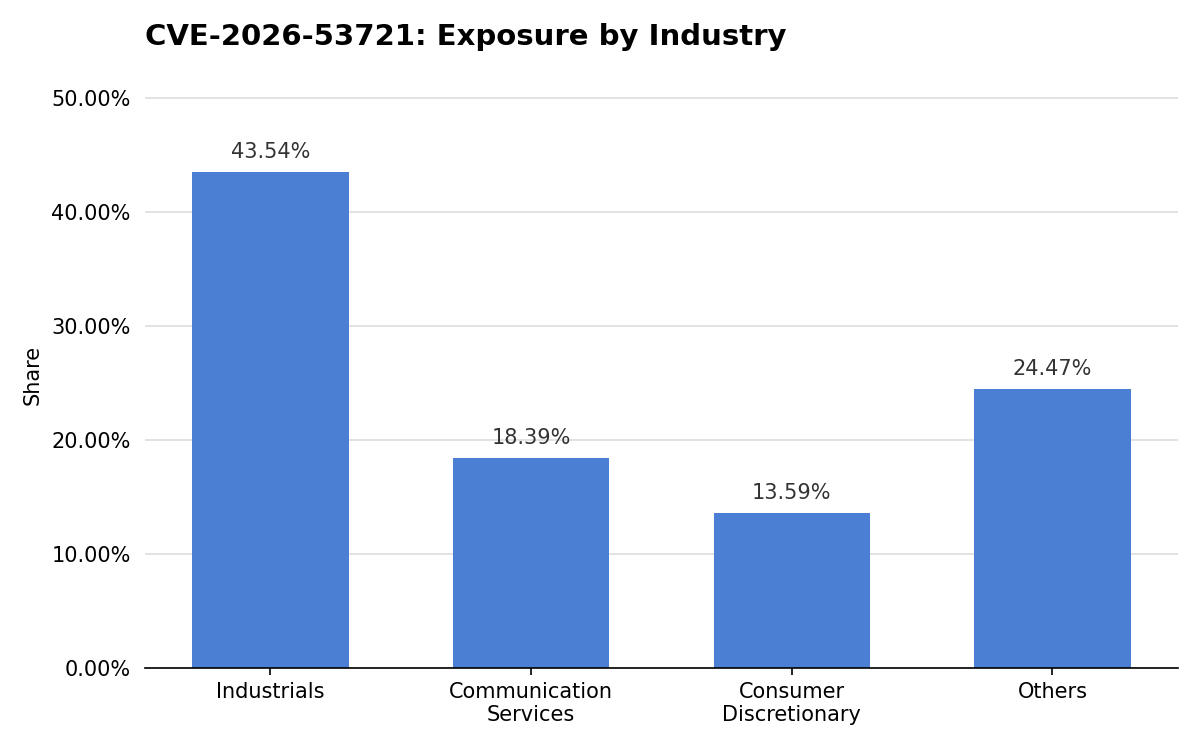
Exposure in this set is led by Industrials at 43.5% of observed assets, with Communication Services contributing 18.4%. Consumer Discretionary follows at 13.6%, and the remaining sectors fall into the Others bucket at 24.5%.
The concentration in Industrials tracks with how that sector builds and runs its web presence. Industrial organizations operate large, distributed portfolios of customer portals, partner sites, and operational front ends, frequently spun up by separate business units or acquired entities.
That breadth produces many independently maintained Nuxt deployments, and patch cadence across them is uneven. Communication Services shows up strongly for a related reason: media and telecom properties favor modern JavaScript frameworks like Nuxt for high-traffic public sites, which puts more vulnerable surface in the open.
The cross-sector pattern points to a visibility gap rather than a single misconfiguration. Framework-level flaws like this one ride along with whatever the development team shipped, so exposure spreads wherever Nuxt was adopted without a central inventory of versions in production. The sectors carrying the most exposure are the ones running the most web properties under the least centralized control.
Are fixes available?
Patches are available. The Nuxt maintainers fixed the issue in versions 3.21.7 and 4.4.7. Organizations running an affected 3.x release should move to 3.21.7 or later, and those on 4.x should move to 4.4.7 or later.
Where applicable, the corresponding builder packages should be aligned to the same patched release line. Teams that pin Nuxt through a monorepo or shared dependency should confirm the resolved version after upgrading rather than assuming the lock file picked it up.
Because the vulnerable behavior is a routing inconsistency rather than a service that announces its version, defenders should verify the running Nuxt version directly against their build artifacts rather than relying on external fingerprinting.
Are there any other recommended actions to take?
Until upgrades are confirmed everywhere, defenders should:
- Inventory all internet-facing Nuxt applications and record their exact versions
- Enforce access control at the server or middleware layer, not in
routeRulesalone - Normalize request path casing at the reverse proxy or WAF before routing
- Monitor access logs for requests to sensitive paths using unusual casing
- Audit
routeRulesdefinitions for any rule used as a security boundary
How can CyCognito help your organization?
CyCognito published an Emerging Threat Advisory for CVE-2026-53721 in the CyCognito platform and is actively researching enhanced detection capabilities for this vulnerability.
To learn how CyCognito can help your organization reduce external exposure and manage emerging threats more effectively, contact us to request a demo.