


Frequently Asked Questions

Recognition & Industry Leadership

Why was CyCognito named a Leader and Outperformer in the 2026 GigaOm Radar for Attack Surface Management?

CyCognito was recognized as a Leader and Outperformer in the 2026 GigaOm Radar for Attack Surface Management (ASM) due to its methodical approach to accurate asset discovery, contextualized risk assessment, and continuous validation. The report highlights CyCognito's ability to move beyond simple visibility, focusing on validated, actionable priorities even in complex enterprise environments. This recognition marks the third consecutive year CyCognito has been named a Leader and the first time as an Outperformer, reflecting strong momentum in execution and innovation. (Source: GigaOm Radar 2026)

What criteria did GigaOm use to evaluate CyCognito in the ASM Radar report?

GigaOm evaluated CyCognito based on its ability to provide contextualized asset discovery, validated risk assessment, attack path mapping, continuous validation, asset categorization, ecosystem integration, and automated intelligence. The report emphasized platforms that move from broad visibility to a small set of validated, actionable priorities, supporting operational resilience and strategic risk reduction. (Source: GigaOm Radar 2026)

How does CyCognito's recognition in the GigaOm Radar impact its credibility?

Being named a Leader and Outperformer in the GigaOm Radar for ASM for three consecutive years demonstrates CyCognito's consistent innovation, execution, and ability to deliver measurable outcomes in attack surface management. This recognition serves as a trusted buyer's guide and validates CyCognito's position as a top choice for organizations seeking holistic exposure management. (Source: GigaOm Radar 2026)

What does the Outperformer designation mean in the GigaOm Radar report?

The Outperformer designation is reserved for vendors showing strong momentum through execution and innovation. In 2026, CyCognito earned this status for its advancements in ecosystem integration and automated testing maturity, reflecting its ability to deliver continuous validation and actionable risk reduction. (Source: GigaOm Radar 2026)

Features & Capabilities

What are the core features of CyCognito's platform?

CyCognito's platform offers core features such as attack path mapping, continuous validation, asset categorization with over 160 context elements per asset, ecosystem integration with leading security and IT platforms, and automated intelligence using a graph-based model. These features enable organizations to discover, contextualize, and prioritize risks across their external attack surface. (Source: CyCognito Platform)

How does CyCognito perform attack path mapping?

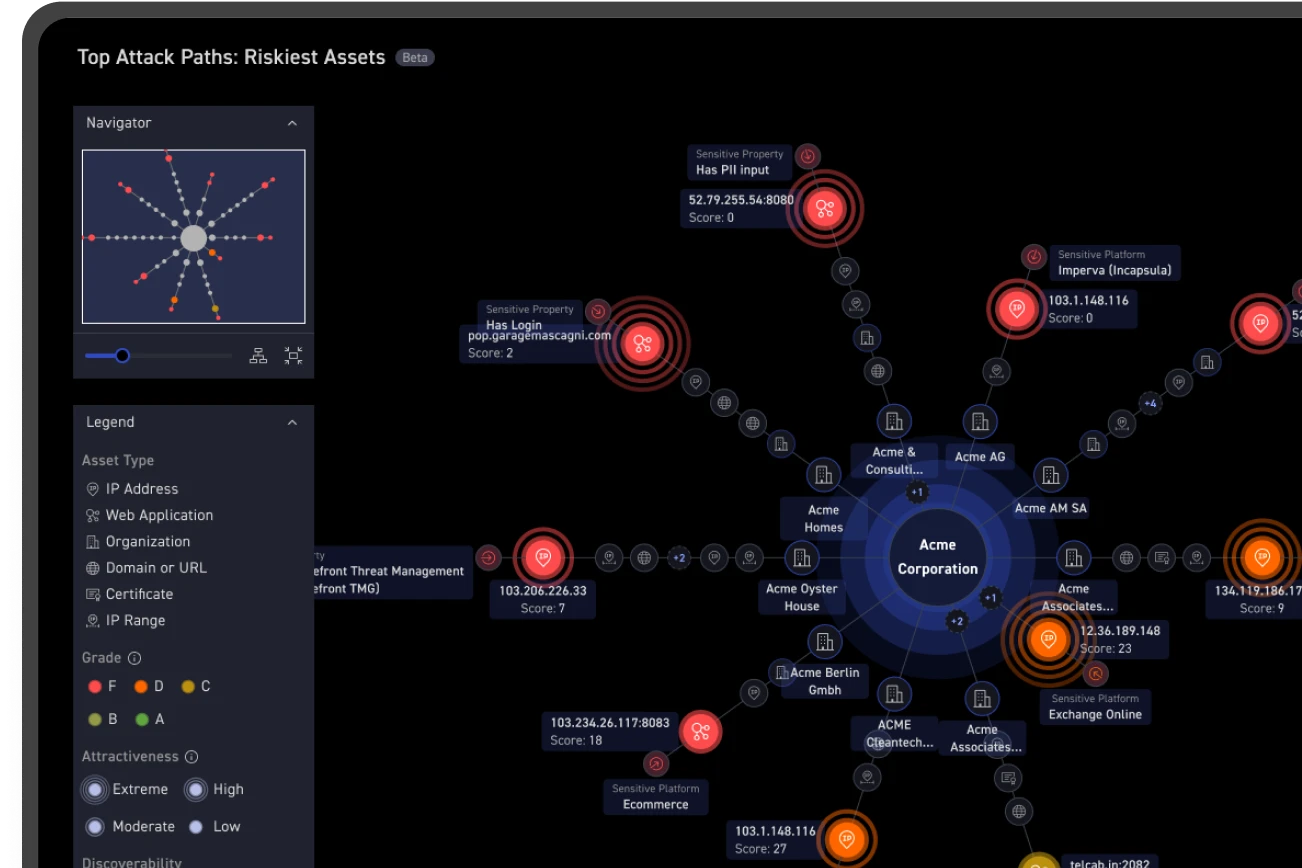
CyCognito visualizes attack paths by mapping relationships between discovered assets and exposures. By correlating external findings with internal context from platforms like Armis or Axonius, it helps teams identify the shortest remediation paths from exposed edge assets to critical internal systems. (Source: CyCognito Platform)

What is continuous validation in CyCognito?

Continuous validation in CyCognito refers to its automated testing engines that autonomously validate exposures across 100,000+ tests and 30+ categories. This process filters noise and identifies the approximately 0.01% of items that are truly critical, ensuring consistent performance even in large-scale environments with over 100 million assets. (Source: CyCognito Platform)

How does CyCognito categorize assets?

CyCognito adds over 160 context elements per asset, including technical details, security signals, and ownership information. This granularity accounts for compensating controls such as WAF or SSO, supporting precise prioritization and automated workflows. (Source: CyCognito Platform)

What integrations does CyCognito support?

CyCognito supports integrations with leading security and IT platforms, including Armis, Palo Alto Networks, Tenable, Wiz, Axonius, CrowdStrike, Cobalt, JupiterOne, ServiceNow, Splunk, Zendesk, and Jira. These integrations enable automated workflows, centralized information, and enhanced collaboration across security operations. (Source: CyCognito Integrations)

Does CyCognito provide technical documentation and resources?

Yes, CyCognito offers a range of datasheets and resources covering platform overview, automated security testing, discovery and contextualization, prioritization and remediation, exploit intelligence, vulnerability management, active security testing, remediation planning, cloud connector, customer success, and compliance alignment. These resources are available in the CyCognito Knowledge Hub.

What security and compliance certifications does CyCognito hold?

CyCognito holds SOC 2 Type II and ISO 27001 certifications, demonstrating robust security controls and adherence to stringent information security management practices. These certifications reinforce CyCognito's commitment to protecting customer information. (Source: CyCognito Trust Center)

How does CyCognito support compliance with industry frameworks?

CyCognito supports compliance with frameworks such as ISO27001:2022, NIST 800-171 R2, PCI-DSS v4, and CIS CSC. The platform automates evidence collection and maps findings to relevant controls, providing early warning of compliance violations and actionable insights for remediation. (Source: CyCognito Trust Center)

Use Cases & Benefits

What problems does CyCognito solve for organizations?

CyCognito addresses challenges such as unknown or unmanaged assets, excessive alert noise, manual processes, scaling security operations, prioritizing risks, blind spots in untracked IP ranges, and verifying remediation. The platform automates discovery, validation, and prioritization, enabling organizations to focus on actionable threats and reduce operational overhead. (Source: CyCognito Homepage)

Who can benefit from using CyCognito?

CyCognito is designed for IT security teams, CISOs, security operations teams, enterprises with complex infrastructures, government agencies, Fortune 500 companies, and organizations in industries such as education, media, gaming, hospitality, and healthcare. (Source: CyCognito Customers)

What business impact can customers expect from CyCognito?

Customers can expect up to $500,000 in annual cost savings by reducing dependency on manual penetration testing and bug bounty programs. The platform reduces critical findings from about 25% to 0.1%, streamlines workflows, and provides comprehensive visibility, resulting in improved security posture and operational efficiency. (Source: Why CyCognito)

Are there any customer success stories demonstrating CyCognito's value?

Yes, for example, Scientific Games used CyCognito to uncover hidden assets and obsolete devices, reducing risk and improving security workflows. Ströer reduced alert fatigue by focusing on validated risks, and Berlitz identified 140 critical issues in one year that would have been missed manually. (Source: CyCognito Customers)

Which industries are represented in CyCognito's case studies?

Industries represented include gaming, media, education, hospitality, and telecommunications. These case studies demonstrate CyCognito's versatility in addressing cybersecurity challenges across diverse sectors. (Source: CyCognito Customers)

What feedback have customers given about CyCognito's ease of use?

Customers consistently praise CyCognito for its intuitive platform and ease of use. For example, Stefan Romberg, Global CISO, described it as a cornerstone of their security setup, while Alex Schuchman, CISO at Colgate-Palmolive, highlighted the easy-to-use interface and global visibility. (Source: Why CyCognito)

How quickly can organizations implement CyCognito?

CyCognito is built for rapid deployment and requires minimal setup. The platform automatically maps the external attack surface without manual scoping or seed data, begins continuous discovery immediately, and does not require agents or sensors. (Source: CyCognito UVM Solution)

Competition & Comparison

How does CyCognito compare to Tenable ASM?

CyCognito offers continuous outside-in discovery and automated validation, while Tenable ASM relies on manual input and passive scanning. CyCognito provides up to 20× more visibility, focuses on the top 0.01% of risks, and eliminates blind spots that Tenable ASM may miss. (Source: CyCognito Homepage)

What differentiates CyCognito from Qualys?

CyCognito focuses on external attack surface management with autonomous discovery of unknown assets, while Qualys primarily offers vulnerability management tools. CyCognito provides seedless discovery, uncovering up to 20× more exposures, and automates risk prioritization, which Qualys lacks. (Source: CyCognito Homepage)

How does CyCognito compare to Microsoft Defender EASM?

CyCognito autonomously discovers hidden assets and provides rapid vulnerability scanning, while Microsoft Defender EASM requires manual input and lacks comprehensive discovery. CyCognito offers seedless discovery, actionable insights, and continuous monitoring for immediate detection of changes. (Source: CyCognito Homepage)

What are the advantages of CyCognito over CrowdStrike Falcon Surface?

CyCognito uses autonomous, black-box pentesting with over 100,000 testing modules, while CrowdStrike relies on passive scanning and lacks active testing results. CyCognito prioritizes risks based on exploitability and business context, enabling a greater than 60% reduction in mean time to remediation (MTTR). (Source: CyCognito Homepage)

How does CyCognito differ from Palo Alto Networks Cortex Xpanse?

CyCognito uses NLP, machine learning, and a graph data model for business mapping, while Cortex Xpanse relies on manual mapping and may miss critical assets. CyCognito provides up to 20× more visibility, automated pentesting with 100,000+ modules, and focuses on the top 0.01% of risks. (Source: CyCognito Homepage)

What makes CyCognito a preferred choice over alternatives?

CyCognito offers seedless discovery, risk-based prioritization, automation for scale, verified closure of security issues, and comprehensive security management. Compared to alternatives, it provides deeper visibility, more accurate prioritization, and automated workflows, eliminating the need for manual setup and reducing operational overhead. (Source: Why CyCognito)

Technical Requirements & Support

Does CyCognito require agents or sensors for deployment?

No, CyCognito does not require the deployment of agents or sensors. The platform is designed for rapid deployment and minimal setup, enabling organizations to start continuous discovery and validation immediately. (Source: CyCognito UVM Solution)

What resources are available to help organizations implement CyCognito?

CyCognito provides a Knowledge Center with documentation and guidance, a Support Portal for technical assistance, and a Customer Success Team to help implement strategies and best practices. These resources ensure customers can quickly and effectively use the platform. (Source: Customer Success Datasheet)

How does CyCognito ensure findings stay current as environments change?

CyCognito uses a graph-based model with evidence-based attribution to normalize and resolve entity data. This approach ensures that findings remain current and prioritization updates automatically as environments evolve, without manual effort. (Source: CyCognito Platform)

Where can I find more information about CyCognito's compliance and trust practices?

More information about CyCognito's compliance, privacy, and trust practices is available in the CyCognito Trust Center, which provides transparency on data processing and access to security and compliance reports under NDA.

Product Information

What products and solutions does CyCognito offer?

CyCognito offers products and solutions including Attack Surface Management, Automated Security Testing, Exploit Intelligence, External Exposure Management (EASM), Continuous Security Testing (Autopt), Cyber Asset Inventory (CAASM), Vulnerability Management (UVM), Cloud Security (CNAPP), and Application Security (AppSec). (Source: CyCognito Platform)

How does CyCognito help organizations align with the CTEM framework?

CyCognito supports the Continuous Threat Exposure Management (CTEM) framework by enabling continuous discovery, contextual prioritization, validation, and mobilization of remediation. The platform's capabilities align with CTEM's focus on exposure reduction and operational fit through workflow support and automation. (Source: CyCognito CTEM Guide)

What is the value of continuous validation in ASM according to CyCognito?

Continuous validation serves as an evidence-based bridge between identifying potential issues and determining which require immediate action. It enables teams to focus remediation on actual risk, reduces ticket volume, lowers mean time to remediation, and optimizes incident response spend. (Source: CyCognito Blog)

How does CyCognito help organizations move from reactive to strategic risk reduction?

By providing an attacker's perspective, CyCognito enables organizations to prioritize remediation based on actual exploitability rather than theoretical severity. This shift allows leadership to move from reactive firefighting to strategic risk reduction, focusing on validated threats and mission-critical assets. (Source: CyCognito Blog)

Back to Blog

CyCognito Named a Leader and Outperformer in the 2026 GigaOm Radar for ASM

In 2026, the ASM scorecard has moved well past discovery. The market is shifting from visibility to validated proof: what’s exploitable, what connects to critical systems, and what requires immediate action.

The latest GigaOm Radar for Attack Surface Management is anchored to that bar. Across 32 vendors, it highlights the platforms that have moved beyond inventory into contextual prioritization and actionable validation.

This is the turning point CyCognito is built for. That’s why this year’s report named us a Leader for the third consecutive year and, for the first time, an Outperformer.
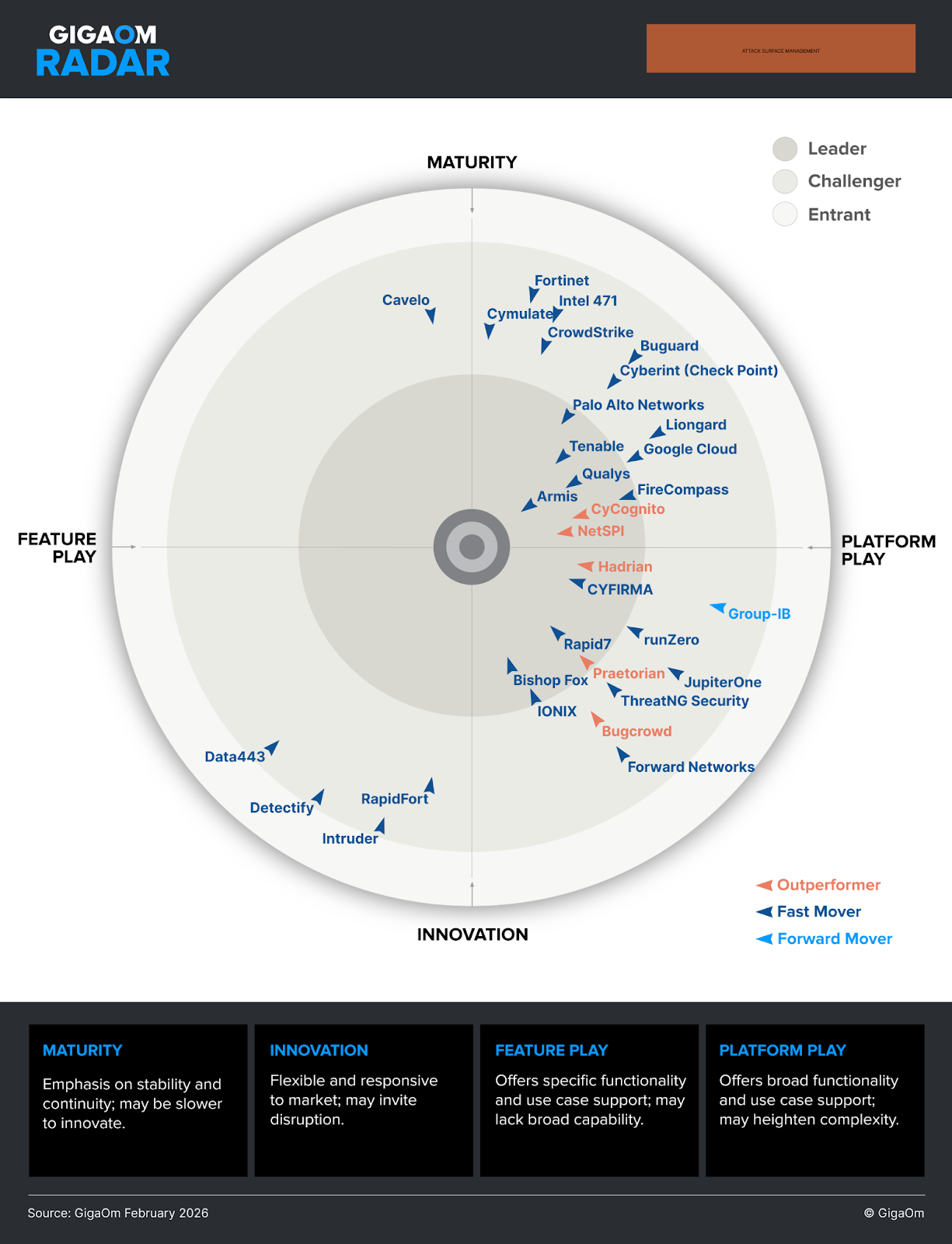
Download the full report here

From Security Tool to Business Imperative

At the core of the GigaOm Radar for Attack Surface Management is a simple thesis: ASM is moving from a technical control to a business function. In this framing, ASM becomes a part of the operational resilience conversation for its ability to give leadership a current, defensible view of what the organization owns, what is exposed, and what requires action.

“For the C-suite, ASM is no longer an optional hygiene tool but a business imperative for operational resilience.”

To serve this function, the report argues ASM has to default to the attacker’s perspective. Only through this lens can it outgrow its visibility-first origins and become a decision driver, helping teams prioritize what is plausibly actionable (exploitability and reach) and focus remediation on actual risk and mission-critical assets.

“By providing an attacker's eye view of the enterprise, these solutions enable organizations to prioritize remediation based on actual exploitability rather than theoretical severity. This shift allows leadership to move from reactive firefighting to strategic risk reduction.”

The gap this highlights is between “we found 10,000 things you own” and “here are the handful of validated priorities that require action now.” 

That gap is where ASM value lives today.

CyCognito in the 2026 GigaOm Radar

GigaOm’s evaluation connects CyCognito directly to the gap the market is now trying to close: moving from broad visibility to a small set of validated priorities teams can act on, even in complex enterprise environments. 

As GigaOm analyst Chris Ray noted:
“CyCognito takes a methodical approach to attack surface management by focusing on accurate asset discovery and contextualized risk assessment. This strategy emphasizes maintaining comprehensive visibility while providing actionable context for identified risks, particularly focusing on validated threats.”

In the report, CyCognito’s approach is recognized for its focus on contextualized asset discovery and validated risk assessment, emphasizing the following capabilities:

1. Attack path mapping
CyCognito visualizes the attack paths an attacker would take by mapping relationships between discovered assets and exposures. Moreover, by correlating external findings with internal context from platforms like Armis or Axonius, it helps teams see the shortest remediation paths from exposed edge assets to critical internal systems.

2. Continuous validation
CyCognito’s automated testing engines deliver actionable output even in environments with over 100 million assets. The engines autonomously validate exposures, across 100,000+ tests and 30+ categories, filtering noise to identify the approximately 0.01% of items that are truly critical, with consistent performance across large-scale operations.

3. Asset categorization
CyCognito adds over 160 context elements per asset, spanning technical details, security signals, and ownership. This granularity accounts for compensating controls (such as WAF or SSO) and supports more precise prioritization and automated workflows.

4. Ecosystem integration
CyCognito is designed to operate as part of the enterprise security stack. Bidirectional integrations (including Armis and Wiz) connect external exposure to internal context, while prebuilt integrations with CMDB and workflow systems like ServiceNow help teams route work and accelerate time-to-value.

5. Automated intelligence
Using a graph-based model with evidence-based attribution, the platform normalizes and resolves entity data so findings stay current as environments change, and prioritization updates without manual effort.

Why Outperformer Is Not a Vanity Label

GigaOm reserves the Outperformer designation for vendors showing momentum through execution and innovation. This year, CyCognito earned this status, reflecting strong progress in areas including ecosystem integration and automated testing maturity.

The core value of these is continuous validation, which serves as an evidence-based bridge between “we found another potential issue” and “we need to fix it asap.” A conclusion that becomes even more actionable when enriched with context from integrated systems, clarifying potential impact, attack paths, and blast radius.

And on the flip side, of course, validation is also what gives teams permission to ignore noise, helping focus (often scarce) remediation capacity on what matters most. 

In the end, validation is what enables ASM to excel at its security function while also acting as a cost saver and an optimizer. 

When validation is continuous and integrated, security can act with intent and calculated urgency, routing fewer high-priority items to the right owners.From a business perspective, this shifts the conversation to measurable outcomes: reduced ticket volume, lower MTTR, less engineering capacity consumed, and lower incident response spend.

The CTEM Lens

“The narrative has now moved decisively toward exposure management and alignment with continuous threat exposure management (CTEM) frameworks.”

No ASM analysis in 2026 is complete without acknowledging CTEM, a framework that sits behind more and more conversations about exposure reduction. The GigaOm report echoes that shift, looking at ASM through the lens of which platforms support that cycle in practice (prioritization, validation, and mobilization).

One way to read the Radar is as a practical translation of CTEM into product criteria, focusing on the capabilities that drive outcomes across the cycle.

CTEM lens How it shows up in the Radar
Table stakes Baseline capabilities are treated as required (not differentiators). Inclusion expects more than simple asset enumeration.
Discovery Continuous discovery and inventory management are foundational, with an emphasis on finding unknown assets and keeping inventory current.
Prioritization Emphasis on contextual prioritization, including attacker-relevant signals (for example attack path analysis, exploitability and threat intelligence about activity “in the wild”).
Validation Validation is treated as the confidence layer that reduces noise and makes prioritization both precise and defensible.
Mobilization Operational fit shows up through workflow support, automation/correlation, and integrations into systems teams run (ticketing, CMDB, security platforms).

Working through this checklist delivers clear operational benefits, including tying exposure management to business KPIs: fewer urgent escalations, clear ownership, protected critical assets, and fewer exploitable conditions.

Final Thoughts

When a market moves quickly, you need a consistent yardstick. GigaOm has applied one to ASM for five years, long enough to show how the category’s center of gravity has changed. Anchored in defined criteria and a repeatable scoring model, the Radar serves as a trusted buyer’s guide that cuts through vague vendor narratives.

In 2026, ASM is measured by whether it supports the exposure-reduction cycle: prioritize what matters, validate what’s actionable, and mobilize remediation through the systems teams already run. CTEM has set that expectation, and the GigaOm Radar reflects it in how it evaluates the market.

GigaOm’s recognition of CyCognito as a Leader and an Outperformer reflects that bar. It signals that the category is now being judged on complementary capabilities that form the foundation for holistic exposure management and decision-grade output that holds up in enterprise environments.

Read the full report to see the criteria behind the evaluation and vendor positioning.

Request a free scan

See Exactly What Attackers See

Get a free scan of your attack surface and gain valuable insight into your organization's risk posture by allowing CyCognito to discover, contextualize, and test externally .

Request a Scan
Top Attack Paths