What is CVE-2026-114938?
CVE-2026-114938 is an unauthenticated remote code execution vulnerability in Oracle Java SE, Oracle GraalVM for JDK, and Oracle GraalVM Enterprise Edition. Exploitation requires two conditions at once: the JVM runs an affected release, and the host processor supports the AVX-512 VBMI instruction set extension.
The vulnerability carries a CVSS v3.1 base score of 8.1 (High).
No authentication is required. A successful attacker can execute arbitrary code within the Java process, with the privileges of the account the service runs under.
A public proof-of-concept is available. At the time of writing, there is no confirmed in-the-wild exploitation, and the vulnerability is not listed in the CISA Known Exploited Vulnerabilities catalog.
What assets are affected by CVE-2026-114938?
The affected releases are:
- Oracle Java SE 17.0.6 through 17.0.21, 21 through 21.0.13, 25 through 25.0.5, 27 through 27.0.1, and 8u511b33-perf
- Oracle GraalVM for JDK 17 and 21, through 17.0.21 and 21.0.13
- Oracle GraalVM Enterprise Edition through 21.3.20
Standard Java 8 and Java 11 are not affected. OpenJDK distributions built on the same release lines, including Amazon Corretto, Eclipse Temurin, Microsoft Build of OpenJDK, Azul Zulu, BellSoft Liberica, SapMachine, and Red Hat builds, carry the same exposure.
The hardware condition narrows the affected population. On Linux, a host is affected only if all four CPU flags avx512f, avx512bw, avx512vbmi, and bmi2 are present. ARM hosts, including AWS Graviton, are not affected.
In practice, an affected asset is an internet-facing service running on an in-range JVM on qualifying x86-64 hardware. That includes Java application servers and web applications, plus Java-based platforms such as Jenkins, JFrog Artifactory, Atlassian Jira and Confluence, and Keycloak when they run on an affected runtime.
These assets are easy to miss. The Java runtime is rarely tracked as an asset of its own, it is often bundled inside container images or installers, and neither the JVM patch level nor the processor features are visible from outside. The same image can be affected on one cloud instance type and unaffected on another.
What does our data show about exposure patterns?
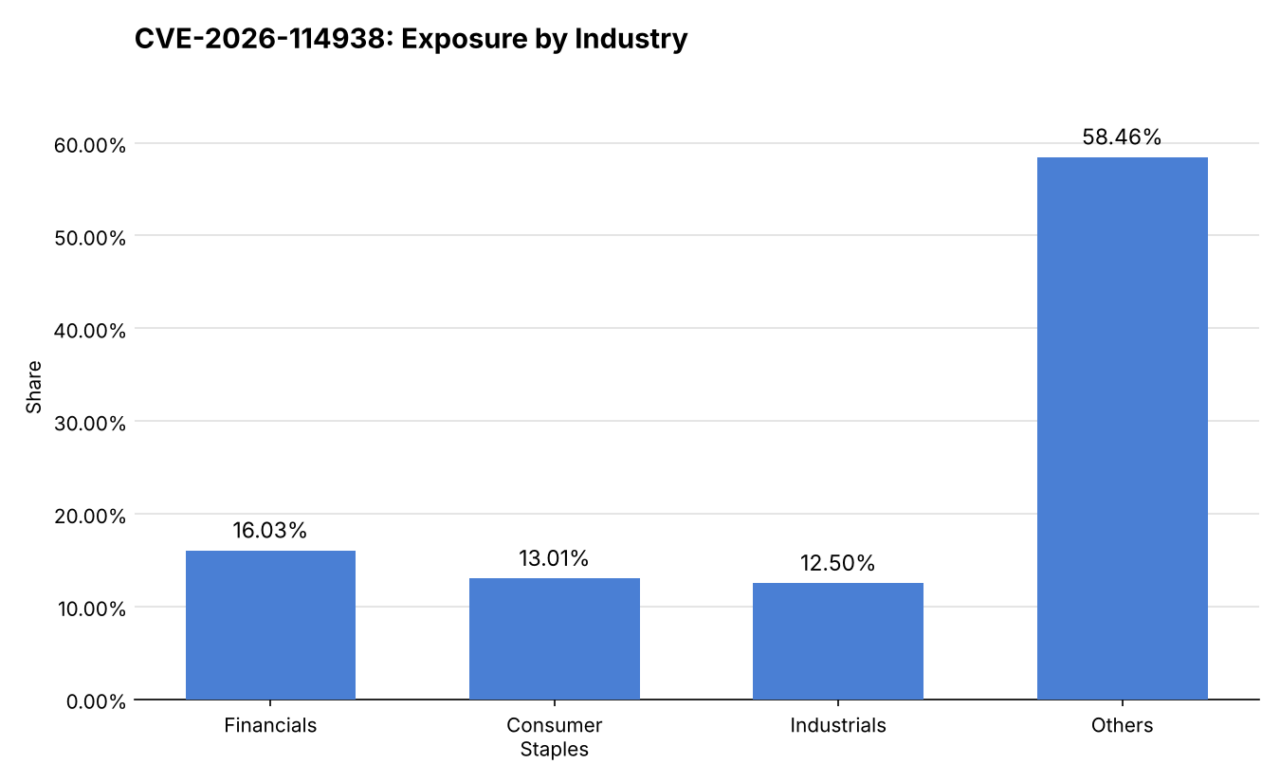
Exposure in this set is led by Financials at 16.0% of observed assets, with Consumer Staples contributing 13.0% and Industrials 12.5%.
The set was predominantly identified by service fingerprint rather than by confirmed version detection. These are assets observed running Java-based services in scope of the advisory, and they should be treated as potentially affected until the JVM version and host processor are confirmed.
Financial institutions tend to run large Java estates, from customer portals to payment and integration middleware. Build servers, artifact repositories, and identity providers that support those estates often end up reachable from outside.
Consumer Staples and Industrials organizations operate distributed footprints across brands, plants, and partner portals. Java applications inherited through acquisitions or delivered by vendors tend to persist there long after their original owners move on.
The wider pattern is a flat one. Consumer Discretionary, Information Technology, Communication Services, and Health Care each account for roughly 11% to 12% of the set, close behind the leaders.
That spread points to the runtime itself as the risk driver rather than any one industry’s practices. Java sits underneath applications that security teams inventory by product name, so the vulnerable component is often absent from the asset records used to plan patching.
Are fixes available?
Yes. Oracle fixed the vulnerability in the 17 November 2026 Critical Patch Update. Releases from that update onward are not affected.
OpenJDK distributors publish their fixed builds in their own release notes, and build numbers differ between distributors. Applications that ship with a bundled JVM receive the fix only when that bundled runtime is updated, either by the application vendor or by the operator.
Defenders should confirm the fixed build directly with their JDK distributor, and with the vendor of any application that ships its own runtime, rather than assume the host’s system Java is the one in use.
Are there any other recommended actions to take?
Until patching is confirmed, defenders should:
- Check java -version on the JVM each exposed service actually uses
- Confirm the avx512f, avx512bw, avx512vbmi, and bmi2 CPU flags on Linux hosts
- Set -XX:-UseBASE64Intrinsics on affected x86-64 JVMs as an interim workaround
- Inventory Java runtimes bundled inside Jenkins, Artifactory, Jira, Confluence, and Keycloak deployments
- Restrict internet access to Java-based administration and build interfaces
- Monitor Java service hosts for unexpected child processes
How can CyCognito help your organization?
CyCognito published an Emerging Threat Advisory for CVE-2026-114938 in the CyCognito platform and is actively researching enhanced detection capabilities for this vulnerability.
To learn how CyCognito can help your organization reduce external exposure and manage emerging threats more effectively, contact us to request a demo.