
Attackers now use AI to hunt for exploitable exposures at scale. CyCognito uses AI to find them first, with complete coverage and around the clock.
Get the demoTrusted by leading global enterprises.


Chatbots, agents, MCP servers, AI-coded applications and RAG pipelines ship without sufficient review, faster than security teams can track.
AI-generated code averages 10.8 issues, nearly double what humans write. It also accounts for 25% of all code in production.
28% of CVEs are exploited within 24 hours of disclosure, well inside most patch cycles, with remediation still measured in weeks.
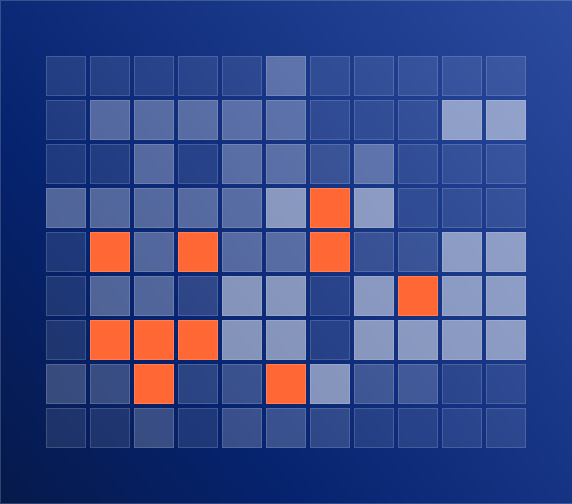
AI pentesting is expensive, so you scope it to priority assets. Meanwhile, attackers are working the soft spots that never made the list.
CyCognito's Target Graph™ dynamically scales AI testing across your entire surface, adapting to changes and keeping shadow AI, forgotten assets and other blind spots in scope.
In short, we make your budget go (much) further.
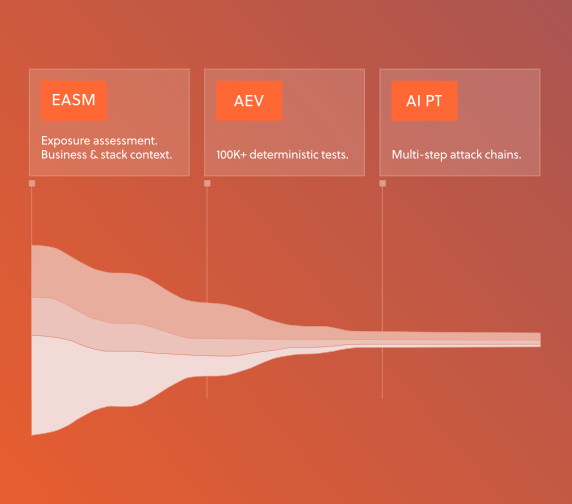
Our platform already maps your full external surface and tests all of it continuously
This clears the way for AI to focus on the deep, high-judgment testing: uncovering attack paths beyond standard CVEs and common issues that scripted tools always miss.
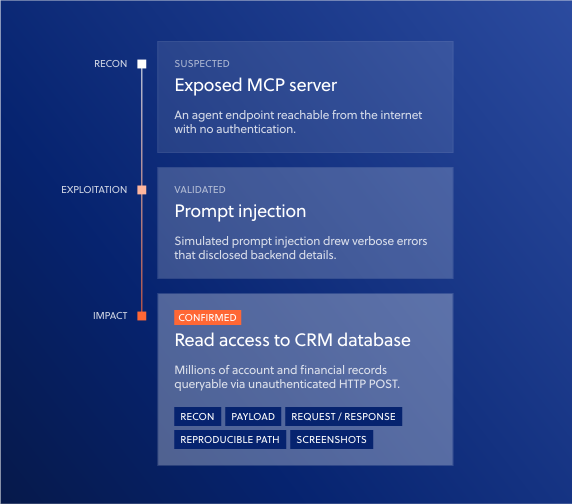
Our AI agents simulate real attackers by running complex attack scenarios, including lateral movement across different asset types, from apps, cloud and APIs to AI services.
Each finding arrives with the request and response, the payload, steps to reproduce, and a fix.
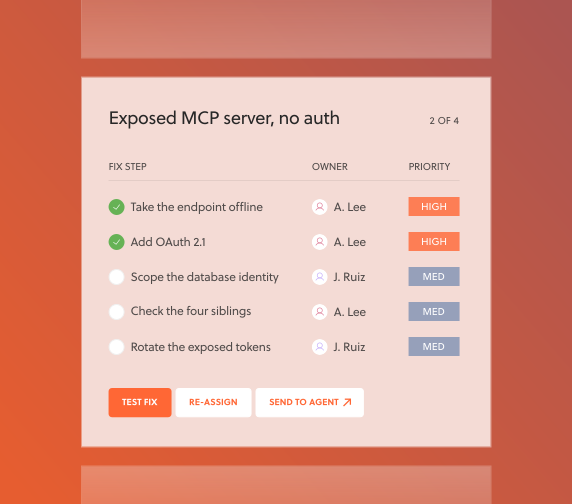
Fixing an issue can be as complicated as spotting it. So the remediation plan breaks it into separate changes, ordered the way they have to run, each with an owner and a priority.
Each change is tracked on its own, so a failed test can easily point to the change that did not take

Fresh exposure data, plus business and stack context

100K+ attack simulations, 30+ categories

Known vulns, emerging TTPs, statistical models
The orchestration engine.
Plans where AI testing runs and with which techniques.
Adapts to new findings, threat intelligence, and attack surface changes.

Builds and runs the per-asset attack playbook

Stress-tests every assumption and finding


Proves AI finding with a deterministic check

Packages evidence, findings, and remediation
Uncovers all exposed assets, enriches findings with business and stack context, and keeps them current as your environment changes.
An autonomous testing engine exercises 100+K deterministic tests, confirming vulnerabilities, known issues and misconfigurations.
Specialized AI agents hunt across your attack surface, reasoning about attack paths, chained vulnerabilities, and business-logic flaws.
Cycognito is a great asm platform. From escalating the latest CVEs, showing the attack path on specific assets. A great tool for monitoring your attack surface.

CyCognito identifies a vulnerability and gives us a clear path to trace it back to its origin. This helps us pinpoint the owner within our company so we can work with them on remediation.

Helps in continuous monitoring to emphasize vulnerabilities and ensures that any new changes in the environment are immediately detected.

We were able to alert a large city of a vulnerability, and they said that isn't even a product we have. I was able tell him the details of how we found it. They were then more than willing to work with us on future Security endeavors.

Prior to Cycognito, we never had visibility like this, even though we use other scanning solutions.
We basically said, 'CyCognito, tell me anywhere in my footprint where we're vulnerable to Log4J.' The platform ran the scan within hours and had verification back to us.
I can't point to another tool that does as thorough a job of exploring and exposing those assets that you didn't even know you had. It's so valuable.

Continuous application security testing - helps us find issues coming from outside our infrastructure.
CyCognito was a fairly small investment in comparison to the cost of responding to even one incident showing us exactly what we're looking at on the outside and helping us to prioritize exactly which assets need to be dealt with.
We use the CyCognito platform to create a more secure business environment. It's a powerful tool for preventing security breaches.
Instead of staying up all weekend responding to an incident, we can assign people to fix the problem during work hours, which means it never gets exploited in the first place.
In the first full year of running the platform, there were approximately 140 criticals that needed to be remediated in a timely manner. I'm pretty sure out of those 140 items, we would have only come across a fraction doing it ourselves manually.

CyCognito is a game-changer! Uncovering shadow risks, prioritizing vulnerabilities, and providing actionable insights have elevated our security posture.
Using CyCognito to be able to test everything to a level on a regular basis, makes our penetration testing program more effective as far as high value assets.
Risk scoring and vulnerability detection features are very useful to prioritize the high-risk assets, which include misconfigurations and unpatched software versions.
CyCognito was the only platform to offer a full inventory of all our subsidiaries. They even found a company from an acquisition just two months prior, one that not even my CIO knew about.
CyCognito is best of breed. It's also standalone. So I can buy it to fix a specific problem without needing to buy five or six other products from another vendor.

Outstanding! I'm in love with this attack surface monitoring tool.
I think it's one of the best tools we have for finding the right people, and being accurate about the things you find.
CyCognito is one of the first and most important tools to understand what a hacker can see; it saves a lot of time and helps us capture all the assets and all the vulnerabilities.

Cycognito seamlessly discovers all external assets, even those that are hidden or unregistered, providing security teams with comprehensive visibility.
Before the CyCognito platform, we had to rely on what the network team was telling us. Now, I have full visibility of all the assets that we own.
CyCognito became a cornerstone of our security setup by solving multiple pain points through automatic asset detection, continuous vulnerability analysis, and an easy-to-use, comprehensive platform for managing these issues.

The CyCognito platform applies automated technology to solve problems that people, legacy tools, and processes alone aren't solving.
There are thousands of threats out there, even an army of security staff can't address them all. CyCognito helps us focus our efforts on what's critical.

CyCognito identifies a vulnerability and gives us a clear path to trace it back to its origin. This helps us pinpoint the owner within our company so we can work with them on remediation.
Helps in continuous monitoring to emphasize vulnerabilities and ensures that any new changes in the environment are immediately detected.
We were able to alert a large city of a vulnerability, and they said that isn't even a product we have. I was able tell him the details of how we found it. They were then more than willing to work with us on future Security endeavors.
Prior to Cycognito, we never had visibility like this, even though we use other scanning solutions.
I can't point to another tool that does as thorough a job of exploring and exposing those assets that you didn't even know you had. It's so valuable.
We use the CyCognito platform to create a more secure business environment. It's a powerful tool for preventing security breaches.
CyCognito was a fairly small investment in comparison to the cost of responding to even one incident showing us exactly what we're looking at on the outside and helping us to prioritize exactly which assets need to be dealt with.
Cycognito is a great asm platform. From escalating the latest CVEs, showing the attack path on specific assets. A great tool for monitoring your attack surface.
We basically said, 'CyCognito, tell me anywhere in my footprint where we're vulnerable to Log4J.' The platform ran the scan within hours and had verification back to us.
Continuous application security testing - helps us find issues coming from outside our infrastructure.
In the first full year of running the platform, there were approximately 140 criticals that needed to be remediated in a timely manner. I'm pretty sure out of those 140 items, we would have only come across a fraction doing it ourselves manually.
CyCognito is a game-changer! Uncovering shadow risks, prioritizing vulnerabilities, and providing actionable insights have elevated our security posture.
Using CyCognito to be able to test everything to a level on a regular basis, makes our penetration testing program more effective as far as high value assets.
CyCognito is one of the first and most important tools to understand what a hacker can see; it saves a lot of time and helps us capture all the assets and all the vulnerabilities.
CyCognito identifies a vulnerability and gives us a clear path to trace it back to its origin. This helps us pinpoint the owner within our company so we can work with them on remediation.
Helps in continuous monitoring to emphasize vulnerabilities and ensures that any new changes in the environment are immediately detected.
We were able to alert a large city of a vulnerability, and they said that isn't even a product we have. I was able tell him the details of how we found it. They were then more than willing to work with us on future Security endeavors.
Prior to Cycognito, we never had visibility like this, even though we use other scanning solutions.
I can't point to another tool that does as thorough a job of exploring and exposing those assets that you didn't even know you had. It's so valuable.
We use the CyCognito platform to create a more secure business environment. It's a powerful tool for preventing security breaches.
CyCognito was a fairly small investment in comparison to the cost of responding to even one incident showing us exactly what we're looking at on the outside and helping us to prioritize exactly which assets need to be dealt with.
Cycognito is a great asm platform. From escalating the latest CVEs, showing the attack path on specific assets. A great tool for monitoring your attack surface.
We basically said, 'CyCognito, tell me anywhere in my footprint where we're vulnerable to Log4J.' The platform ran the scan within hours and had verification back to us.
Continuous application security testing - helps us find issues coming from outside our infrastructure.
In the first full year of running the platform, there were approximately 140 criticals that needed to be remediated in a timely manner. I'm pretty sure out of those 140 items, we would have only come across a fraction doing it ourselves manually.
CyCognito is a game-changer! Uncovering shadow risks, prioritizing vulnerabilities, and providing actionable insights have elevated our security posture.
Using CyCognito to be able to test everything to a level on a regular basis, makes our penetration testing program more effective as far as high value assets.
CyCognito is one of the first and most important tools to understand what a hacker can see; it saves a lot of time and helps us capture all the assets and all the vulnerabilities.
CyCognito is best of breed. It's also standalone. So I can buy it to fix a specific problem without needing to buy five or six other products from another vendor.
Instead of staying up all weekend responding to an incident, we can assign people to fix the problem during work hours, which means it never gets exploited in the first place.
Outstanding! I'm in love with this attack surface monitoring tool.
I think it's one of the best tools we have for finding the right people, and being accurate about the things you find.
Cycognito seamlessly discovers all external assets, even those that are hidden or unregistered, providing security teams with comprehensive visibility.
There are thousands of threats out there, even an army of security staff can't address them all. CyCognito helps us focus our efforts on what's critical.
The CyCognito platform applies automated technology to solve problems that people, legacy tools, and processes alone aren't solving.
CyCognito became a cornerstone of our security setup by solving multiple pain points through automatic asset detection, continuous vulnerability analysis, and an easy-to-use, comprehensive platform for managing these issues.
Before the CyCognito platform, we had to rely on what the network team was telling us. Now, I have full visibility of all the assets that we own.
Risk scoring and vulnerability detection features are very useful to prioritize the high-risk assets, which include misconfigurations and unpatched software versions.
CyCognito was the only platform to offer a full inventory of all our subsidiaries. They even found a company from an acquisition just two months prior, one that not even my CIO knew about.
CyCognito is best of breed. It's also standalone. So I can buy it to fix a specific problem without needing to buy five or six other products from another vendor.
Instead of staying up all weekend responding to an incident, we can assign people to fix the problem during work hours, which means it never gets exploited in the first place.
Outstanding! I'm in love with this attack surface monitoring tool.
I think it's one of the best tools we have for finding the right people, and being accurate about the things you find.
Cycognito seamlessly discovers all external assets, even those that are hidden or unregistered, providing security teams with comprehensive visibility.
There are thousands of threats out there, even an army of security staff can't address them all. CyCognito helps us focus our efforts on what's critical.
The CyCognito platform applies automated technology to solve problems that people, legacy tools, and processes alone aren't solving.
CyCognito became a cornerstone of our security setup by solving multiple pain points through automatic asset detection, continuous vulnerability analysis, and an easy-to-use, comprehensive platform for managing these issues.
Before the CyCognito platform, we had to rely on what the network team was telling us. Now, I have full visibility of all the assets that we own.
Risk scoring and vulnerability detection features are very useful to prioritize the high-risk assets, which include misconfigurations and unpatched software versions.
CyCognito was the only platform to offer a full inventory of all our subsidiaries. They even found a company from an acquisition just two months prior, one that not even my CIO knew about.