
What is CVE-2026-22769?
CVE-2026-22769 is a hardcoded credential vulnerability affecting Dell RecoverPoint for VMs, a disaster recovery orchestration platform used to manage replication and failover of virtualized workloads. The issue stems from static authentication credentials embedded within a product component. Because these credentials are not uniquely generated per deployment and cannot be changed by administrators, they introduce a structural authentication weakness.
Hardcoded credentials eliminate the expectation that authentication secrets are environment-specific and confidential. If the associated service is reachable over the network, an attacker who is aware of the embedded credential can authenticate without prior compromise of user accounts. This shifts exploitation from credential theft or brute-force activity to simple service discovery combined with known authentication material.
The severity of impact depends on the privilege level assigned to the embedded account and the interfaces it can access. In management and orchestration platforms, service-level credentials frequently operate with elevated privileges to interact with hypervisors, replication engines, and configuration APIs. If exposed, this can grant administrative control over the RecoverPoint for VMs management plane, enabling modification of replication policies, disruption of failover processes, and potential access to metadata about protected virtual machines.
What assets are affected by CVE-2026-22769?
The vulnerability affects deployments of Dell RecoverPoint for VMs that include the component containing the hardcoded credential. Organizations should reference Dell’s official security advisory to confirm the precise affected version range and deployment models.
From an exposure perspective, the highest-risk assets are internet-accessible RecoverPoint for VMs management interfaces, APIs, and supporting services. Although these systems are typically intended for internal management networks, real-world enterprise environments frequently include exceptions. Public IP assignments, misconfigured firewall rules, cloud security group misalignment, third-party access requirements, and inherited network configurations can unintentionally expose orchestration platforms to the internet.
RecoverPoint for VMs is often deployed as a virtual appliance integrated into virtualized data center or hybrid cloud environments. In multi-site or cloud-connected architectures, administrative interfaces may be reachable through NAT configurations, VPN endpoints, or externally accessible management segments. If these services are discoverable through internet scanning and protected only by the embedded static credential, they become viable remote entry points.
Compromise of the disaster recovery management layer carries downstream risk. An attacker with authenticated access may be able to alter protection groups, modify replication settings, initiate or disrupt failover workflows, or enumerate protected workloads. Depending on integration depth and network segmentation, this access could also facilitate lateral movement into hypervisor management networks or other connected infrastructure systems.
What does our data show about exposure patterns?
CyCognito’s external exposure telemetry indicates that internet-reachable management services associated with enterprise infrastructure platforms are distributed across multiple industry sectors rather than concentrated in a single vertical. The accompanying graph illustrates the relative distribution of observed exposed assets across Consumer, Financial Services, Education, Transportation, Energy, Manufacturing, and Technology organizations.
This cross-sector distribution reinforces that exposure of high-privilege management interfaces is not limited to traditionally targeted industries. Organizations operating complex hybrid environments, distributed infrastructure, or multi-domain architectures frequently accumulate externally reachable administrative systems over time. In many cases, these exposures originate from legacy deployments, temporary access exceptions that became permanent, or cloud migration artifacts that were never fully decommissioned.
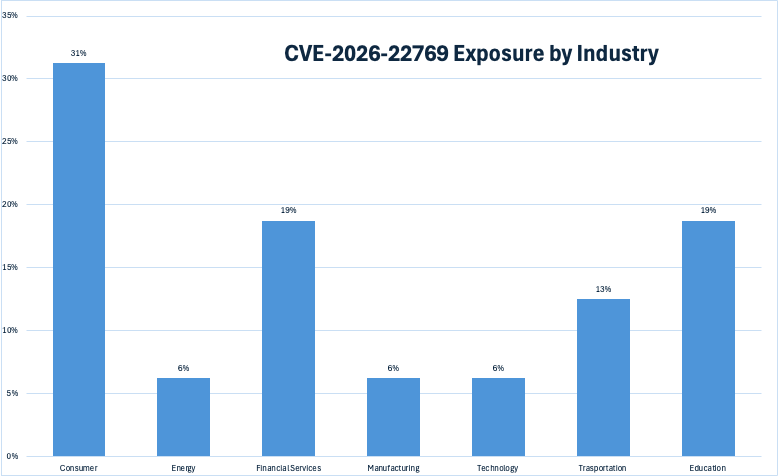
From an attacker’s perspective, industry vertical is secondary to reachability and authentication posture. A hardcoded credential vulnerability such as CVE-2026-22769 becomes materially exploitable only when the affected service is externally discoverable. The data underscores that cross-industry exposure of infrastructure management platforms remains a persistent condition, reinforcing the need for continuous external attack surface monitoring rather than reliance on assumed network segmentation.
Are fixes available?
Dell has released security updates addressing CVE-2026-22769. Affected organizations should consult Dell’s advisory to identify impacted versions and apply the recommended patches or upgrades. Remediation is expected to remove or disable the hardcoded credential and enforce secure, administrator-controlled authentication mechanisms.
Because hardcoded credentials represent a design-level weakness, patching is the primary remediation strategy. Network-layer controls such as IP restrictions or VPN gating may reduce exposure but do not eliminate the underlying authentication flaw. Organizations should prioritize upgrading all affected instances and validating that no legacy or unmanaged appliances remain in operation.
After applying updates, security teams should verify that authentication mechanisms require unique credentials and confirm that no externally accessible services remain unnecessarily exposed.
Are there any other recommended actions to take?
Organizations should immediately inventory all RecoverPoint for VMs deployments, identify any externally reachable management interfaces, restrict access to trusted administrative networks, rotate all related service and administrative credentials, and review authentication logs for anomalous access patterns.
How can CyCognito help your organization?
CyCognito published an Emerging Threat Advisory for CVE-2026-24858 inside the CyCognito platform on February 2, 2026, and is actively researching enhanced detection capabilities for this vulnerability.
To learn how CyCognito can help your organization reduce external exposure and manage emerging threats more effectively, contact us to request a demo.