
What is CVE-2026-32746?
CVE-2026-32746 is a critical out-of-bounds write in GNU Inetutils telnetd caused by insufficient bounds checking in the LINEMODE SLC (Set Local Characters) suboption handler. Public advisories attribute the issue to the add_slc logic not verifying whether the destination buffer is already full before writing additional data.
The published CVSS v3.1 score is 9.8, with network attack vector, no required privileges, and no user interaction. Public reporting describes the vulnerable path as reachable during Telnet option negotiation, before authentication completes, which makes this a pre-authentication remote code execution (RCE) risk for exposed telnetd services.
What assets are affected by CVE-2026-32746?
The affected software is GNU Inetutils telnetd, with public advisories listing vulnerable versions through 2.7. This does not mean every service speaking Telnet is affected; the exposure is specific to deployments that actually use the GNU Inetutils server implementation.
In practice, the most relevant assets are internet-facing Linux or Unix-like systems where inetutils is installed, telnetd is enabled, and TCP/23 is reachable from untrusted networks. That can include legacy administration hosts, lab environments, embedded or industrial systems built on general-purpose Linux distributions, and forgotten transitional infrastructure where Telnet remained enabled long after SSH became standard.
Ubuntu is still evaluating package impact across supported releases, while Debian’s tracker shows vulnerable package branches across multiple releases and a downstream fix in unstable.
What does our data show about exposure patterns?
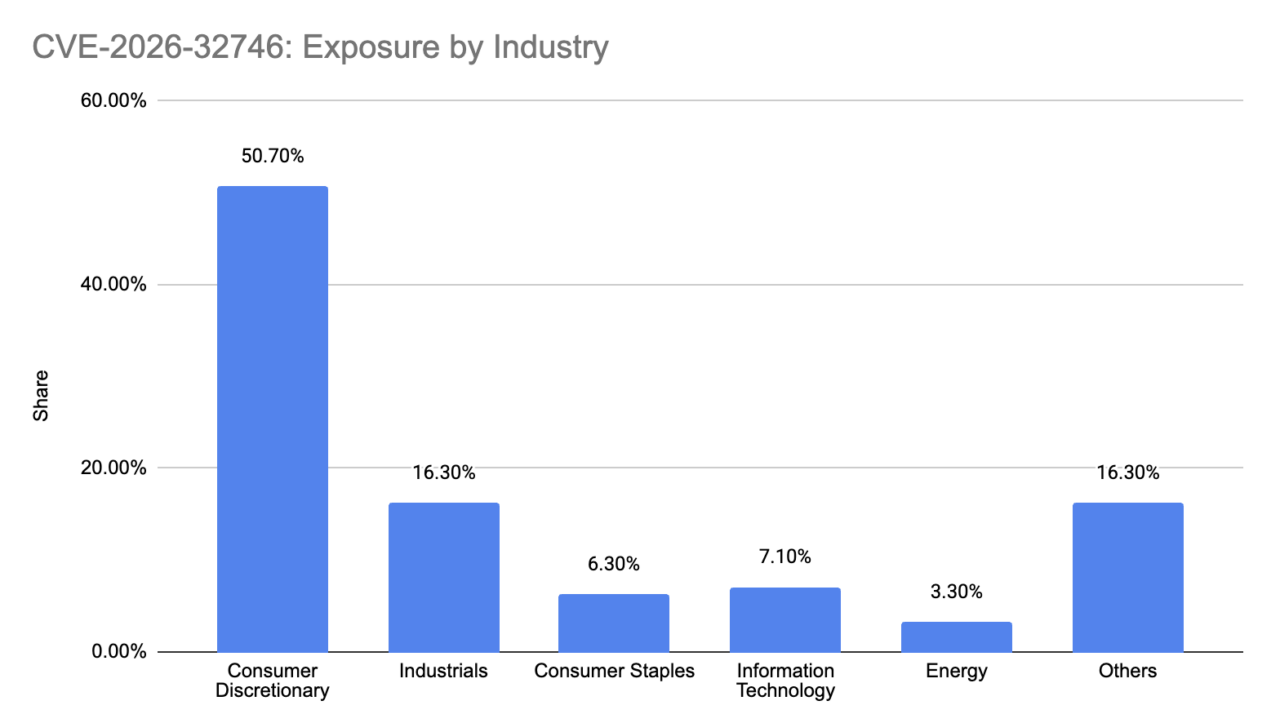
Exposure is concentrated in a few industries, with Consumer Discretionary accounting for 50.7% of observed assets and Industrials contributing 16.3%. Smaller portions appear across Information Technology (7.1%), Consumer Staples (6.3%), Energy (3.3%), and a broader long tail of other sectors (16.3%).
The concentration in Consumer Discretionary and Industrials is consistent with environments that operate large, distributed networks with mixed ownership and embedded systems. These conditions increase the likelihood that telnetd remains enabled on edge systems, partner-connected assets, or infrastructure that is no longer actively managed.
Across all sectors, the primary risk driver is lack of visibility into internet-facing assets. Exposed telnetd services are often unintentional, introduced through misconfigurations or incomplete decommissioning. Uncertainty around whether a service is running GNU Inetutils further complicates prioritization, allowing vulnerable instances to remain externally reachable longer than expected.
Are fixes available?
A public fix path exists, but patch status is uneven across sources. Debian’s security tracker records the issue as fixed in its unstable inetutils source package at version 2:2.7-4 and links to the upstream corrective commit. Ubuntu, by contrast, still lists supported releases as “Needs evaluation” as of its March 18, 2026 update.
Public advisory databases such as GitHub’s still show patched versions as unknown, and the researcher advisory stated that no released fix was available at the time of publication. Based on the currently available public sources, defenders should not assume that a vendor-packaged fix is broadly available across distributions yet; they should verify package status directly with their platform vendor or distribution tracker before treating systems as remediated.
Are there any other recommended actions to take?
Disable telnetd wherever possible, block external access to TCP/23 immediately, validate which exposed Telnet services actually run GNU Inetutils, and prioritize containment for any internet-reachable or weakly segmented instances until a confirmed fixed package is installed.
How can CyCognito help your organization?
CyCognito published an Emerging Threat Advisory for CVE-2026-32746 in the CyCognito platform and is actively researching enhanced detection capabilities for this vulnerability.
To learn how CyCognito can help your organization reduce external exposure and manage emerging threats more effectively, contact us to request a demo.