
What is CVE-2026-86858?
CVE-2026-86858 is an improper access control flaw in the ServiceNow AI Platform, classified as CWE-284. ServiceNow describes it as an unauthenticated privilege escalation reachable through GraphQL. In certain circumstances an unauthenticated user can create, modify, or delete instance data beyond what was intended.
The vulnerability carries a CVSS v4.0 base score of 8.7 (High). Attack vector is network, attack complexity is low, and neither privileges nor user interaction are required.
The impact profile is narrower than the score alone suggests, and it is worth reading precisely. ServiceNow scores integrity impact as high and both confidentiality and availability impact as none. This is a write primitive rather than a read primitive. An attacker can alter instance records, not extract them. For a platform that holds change records, approval workflows, incident queues, CMDB entries, and access request flows, the ability to write without authentication is the concerning part. A record that governs who gets access to what, altered quietly, is a more durable foothold than a copy of that record would be.
ServiceNow states it is not currently aware of malicious exploitation against ServiceNow instances. The advisory was published on September 24, 2026.
What assets are affected by CVE-2026-86858?
ServiceNow lists affected releases across three families. Yokohama is affected before Patch 13 Hot Fix 5a. Zurich is affected before Patch 10 Hot Fix 3b, Patch 10 Hot Fix 4a W32, and Patch 11 Hot Fix 3. Australia is affected before Patch 2 Hot Fix 4b W32, Patch 4 Hot Fix 3, and Patch 5.
The deployment model is what governs who has work to do here, and it separates this issue from most emerging threats. ServiceNow is predominantly delivered as a managed cloud service. ServiceNow deployed the security update to hosted instances in August 2026, ahead of the advisory, and provided the update to partners and self-hosted customers at the same time. An organization on a standard hosted instance was remediated by the vendor before the CVE became public and has no patching action of its own.
The organizations with outstanding work are therefore a specific subset: those running self-hosted deployments, those whose instances are operated by an implementation partner rather than by ServiceNow directly, and those on hosted instances that have deferred or declined the patch cycle. Sub-production instances are a recurring blind spot in that last category, because development, test, and sandbox instances are often held back from upgrade windows deliberately and then forgotten.
Nothing about this is visible externally. A ServiceNow endpoint presents the same login panel whether it is vendor-hosted and current, partner-hosted and behind, or self-hosted and unpatched. The release family and patch level are not exposed, and neither is the hosting arrangement.
What does our data show about exposure patterns?
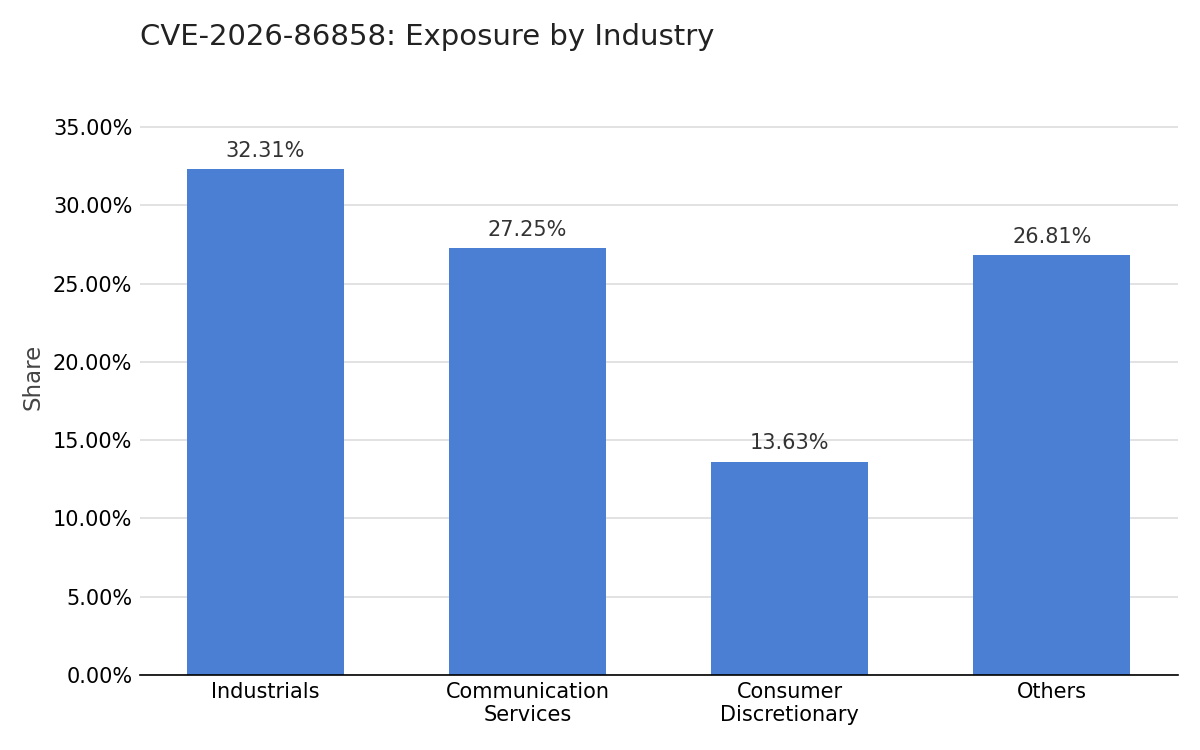
Exposure in this set is led by Industrials at 32.3% of observed assets, with Communication Services contributing 27.3% and Consumer Discretionary 13.6%.
This distribution follows ServiceNow’s enterprise footprint rather than any sector-specific weakness. The platform is bought by organizations large enough to need formalized IT service management, and exposure here is concentrated accordingly, with individual large estates accounting for a substantial share of the observed assets.
Professional services firms, logistics and transport operators, and large media groups all run exactly the kind of multi-entity, multi-region operations that produce many separate ServiceNow instances under one organization: one per business unit, one per acquisition not yet consolidated, plus the development, test, and sandbox instances that accompany each.
That instance sprawl is the finding worth acting on, and it is sharpened by the vendor-patching picture above. The assets in this set were identified by service fingerprint rather than by confirmed version detection, and a fingerprint cannot distinguish a current vendor-hosted instance from a self-hosted one running an older patch level.
The population running ServiceNow is therefore far broader than the population where this flaw is still live, and for most organizations the honest answer is that the vendor already closed it. The exception is the instance nobody is tracking, and asset naming patterns in this set point to a meaningful share of sub-production and partner-operated endpoints. Those are precisely the instances that fall outside a managed upgrade schedule, and an organization cannot tell which of its endpoints are in that category from the outside any more than an attacker can.
Are fixes available?
Yes, and for most customers they have already been applied. ServiceNow deployed the security update to its hosted instances in August 2026, before publishing the advisory in September. Organizations on standard vendor-hosted instances were remediated without action on their part.
Updates were provided to partners and to self-hosted customers on the same timeline. Those customers apply the fix themselves, either by taking the relevant hot fix or by upgrading to a patched release within their family. The specific target depends on the release family and patch level an instance is currently on, since each family has its own patched version rather than a single cumulative fix.
ServiceNow’s own guidance is for customers to promptly apply the appropriate updates or upgrade to a patched release if they have not already done so. The practical step for most organizations is not patching but verification: confirming with the platform owner which instances exist, which are vendor-hosted, and which sit outside that arrangement. An instance operated by an implementation partner is easy to assume is covered and worth confirming rather than assuming.
Are there any other recommended actions to take?
Until patching is confirmed, defenders should:
- Inventory every ServiceNow instance, including development, test, and sandbox
- Confirm which instances are vendor-hosted and which are partner-hosted or self-hosted
- Verify the release family and patch level on every non-vendor-hosted instance
- Restrict internet access to sub-production instances that do not need it
- Audit recent changes to access control and approval records for unexpected modifications
- Review GraphQL endpoint logs for unauthenticated requests that resulted in writes
- Decommission sub-production instances that no longer serve an active project
How can CyCognito help your organization?
CyCognito published an Emerging Threat Advisory for CVE-2026-86858 in the CyCognito platform and is actively researching enhanced detection capabilities for this vulnerability.
To learn how CyCognito can help your organization reduce external exposure and manage emerging threats more effectively, contact us to request a demo.