
What is CVE-2026-81891?
CVE-2026-81891 is an unrestricted file upload vulnerability in Studio 42 elFinder, an open source web file manager embedded in a wide range of PHP applications and content management systems. The flaw sits in the checkExtractItems() function in php/elFinderVolumeDriver.class.php, which calls mimetypeInternalDetect() without passing the result through mimeTypeNormalize(). Because the detected MIME type is never normalized, PHP-executable extensions including .phtml, .phar, .php5, and .php3 are never matched against the uploadDeny filter and pass through unchecked.
The vulnerability carries a CVSS v3.1 base score of 8.1 (High). Exploitation requires no authentication against the flaw itself, though the attacker does need the ability to upload and extract an archive through the elFinder connector. Where the connector is reachable without authentication, a configuration the maintainers have previously warned against, that requirement is trivially met.
The practical impact is remote code execution. An attacker uploads an archive containing a file with one of the bypassed extensions, triggers extraction into a web-accessible directory, then requests the extracted file over HTTP. The web server executes it as PHP, giving the attacker command execution in the context of the web server process.
The vulnerability was published on August 31, 2026, alongside two other elFinder issues fixed in the same release: a server-side request forgery bypass in the URL upload fallback, and a cross-site request forgery gap in the netmount command.
What assets are affected by CVE-2026-81891?
The affected component is the elFinder PHP connector, specifically its archive extraction handler. All elFinder releases prior to 2.1.70 are affected. Version 2.1.70 corrects the MIME normalization step.
In practice, an affected asset is a web server running a PHP application that embeds elFinder as its file browser or media manager. elFinder is rarely deployed as a standalone product. It arrives bundled inside content management systems, admin panels, e-commerce back offices, customer portals, and internal file-sharing tools, which means the organization running it often does not track it as a distinct piece of software. The connector usually sits at a predictable path under the host application, such as an elfinder or filemanager directory.
That bundling is what makes these assets easy to overlook. Inventories built from application names will not surface elFinder, and a component installed once as part of a theme or plugin tends to stay at whatever version shipped with it. Assets fitting this description are also frequently internet-facing by design, since the file manager exists to serve remote administrators and content editors.
What does our data show about exposure patterns?
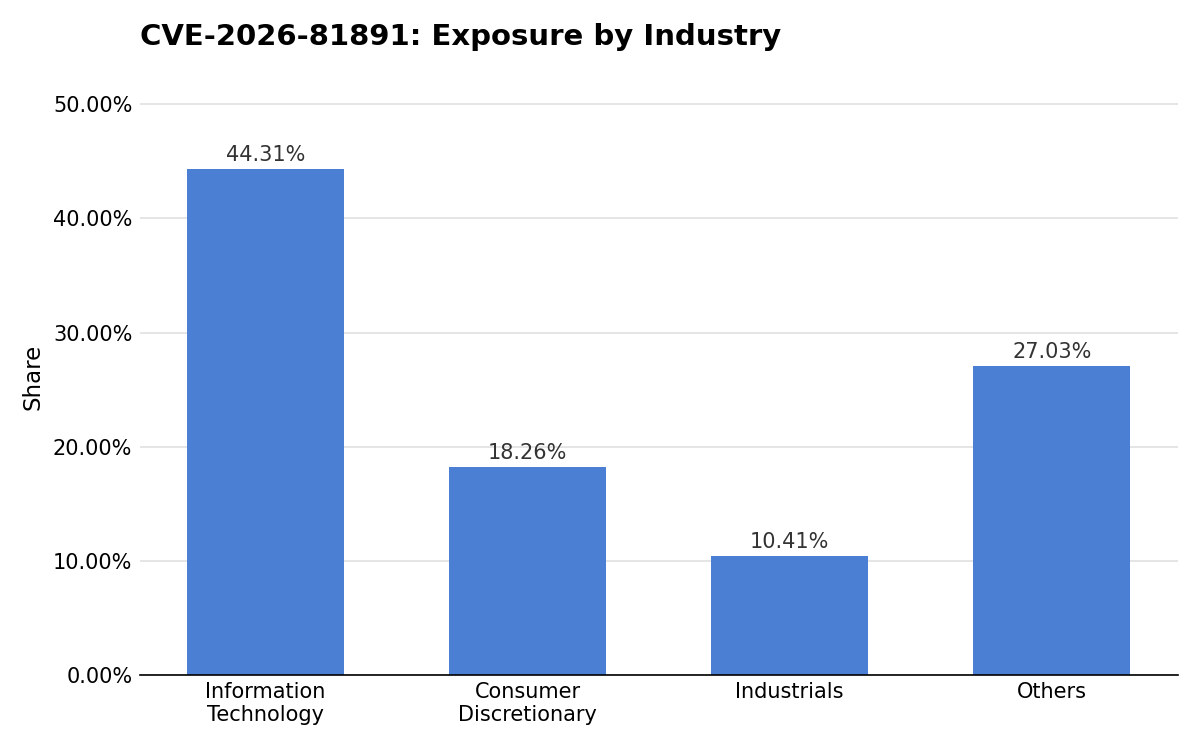
Exposure in this set is led by Information Technology at 44.3% of observed assets, with Consumer Discretionary contributing 18.3%. These assets were predominantly identified by service fingerprint rather than by confirmed version detection, so they read as hosts observed running the affected software and potentially exposed, not as confirmed vulnerable systems.
The concentration in Information Technology reflects how technology organizations accumulate web infrastructure. They operate large numbers of externally reachable hosts across product documentation sites, developer portals, partner extranets, support tools, and acquired product lines, each of which may carry its own PHP application stack. Consumer Discretionary follows a comparable pattern for different reasons. Retail, hospitality, and consumer brand estates are built on distributed marketing sites, regional storefronts, and campaign microsites, often delivered by outside agencies and left running long after the campaign ends.
The cross-sector spread points at a component visibility problem rather than a sector-specific one. elFinder is rarely the software an organization set out to deploy. It arrives with something else, and it persists at its installed version because nothing in the normal patch cycle is looking for it. The sectors with the largest externally reachable web estates show the most exposure, which is the pattern to expect when the driver is unmanaged inherited components rather than any property of the industry itself.
Are fixes available?
A patch is available. elFinder 2.1.70 fixes the MIME validation gap during archive extraction, and the same release addresses the cross-site request forgery gap in netmount and the server-side request forgery bypass in the URL upload fallback. Organizations on any earlier release should treat all three as in scope for the same upgrade.
The practical difficulty is not patch availability, it is patch reachability. Where elFinder is vendored inside a theme, a plugin, or a commercial application, upgrading the bundled copy may not be supported by the host application, and replacing it by hand can break the integration. In those cases the fix depends on the upstream vendor shipping an updated bundle.
Advisory coverage across distribution and package trackers remains uneven for a vulnerability published this recently. Defenders should verify the version actually deployed at the file system level rather than relying on a host application version number, and should confirm patch status directly with the vendor of any product that bundles the connector.
Are there any other recommended actions to take?
Until patching is confirmed, defenders should:
- Inventory elFinder deployments, including copies bundled inside themes and plugins
- Restrict connector access to authenticated administrative users only
- Disable the archive extraction command where content workflows do not require it
- Block PHP execution inside upload and extraction directories at the web server
- Monitor upload directories for newly written files with PHP-executable extensions
- Audit web server logs for requests to unexpected paths under file manager directories
How can CyCognito help your organization?
CyCognito published an Emerging Threat Advisory for CVE-2026-81891 in the CyCognito platform and is actively researching enhanced detection capabilities for this vulnerability.
To learn how CyCognito can help your organization reduce external exposure and manage emerging threats more effectively, contact us to request a demo.