
What Is the OWASP API Security Project?
The OWASP API Security Project is an initiative by the Open Web Application Security Project (OWASP) aimed at addressing the unique security challenges posed by APIs. It provides guidelines, tools, and resources to help developers and security professionals secure their APIs against common threats.
The project emphasizes practical advice for protecting APIs, from design to deployment. It also includes the OWASP API Security Top 10 list, which highlights the most critical API security risks. This list, introduced in 2019 and last updated in 2023, serves as a valuable resource for understanding and mitigating these risks. By following the project’s recommendations, organizations can enhance their API security posture and reduce vulnerability exposure.
What Is New in the OWASP Top 10 List for 2023?
The OWASP API Security Top 10 list for 2023 includes significant updates to reflect the evolving security landscape. Several new entries highlight the increasing risks associated with exposing critical business functions, server-side request manipulation, and untrusted third-party data.
The new threats added in the API Top 10 List for 2023 are:
- Unrestricted Access to Sensitive Business Flows (API 06:2023)
- Server Side Request Forgery (API 07:2023)
- Unsafe Consumption of APIs (API 10:2023)
Several existing categories have been modified to address broader issues or combine related vulnerabilities. Broken Authentication (API 02:2023) now encompasses all authentication issues, while Broken Object Property Level Authorization (API 03:2023) merges previous concerns about data exposure and mass assignment. Additionally, Unrestricted Resource Consumption (API 04:2023) and Improper Inventory Management (API 09:2023) have been updated to emphasize resource limits and accurate API inventories.
The 2019 category Insufficient Logging and Monitoring has been removed, indicating a shift in focus towards more pressing API security threats.

Operationalizing CTEM Through External Exposure Management
CTEM breaks when it turns into vulnerability chasing. Too many issues, weak proof, and constant escalation…
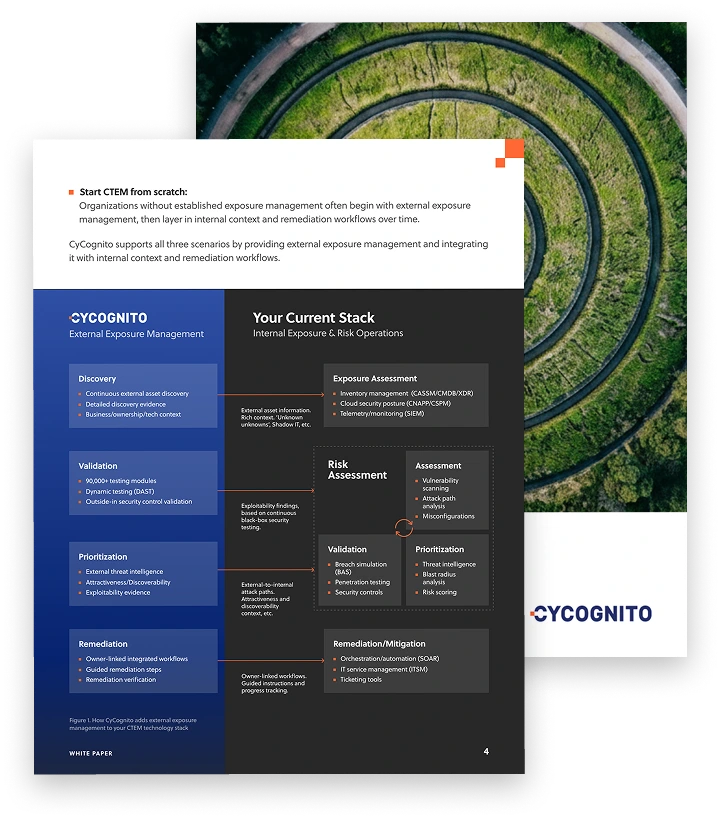
This whitepaper offers a practical starting point for operationalizing CTEM, covering what to measure, where to start, and what “good” looks like across the core steps.
OWASP Top 10 API Security Risks and How to Mitigate Them
API1:2023: Broken Object Level Authorization
Broken Object Level Authorization (BOLA) occurs when an API fails to enforce proper access controls at the object level, allowing unauthorized users to access or manipulate sensitive data. It arises due to inadequate authorization checks on endpoints that handle object identifiers. Attackers exploit these weaknesses by manipulating object IDs to gain unauthorized access to data they should not be able to view or modify.
How to mitigate:
To mitigate BOLA, developers must implement authorization checks for every function that accesses a data source using an identifier from the user. These checks should verify that the requester has the necessary permissions to perform actions on the specified object.
Additionally, using non-guessable identifiers like UUIDs can reduce the risk of ID-based attacks.
Regular security audits and penetration testing can help identify and address instances of broken object level authorization. Ensuring comprehensive logging and monitoring of access patterns also aids in detecting and responding to unauthorized access attempts.
API2:2023: Broken Authentication
Broken authentication occurs when API authentication mechanisms are improperly implemented, allowing attackers to compromise user accounts or sensitive data. Common issues include weak password policies, flawed session management, and incorrect implementation of authentication protocols. Attackers can exploit these weaknesses to gain unauthorized access, often using techniques like credential stuffing or brute-force attacks.
How to mitigate:
To mitigate broken authentication risks, it’s crucial to enforce strong password policies and implement multi-factor authentication (MFA). Proper session management is also essential; sessions should be securely generated and invalidated after logout. APIs should use secure storage for credentials and tokens, ensuring they are encrypted both in transit and at rest.
Regular security assessments and code reviews can help identify vulnerabilities in the authentication process. Automated tools can be used to test for common flaws such as weak passwords or token mismanagement.
API3:2023: Broken Object Property Level Authorization
Broken Object Property Level Authorization (BOPLA) is a critical security issue that arises when an API fails to enforce proper access controls at the property level of an object. This allows attackers to exploit endpoints to read, modify, or delete sensitive properties of objects without authorization.
How to mitigate:
BOPLA combines aspects of excessive data exposure and mass assignment, focusing on unauthorized interactions with individual properties rather than entire objects. To mitigate BOPLA risks, developers must implement strict property-level access controls. This involves ensuring that each property within an object is validated against the user’s permissions before any read or write operations are allowed.
APIs should only expose necessary properties and use allowlists to filter out any unauthorized data from requests and responses. Regular security testing and code reviews are essential in identifying potential BOPLA vulnerabilities. Automated tools can help in scanning for excessive data exposure and improper authorization checks at the property level.
API4:2023: Unrestricted Resource Consumption
Unrestricted resource consumption, also known as resource exhaustion, occurs when an API fails to implement limits on the usage of critical resources such as CPU, memory, bandwidth, or storage. Attackers exploit this vulnerability by sending a high volume of requests or large payloads, consuming excessive amounts of system resources. This can lead to degraded performance or unavailability of the API service.
How to mitigate:
Mitigating unrestricted resource consumption involves rate limiting and throttling mechanisms. Rate limiting restricts the number of requests a client can make in a given time frame, while throttling controls the rate at which requests are processed. These measures help ensure that no single client can overwhelm the system, maintaining service availability and performance.
APIs should enforce strict input validation to limit payload sizes and complexity. This includes setting maximum size constraints on request bodies and parameters. Regular monitoring and alerting for unusual patterns in resource usage can also help detect and mitigate potential attacks early.
API5:2023: Broken Function Level Authorization
Broken Function Level Authorization (BFLA) occurs when APIs fail to enforce proper authorization checks at the function or operation level. This allows attackers to access sensitive functions, such as administrative endpoints or other users’ data. Complex access control policies, involving various roles and user hierarchies, often contribute to these flaws.
How to mitigate:
Properly segregating administrative and regular functions is crucial in mitigating this risk. To prevent BFLA, implement authorization mechanisms that validate user permissions for each function call. Ensure that every API endpoint has clearly defined access controls aligned with the least privilege principle.
Regular audits and testing help identify and rectify any gaps in authorization logic. Additionally, adopting a zero-trust security model can further enhance protection against BFLA by continuously verifying user identities and their access rights before granting permissions.
API6:2023: Unrestricted Access to Sensitive Business Flows
APIs vulnerable to unrestricted access to sensitive business flows expose critical business functionalities without adequate controls. This can include operations like placing orders, transferring funds, or accessing customer data. Attackers exploit these APIs by automating their interactions, often using bots or scripts, to perform actions that can disrupt services or cause financial loss.
How to mitigate:
To mitigate this risk, implement strict rate limiting and monitoring mechanisms. Rate limiting helps control the number of requests an API can handle within a specific timeframe, preventing abuse through automated attacks. Monitoring allows for real-time detection of unusual patterns or behaviors indicative of malicious activity.
Strong authentication and authorization checks are also crucial. Ensuring that only authenticated users with the appropriate permissions can access sensitive business flows reduces the likelihood of unauthorized exploitation. Implementing multi-factor authentication (MFA) adds an extra layer of security by requiring more than one form of verification.
API7:2023: Server Side Request Forgery
Server Side Request Forgery (SSRF) occurs when an attacker manipulates a server to make unauthorized requests to unintended locations. This vulnerability typically arises when an API endpoint fetches remote resources based on user-supplied inputs without proper validation. Attackers can exploit SSRF to access internal systems, bypassing firewalls and other network defenses.
An SSRF attack can be particularly dangerous because it allows attackers to interact with internal services that are not exposed to the public Internet. For example, an attacker might use SSRF to query internal APIs, access metadata services on cloud platforms, or scan the internal network for vulnerabilities. This can lead to data breaches or further compromise of internal assets.
How to mitigate:
Mitigating SSRF involves validating and sanitizing user inputs, ensuring URLs are allowlisted, and avoiding direct network calls based on user-supplied data. Developers should also use secure coding practices like restricting the types of addresses that can be connected to and employing network segmentation to limit potential damage from compromised components.
API8:2023: Security Misconfiguration
Security misconfiguration is a prevalent issue in API security, often arising from default settings, incomplete configurations, or lack of proper hardening. Common examples include leaving unnecessary features enabled, using outdated software versions, and failing to secure cloud storage. These gaps can provide attackers easy access to sensitive data and systems.
How to mitigate:
To mitigate security misconfiguration risks, organizations should implement a thorough configuration management process. This includes regularly updating software components, disabling unused features and services, and following industry best practices for secure configurations. Automation tools can help enforce these configurations consistently across environments.
Additionally, performing regular security audits and penetration testing can identify misconfigurations before they are exploited. Continuous monitoring of configuration changes ensures that deviations from the secure baseline are promptly detected and corrected.
API9:2023: Improper Inventory Management
APIs often expose numerous endpoints, making it challenging to maintain an accurate and current inventory. Improper inventory management can result in outdated or insecure API versions remaining in production, increasing the risk of security breaches. Without an accurate inventory, it’s difficult to track which APIs are active, deprecated, or require updates.
How to mitigate:
Mitigating this risk involves implementing automated tools for API discovery and monitoring. These tools can continuously scan the environment to detect all active APIs, ensuring that any deprecated or vulnerable endpoints are identified and addressed promptly. Regular audits should also be conducted to verify the accuracy of the API inventory.
Maintaining detailed documentation for each API version is crucial. This documentation should include information about each endpoint’s purpose, security requirements, and update history.
API10:2023: Unsafe Consumption of APIs
Developers often trust data received from third-party APIs more than user input, leading to weaker security standards. This misplaced trust can result in vulnerabilities when the data is not properly validated or sanitized. Attackers exploit this by targeting integrated third-party services, which may have less stringent security measures compared to the primary API.
Another aspect of unsafe consumption involves the usage of insecure protocols for API communication. If developers do not enforce secure transport mechanisms like HTTPS, sensitive data can be intercepted during transmission. This opens up possibilities for man-in-the-middle attacks where attackers can eavesdrop or manipulate data being exchanged.
How to mitigate:
Improper handling of API responses can also lead to unauthorized access and data exposure. When APIs consume responses without adequate checks, attackers can manipulate these responses to gain access to restricted areas or sensitive information within the application. Proper validation and sanitization of all incoming and outgoing data are crucial for mitigating these risks.
Tips from the Expert

Dima Potekhin, CTO and Co-Founder of CyCognito, is an expert in mass-scale data analysis and security. He is an autodidact who has been coding since the age of nine and holds four patents that include processes for large content delivery networks (CDNs) and internet-scale infrastructure.
In my experience, here are tips that can help you better secure your APIs beyond the OWASP recommendations:
- Use API gateways with security policies: Deploy API gateways to enforce security policies like authentication, rate limiting, and data encryption. Gateways can also centralize logging and monitoring, making it easier to detect and respond to security incidents.
- Implement mutual TLS (mTLS): While standard TLS encrypts communication, mutual TLS adds an additional layer of security by requiring both client and server to authenticate each other. This is particularly important for APIs dealing with sensitive data or operating in regulated industries.
- Employ runtime protection mechanisms: Implement runtime application self-protection (RASP) solutions that can monitor and protect APIs in real-time, automatically blocking or mitigating threats as they occur, without waiting for an update or patch.
- Secure API documentation: Restrict access to API documentation to only those who need it, and ensure that sensitive information like API keys or internal API endpoints are never exposed in public documentation. Regularly review and sanitize documentation to prevent leakage of security-critical details.
- Monitor for shadow APIs: Use tools that can detect shadow APIs—undocumented or forgotten APIs that still reside in your environment. These can be significant attack vectors if they are not managed properly.
API Security with CyCognito
CyCognito is an exposure management platform that reduces risk by discovering, testing and prioritizing security issues. The platform scans billions of websites, cloud applications and APIs and uses advanced AI to identify the most critical risks and guide remediation.
Emerging companies, government agencies and Fortune 500 organizations rely on CyCognito to secure and protect from growing threats.
Want to see how it works?
- Check out our website and explore our platform with a self-guided, interactive dashboard product tour.
- To learn how CyCognito can help you understand your external attack surface and exposed risks, please visit our Contact Us page to schedule a demo.