
What Is API Security?
API security is the practice of protecting the integrity of application programming interfaces (APIs) from malicious attacks and other threats to their confidentiality, integrity and availability. This includes securing the software that provides access to the API and the network connections over which API calls are made.
Implementing robust API security measures is crucial because APIs often handle sensitive data and actions. If an API is compromised, it can lead to data breaches, unauthorized access to system functions, and other impactful security incidents.
This is part of an extensive series of guides about information security.
Why Is API Security Important?
APIs have become foundational elements of the digital economy, acting as building blocks for modern software applications and services. They enable businesses to offer more tailored services, extend their market reach, and enhance customer engagement by allowing various applications to interact seamlessly. APIs are integral to strategies that leverage third-party platforms, cloud services, and internal infrastructure to create value-added services.
However, the pervasive use of APIs also presents significant security risks. They often serve as gateways to critical business functions and sensitive data, making them a preferred target for attacks. Due to their accessibility over the internet and standardized methods of communication, APIs present a lucrative attack surface for cybercriminals. They can expose business logic and data flows that, if not properly secured, can be exploited to access sensitive data, disrupt service operations, or even take over entire systems.
Many high profile breaches have illustrated how APIs can be the weakest link in the security chain, with attackers exploiting flaws in API security to bypass traditional security measures like firewalls and intrusion detection systems. This potential for significant damage makes robust API security not just a technical requirement but a critical business imperative for modern digital systems.
How Is API Security Different from General Application Security?
Here are a few key differences between API security and general application security:
- Scope of protection: API security specifically targets the interfaces through which applications expose functionality and data, whereas general application security encompasses the entire application, including the front end, back end, database, and the interactions between these components.
- Exposure level: APIs are often exposed over the internet and used to connect services across different environments, making them more accessible and at higher risk of being targeted by external threats compared to internal application components.
- Authentication and authorization: API security requires robust and often complex authentication and authorization mechanisms to ensure that only legitimate users and services can access them. This is because APIs are a common entry point for attackers looking to exploit system vulnerabilities.
- Data sensitivity: APIs frequently handle highly sensitive data, necessitating stringent data protection measures. The need for secure data transmission and stringent access controls is more pronounced in API security.
- Rate limiting and throttling: APIs need specific protections like rate limiting to prevent abuse and ensure service availability, which may not be as critical in other parts of an application.
- Vulnerability types: The types of vulnerabilities that APIs are susceptible to can differ from those affecting other parts of the application. For example, APIs are uniquely vulnerable to issues like broken object level authorization and mass assignment.
- Standardization: API security often involves adhering to specific protocols and standards, such as REST or SOAP, each with its own security implications and best practices, whereas general application security might be more diverse in the technologies and methodologies employed.
Tips from the Expert

Rob Gurzeev, CEO and Co-Founder of CyCognito, has led the development of offensive security solutions for both the private sector and intelligence agencies.
In my experience, here are tips that can help you better secure APIs:
- Implement fine-grained access control: Use attribute-based access control (ABAC) or role-based access control (RBAC) combined with contextual factors like IP address, device type, and user behavior to ensure API endpoints are only accessible under the right conditions.
- Leverage machine learning for anomaly detection: Implement machine learning models to detect unusual API traffic patterns, such as unexpected spikes in access or data exfiltration attempts. This proactive approach can help catch sophisticated attacks that traditional monitoring might miss.
- Secure API documentation and versioning: Restrict access to API documentation and ensure that deprecated versions of APIs are fully retired or secured. Attackers often target outdated or poorly documented API endpoints to find vulnerabilities.
- Implement dynamic API schema validation: Use dynamic schema validation to ensure that API inputs and outputs adhere strictly to the expected structure. This can help prevent common vulnerabilities like injection attacks and broken object-level authorization.
- Regularly rotate API keys and secrets: Automate the rotation of API keys and secrets, and enforce short expiration periods to minimize the risk if a key is compromised. Ensure that old keys are properly decommissioned.

Operationalizing CTEM Through External Exposure Management
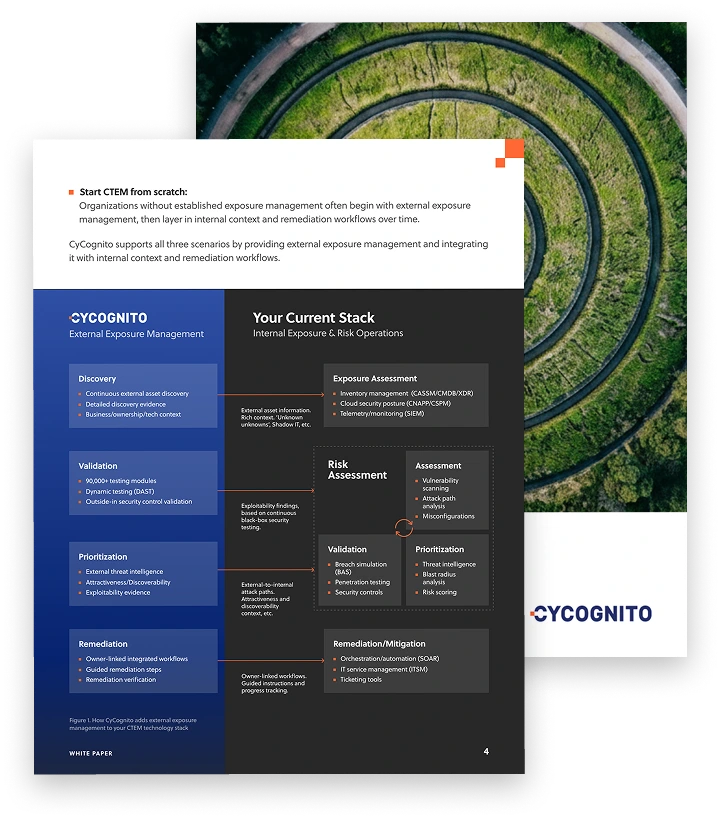
CTEM breaks when it turns into vulnerability chasing. Too many issues, weak proof, and constant escalation…
This whitepaper offers a practical starting point for operationalizing CTEM, covering what to measure, where to start, and what “good” looks like across the core steps.
OWASP API Security Top 10: Common Types of API Vulnerabilities
The OWASP (Open Web Application Security Project) API Security Top 10 is a research effort that highlights the most critical security risks to APIs. This list serves as a key resource for developers, security professionals, and organizations to understand and mitigate potential vulnerabilities within their API infrastructures.
The Top 10 list is periodically updated to reflect the evolving cybersecurity landscape. Here are the top 10 API security risks, ranked in order of severity, according to the 2023 OWASP report:
- Broken Object Level Authorization (BOLA): Vulnerabilities arise when users can access objects, such as files or database records, without proper authorization. Attackers exploit these flaws to access or modify data they shouldn’t have access to.
- Broken User Authentication: This risk occurs when authentication mechanisms are implemented incorrectly, allowing attackers to assume the identities of other users. Flaws can include weak password policies and inadequate session management.
- Broken Object Property Level Authorization: APIs often expose more data than necessary or allow attackers to manipulate data. This occurs because authorization is not sufficiently validated at the object property level.
- Unrestricted Resource Consumption: APIs without restrictions on the size or number of resources that can be requested can be vulnerable to denial-of-service attacks, as attackers can overwhelm the API or backend services with too many requests.
- Broken Function Level Authorization: Similar to BOLA but at the function level, this involves failures in applying proper access controls on API functions. Attackers exploit these flaws to access unauthorized functionalities.
- Unrestricted Access to Sensitive Business Flows: APIs may expose business flows, for example posting comments or buying products. If there are no restrictions on their usage, this can allow attackers to perform excessive automated actions in a way that could harm the organization.
- Server Side Request Forgery: APIs that retrieve remote resources without validating the information supplied by users are vulnerable to tampering. Attackers can induce an application to send sensitive information via a request to unauthorized destinations, bypassing security mechanisms like firewalls and VPNs.
- Security Misconfiguration: This occurs when APIs are not securely configured, or default configurations are left unchanged. This can include verbose error messages, unnecessary HTTP methods, open cloud storage, etc.
- Improper Inventory Management: APIs often have different versions and environments (e.g., development, staging, production). Improper management and exposure of these can lead to security issues if endpoints are not properly documented or decommissioned.
- Unsafe Consumption of APIs: The data received from other APIs is often trusted, resulting in less secure handling compared to other types of information like user input. Attackers can compromise APIs indirectly by targeting third-party APIs.
Securing Different Types of API Architecture
There are several ways to approach API security, depending on the type of API.
REST API Security
A REST API, also known as RESTful API, is an architectural style defining how two software components interact. A request is sent from a client to a server via a web URL, in the form of an HTTP GET, POST, PUT, or DELETE request. The server’s response is typically in the format of HTML, XML, or JSON.
To secure REST APIs effectively, it’s crucial to implement strong authentication and authorization mechanisms. OAuth is widely recommended for its robust framework in managing access tokens that allow users to authenticate and authorize applications without exposing their credentials. Additionally, it’s important to ensure comprehensive validation of all input data to mitigate injection attacks. API endpoints must consistently enforce these validations to prevent attackers from exploiting any inconsistencies.
Another essential security practice for REST APIs involves thorough and regular security testing, including penetration testing and vulnerability assessments specific to the API during the development process and after the API is deployed. Tools such as Postman and Swagger can help in testing APIs for security vulnerabilities during the development phase. Implementing rate limiting and throttling can also protect against denial-of-service (DoS) attacks, which attempt to overwhelm APIs with excessive requests.
SOAP API Security
SOAP APIs are generally used in enterprise environments for their robust security features, and have specific security considerations. WS-Security, a standard that provides security for SOAP messages, ensures message integrity and confidentiality through methods like XML Encryption and XML Signature. It’s also critical to implement strict access controls and maintain rigorous standards for message validation to prevent XML External Entity (XXE) and XML Injection attacks.
For SOAP APIs, employing security assertion markup language (SAML) tokens for identity verification can offer a higher degree of security, especially in enterprise applications involving multiple domains. Regularly updating the SOAP version and security protocols used is vital to protect against emerging security vulnerabilities. Additionally, it is advisable to conduct regular audits and updates of the WSDL (Web Services Description Language) files, which can expose sensitive information about the underlying architecture if not properly secured.
Learn more in our detailed guide to SOAP security (coming soon).
GraphQL API Security
GraphQL is an open source query language that allows clients to request information from a server in a richer and more nuanced manner than traditional APIs. Developers can use one GraphQL query to ask for specific data, which is then returned from multiple sources. The client defines the structure of the data needed, and the server returns data using that exact structure.
Because GraphQL allows clients to request exactly the data they need, it’s crucial to implement depth limiting and amount limiting to prevent malicious queries from overloading the server. Depth limiting restricts the complexity of the queries allowed, while amount limiting restricts the volume of data returned, mitigating potential denial-of-service (DoS) attacks.
Furthermore, robust error handling in GraphQL APIs can prevent attackers from gaining insights into the API schema or the underlying database through error messages. Implementing a permissions layer is also essential to ensure that users can only access the data and actions that their roles authorize. Since GraphQL can increase the risk of inadvertent data exposure, every field in the API should be explicitly secured, and developers should use appropriate tools for monitoring and safeguarding the API against inappropriate data retrieval practices.
API Security Challenges
Here are some of the challenges associated with securing APIs.
User Authentication and Authorization
Authentication verifies a user’s identity, ensuring that the person or system making the API call is who they claim to be. Authorization determines what an authenticated user is allowed to do.
Challenges in this area include the management of secure tokens, the implementation of robust access control policies, and the prevention of identity spoofing. Ensuring that only legitimate users can access and perform operations via an API can be complicated, especially when there is a diverse range of devices and services interacting with APIs.
Data Protection and Encryption
Ensuring the confidentiality and integrity of data as it moves between clients and servers is crucial. This involves implementing strong encryption protocols for data in transit, such as TLS, and ensuring that sensitive data is also encrypted at rest.
However, challenges arise in the consistent application of encryption standards, managing encryption keys securely, and ensuring that no unencrypted data leaks through caching or logging mechanisms. Additionally, APIs must validate and sanitize all incoming data to protect against injection and other forms of attacks that compromise data integrity.
API Rate Limiting and Throttling
Rate limiting and throttling are essential for controlling the amount of traffic an API can handle over a given period, protecting against abuse and ensuring availability for all users. These measures help prevent denial-of-service attacks and can mitigate the effects of sudden traffic spikes.
The challenge lies in setting appropriate limits that block malicious traffic without hindering legitimate users. This requires a balance between strict controls and flexibility, often necessitating dynamic rate limiting based on user behavior, traffic patterns, and other contextual factors.
API Lifecycle Security
From design and development to deployment and decommissioning, each stage of an API’s lifecycle introduces security considerations. Ensuring that security is integrated at every phase requires a comprehensive strategy that incorporates secure coding practices, thorough testing for vulnerabilities, regular security updates, and monitoring for unusual activity.
Challenges include maintaining security standards across different teams and technologies, managing API versioning without introducing vulnerabilities, and effectively deprecating and decommissioning outdated APIs without leaving gaps in the system’s security posture.
Related content: Read our guide to API discovery.
API Security Best Practices
Here are some best practices for ensuring API security.
HTTPS Encryption
HTTPS (Hypertext Transfer Protocol Secure) encrypts the data exchanged between the client and the server, ensuring that sensitive information like personal details, authentication tokens, and business data remains confidential and protected from interception or alteration during transit. This encryption is achieved through the use of SSL/TLS protocols.
Enforcing HTTPS for all API communication prevents a variety of attacks, including Man-in-the-Middle (MITM), where attackers intercept or alter communications between two parties.
Input Validation and Sanitization
Input validation and sanitization are critical defenses against numerous attack vectors, including SQL injection, Cross-Site Scripting (XSS), and command injection. They involve verifying and cleaning all user-supplied data to ensure it conforms to expected formats and values before processing it.
Validation checks if the input meets certain criteria (e.g., a string contains only letters, a date is within a specific range), rejecting any data that does not. Sanitization modifies the input to remove or replace harmful data. Implementing both measures helps ensure that only safe, expected input is allowed through to the API’s logic.
API Keys and Tokens
API keys and tokens are mechanisms for authenticating and authorizing users or applications to access an API. An API key is a unique identifier used to authenticate a client requesting access to an API. However, since it does not expire and is often sent with each request, its security depends heavily on being kept confidential.
Tokens, particularly JSON Web Tokens (JWT), offer a more secure and flexible alternative. Tokens can carry information about the user and the session, and they can be configured to expire after a certain period, reducing the risk if they are compromised. It is recommended to use tokens for authentication and implement token management strategies like rotation and expiration.
Secure Error Handling
Secure error handling involves suppressing detailed error messages that could reveal insights into the API’s internal workings to potential attackers. Instead, generic error messages should be returned to the client, while detailed logs are kept on the server side for debugging purposes by authorized personnel.
This approach prevents information leakage that could aid in crafting further attacks. Implementing a consistent error handling mechanism across the API also ensures that all errors are caught and managed appropriately, reducing the risk of unintended data exposure or system behavior.
API Logging and Monitoring
Implementing comprehensive logging and monitoring for API activity is essential for detecting and responding to security incidents. Logging should capture detailed information about API requests and responses, including timestamps, source IP addresses, endpoints accessed, and errors or anomalies detected. This data is useful for forensic analysis in the event of a breach.
Monitoring involves real-time tracking of log data to identify unusual activity that could indicate an attack, such as high rates of failed authentication attempts or unusual access patterns. Effective monitoring can alert security teams to potential issues, allowing for quick response to mitigate any damage.
API Security Testing Tools
Incorporating security testing tools into the API development and deployment lifecycle is crucial for identifying and mitigating vulnerabilities. These tools can automate the process of testing for common security issues, such as those listed in the OWASP API Security Top 10.
Static application security testing (SAST) tools can analyze source code to detect vulnerabilities early in API development, while dynamic application security testing (DAST) tools test an API at runtime by attempting to exploit vulnerabilities from an attacker’s perspective.
Learn more in our detailed guide to API security testing.
API Security with CyCognito
CyCognito is an exposure management platform that reduces risk by discovering, testing and prioritizing security issues. The platform scans billions of websites, cloud applications and APIs and uses advanced AI to identify the most critical risks and guide remediation.
Emerging companies, government agencies and Fortune 500 organizations rely on CyCognito to secure and protect from growing threats.
Want to see how it works?
- Check out our website and explore our platform with a self-guided, interactive dashboard product tour.
- To learn how CyCognito can help you understand your external attack surface and exposed risks, please visit our Contact Us page to schedule a demo.
See Additional Guides on Key Information Security Topics
Together with our content partners, we have authored in-depth guides on several other topics that can also be useful as you explore the world of information security.
Data Security
Authored by Cloudian
- [Guide] Data Security: Risks, Policies, Best Practices & Compliance
- [Guide] Data Security in Cloud Computing: Who Is Responsible?
- [Blog] Cloudian Ransomware Survey
- [Product] HyperStore Object Storage
DDoS Protection
Authored by Radware
- [Guide] Anti-DDoS: 6 Techniques, Solution Types & 8 Key Considerations
- [Guide] DDoS Protection: Techniques, Types & 7 Solutions to Know in 2024
- [Product] Radware DDoS Attack Mitigation and Defense
Azure Disaster Recovery
Authored by N2WS