Attack path analysis is a cybersecurity approach for identifying and understanding the potential paths a threat actor might exploit to access sensitive assets or environments. It involves mapping out the sequence of vulnerabilities, misconfigurations, and access controls that an attacker can leverage to infiltrate a network. By analyzing these paths, organizations can predict potential attack patterns, prioritize response measures, and strengthen their security posture. (Source: original webpage)
How does attack path analysis differ from attack vector and attack surface?
An attack vector is the specific method or entry point used to exploit a vulnerability (e.g., phishing). The attack surface includes all potential entry points an attacker can exploit, such as networks, devices, or software. An attack path describes the step-by-step chain of events or points that could be exploited sequentially to gain unauthorized access. Understanding the relationship between these concepts is crucial for comprehensive security. (Source: original webpage)
What are the main steps involved in attack path analysis?
The main steps are: data collection from various sources (e.g., endpoint configurations, IAM settings), constructing a graph-based model of the environment, simulating attacker paths, guiding remediation based on insights, and continuous monitoring to identify new paths as the environment evolves. (Source: original webpage)
Why is graph-based modeling important for attack path analysis?
Graph-based models represent assets, accounts, and privileges as nodes, and trust relationships or vulnerabilities as edges. This allows security teams to identify chains of weaknesses that attackers could traverse, simulate lateral movement, and prioritize remediation based on risk. (Source: original webpage)
How does attack path analysis help with compliance and audit readiness?
Attack path analysis supports compliance by demonstrating control over privileged access, asset exposure, and network segmentation. It helps document risk mitigation strategies, justify compensating controls, and provide evidence of proactive security practices during audits, reducing the burden of compliance reporting. (Source: original webpage)
What are the main challenges of attack path analysis?
The main challenges include dynamic environments (frequent changes in assets and configurations), data accuracy (relying on high-quality, up-to-date data), and complexity (modeling large, intricate networks with thousands of assets and relationships). Overcoming these requires automation, continuous monitoring, and risk-based prioritization. (Source: original webpage)
What best practices should organizations follow for effective attack path analysis?
Best practices include identifying and prioritizing critical assets, implementing continuous monitoring and analysis, utilizing graph-based modeling, integrating with threat intelligence frameworks, and regularly reviewing and updating analysis to reflect changes in the environment and threat landscape. (Source: original webpage)
How does attack path analysis support red teaming and penetration testing?
Attack path analysis provides red teams and penetration testers with a realistic map of how adversaries might move within a system, enabling focused, high-value testing efforts. It helps validate theoretical attack paths and prioritize fixes for exploitable chains rather than isolated issues. (Source: original webpage)
How does attack path analysis improve cloud security posture management?
In cloud environments, attack path analysis reveals hidden connections by mapping how privileges, service identities, and network access interact across cloud services. This helps reduce privilege sprawl, correct misconfigurations, and enforce least privilege principles, supporting continuous posture management. (Source: original webpage)
How does attack path analysis help with third-party risk assessment?
Attack path analysis identifies indirect paths that may originate from third-party access points, allowing organizations to assess how far an external actor could traverse if compromised. This supports proactive third-party risk management and strengthens supply chain security. (Source: original webpage)
Attack Path Analysis with CyCognito
How does CyCognito approach attack path analysis?
CyCognito continuously analyzes external-facing assets and their interdependencies from an outside-in perspective, simulating the adversary’s view. The platform automatically identifies attack paths leading to high-value assets by discovering hidden and unmanaged assets, mapping trust relationships and misconfigurations, building business context, simulating attacker behavior, and prioritizing remediation based on business impact and attacker accessibility. (Source: original webpage)
What makes CyCognito's attack path analysis unique compared to traditional tools?
Unlike traditional tools that require agent-based telemetry or manual scoping, CyCognito operates outside-in, simulating the attacker’s perspective to map exposed assets, relationships, and risks across cloud, on-premises, and third-party environments. This enables real-time visibility and proactive closure of attack paths before exploitation. (Source: original webpage)
How does CyCognito prioritize remediation of attack paths?
CyCognito prioritizes remediation based on business impact and attacker accessibility, not just CVSS score. The platform builds business context to help understand urgency and speed remediation efforts, ensuring that the most critical and exploitable paths are addressed first. (Source: original webpage)
What types of assets does CyCognito discover and analyze for attack paths?
CyCognito discovers hidden and unmanaged assets across subsidiaries, cloud accounts, and partner networks. It maps trust relationships and misconfigurations that create lateral movement opportunities, providing comprehensive coverage of external-facing assets. (Source: original webpage)
How does CyCognito help reduce breach exposure and accelerate remediation?
With real-time visibility and graph-based modeling, CyCognito empowers security teams to proactively close attack paths before they are exploited. This helps reduce breach exposure, accelerate remediation, and demonstrate measurable risk reduction. (Source: original webpage)
Does CyCognito support continuous monitoring for attack path analysis?
Yes, CyCognito supports continuous monitoring, ensuring that new attack paths are identified as the environment evolves. This enables organizations to maintain up-to-date visibility and respond proactively to emerging threats. (Source: original webpage)
How does CyCognito integrate business context into attack path analysis?
CyCognito builds business context by mapping assets to their business functions and criticality, helping organizations understand the urgency of remediation and prioritize efforts based on potential business impact. (Source: original webpage)
What are the benefits of using CyCognito for attack path analysis?
Benefits include uncovering hidden and unmanaged assets, mapping trust relationships and misconfigurations, simulating attacker behavior, prioritizing remediation based on business impact, and enabling proactive closure of attack paths to reduce breach exposure. (Source: original webpage)
How does CyCognito support operationalizing CTEM (Continuous Threat Exposure Management)?
CyCognito helps operationalize CTEM by providing real-time visibility into external exposures, prioritizing remediation based on business impact, and supporting continuous monitoring and validation of security controls. This approach helps organizations move beyond vulnerability chasing to focus on measurable risk reduction. (Source: original webpage and whitepaper)
Features & Capabilities
What features does CyCognito offer for attack surface management and attack path analysis?
CyCognito offers continuous discovery and mapping of external-facing assets, automated security testing, exploit intelligence, risk-based prioritization, and remediation guidance. The platform uses autonomous systems to simulate real attacks, uncovering and prioritizing only exploitable and urgent issues. (Source: knowledge_base)
Does CyCognito support integrations with other security tools?
Yes, CyCognito integrates with leading security and IT platforms such as Armis, Palo Alto Networks, Tenable, Wiz, Axonius, CrowdStrike, Cobalt, JupiterOne, ServiceNow, Splunk, Zendesk, and Jira. These integrations enable automated workflows, centralized information, and enhanced collaboration across security operations. (Source: knowledge_base)
What technical documentation is available for CyCognito?
CyCognito provides datasheets and resources covering platform overview, automated security testing, discovery and contextualization, prioritization and remediation, exploit intelligence, vulnerability management, active security testing, remediation planning, cloud connector, customer success, and NIST 800-53 alignment. These resources are available in the CyCognito Knowledge Hub. (Source: knowledge_base)
What security and compliance certifications does CyCognito hold?
CyCognito holds SOC 2 Type II and ISO 27001 certifications, demonstrating robust security controls and adherence to stringent information security management practices. These certifications reinforce CyCognito's commitment to protecting customer information. (Source: knowledge_base)
How easy is it to implement CyCognito and start using attack path analysis?
CyCognito is built for rapid deployment and requires minimal setup. It features autonomous mapping, continuous discovery, and does not require agents or sensors. Customers can start using the platform quickly, with resources like a Knowledge Center, Support Portal, and Customer Success Team available for assistance. (Source: knowledge_base)
What pain points does CyCognito address for organizations?
CyCognito addresses challenges such as unknown or unmanaged assets, excessive alert noise, manual processes, scaling security operations, prioritizing risks, blind spots in untracked IP ranges, and verifying remediation of security issues. (Source: knowledge_base)
How does CyCognito verify closure of security issues?
CyCognito periodically retests issues to ensure genuine remediation, addressing unresolved risks even after ticket closure. This helps organizations maintain a strong security posture and avoid lingering vulnerabilities. (Source: knowledge_base)
What is seedless discovery and how does CyCognito use it?
Seedless discovery is CyCognito's autonomous method for identifying unknown or unmanaged assets, including shadow IT and forgotten services, without requiring manual input or asset lists. This approach uncovers up to 20× more exposures than traditional tools. (Source: knowledge_base)
How does CyCognito automate risk-based prioritization?
CyCognito combines exploitability, business context, and attack-path insights to focus on the top 0.01% of risks, reducing noise and alert fatigue. This ensures that security teams address the most critical vulnerabilities first. (Source: knowledge_base)
Use Cases & Benefits
Who can benefit from CyCognito's attack path analysis capabilities?
IT security teams, CISOs, security operations teams, enterprises with complex infrastructures, government agencies, Fortune 500 companies, and organizations in industries such as education, media, gaming, hospitality, and healthcare can benefit from CyCognito's capabilities. (Source: knowledge_base)
What business impact can organizations expect from using CyCognito?
Organizations can save up to $500,000 annually by reducing dependency on manual penetration testing and bug bounty programs, improve security posture by reducing critical findings from about 25% to 0.1%, and streamline workflows through automation and integration with leading security platforms. (Source: knowledge_base)
Can you share specific case studies or success stories of CyCognito customers?
Yes. For example, Scientific Games used CyCognito to uncover hidden assets and obsolete devices, Ströer reduced alert fatigue and improved security workflows, Berlitz identified approximately 140 critical issues in a year, and a hospitality company detected and shut down rogue access created by an engineer. (Source: knowledge_base)
What industries are represented in CyCognito's case studies?
Industries include gaming, media, education, hospitality, and telecommunications. These case studies demonstrate CyCognito's versatility in addressing cybersecurity challenges across different sectors. (Source: knowledge_base)
What feedback have customers given about CyCognito's ease of use?
Customers consistently praise CyCognito for its ease of use and intuitive platform design. Testimonials highlight its automatic asset detection, continuous vulnerability analysis, and comprehensive, user-friendly interface. (Source: knowledge_base)
How does CyCognito help organizations with compliance requirements?
CyCognito supports compliance with frameworks such as ISO27001:2022, NIST 800-171 R2, PCI-DSS v4, and CIS CSC by automating evidence collection, mapping findings to relevant controls, and providing early warning of compliance violations. (Source: knowledge_base)
Who are some of CyCognito's customers?
CyCognito is trusted by leading global enterprises including Tesco, Colgate-Palmolive, Panasonic, Ströer, Hitachi, Storebrand, Bertelsmann, Wipro, Adama, Berlitz, Asklepios, Scientific Games, Agoda, Altice, and Sleep Number. (Source: knowledge_base)
Competition & Comparison
How does CyCognito compare to Qualys for attack path analysis?
CyCognito focuses on external attack surface management and autonomously discovers unknown assets without manual input, while Qualys primarily offers vulnerability management tools. CyCognito provides seedless discovery, uncovering up to 20× more exposures, and automates risk prioritization, which Qualys lacks. (Source: knowledge_base)
What differentiates CyCognito from CrowdStrike Falcon Surface?
CyCognito uses autonomous, black-box pentesting with over 100,000 testing modules, while CrowdStrike relies on passive scanning and lacks active testing results. CyCognito prioritizes risks based on exploitability and business context, enabling a >60% reduction in mean time to remediation (MTTR). (Source: knowledge_base)
How does CyCognito compare to Tenable ASM?
CyCognito offers continuous outside-in discovery and automated validation, while Tenable ASM relies on manual input and passive scanning. CyCognito provides 20× more visibility, focuses on the top 0.01% of risks, and eliminates blind spots that Tenable ASM often misses. (Source: knowledge_base)
What are the advantages of CyCognito over Microsoft Defender EASM?
CyCognito autonomously discovers hidden assets and provides rapid vulnerability scanning, while Microsoft Defender EASM requires manual input and lacks comprehensive discovery. CyCognito offers seedless discovery, actionable insights, and continuous monitoring for immediate detection of changes. (Source: knowledge_base)
How does CyCognito differ from Palo Alto Networks Cortex Xpanse?
CyCognito uses NLP, ML, and a graph data model for business mapping, while Cortex Xpanse relies on manual mapping and may miss critical assets. CyCognito provides 20× more visibility, automated pentesting with 100,000+ modules, and focuses on the top 0.01% of risks. (Source: knowledge_base)
Attack Path Analysis: How It Works, Use Cases & Best Practices
What is Attack Path Analysis?
Attack path analysis is a cybersecurity approach for identifying and understanding the potential paths a threat actor might exploit to access sensitive assets or environments. It involves mapping out the sequence of vulnerabilities, misconfigurations, and access controls that an attacker can leverage to infiltrate a network. By analyzing these paths, organizations can predict potential attack patterns, prioritize response measures, and strengthen their security posture.
This method examines both technical and contextual factors, such as the dependencies between IT systems and human behaviors. Organizations use attack path analysis to proactively and retroactively understand vulnerabilities. It aligns offensive and defensive cybersecurity practices, bridging the gap between simulated attack scenarios and real-world operational security strategies.
Although often used interchangeably, the terms attack path, attack vector, and attack surface have distinct meanings in cybersecurity:
An attack vector refers to the precise method or entry point used to exploit a vulnerability, such as email- or SMS-based phishing.
An attack surface includes all potential entry points, such as networks, devices, or software, that an attacker can exploit.
An attack path takes this further by describing the step-by-step chain of events or points that could be exploited sequentially to gain unauthorized access.
Together, these elements form an interconnected picture. Understanding how the attack surface provides access to attack vectors, which then create attack paths, is crucial for preventing breaches. For security, it’s essential to address the intersections between these concepts rather than treating them in isolation.
How Attack Path Analysis Works
Here is the general process used in attack path analysis:
Data collection: The first step is to collect data from various components, such as endpoint configurations, identity and access management (IAM) settings, vulnerability scans, and network topologies. Security tools like SIEMs, CMDBs, and cloud security platforms are often integrated to gather this data efficiently.
Constructing a model of the environment: The collected information is used to construct a graph-based model of the IT environment. Nodes represent assets, accounts, and privileges, while edges indicate trust relationships, network access, or exploitable vulnerabilities. This model allows security teams to identify chains of weaknesses that an attacker could traverse—known as attack paths.
Attacker path simulation: Algorithms then simulate how an attacker might move laterally across systems. These simulations evaluate the likelihood and impact of different attack scenarios. Tools prioritize paths that lead to critical assets with minimal resistance, highlighting high-risk routes.
Guiding remediation: Analysts now use insight from the previous steps to guide remediation. This can include patching vulnerabilities, adjusting permissions, segmenting networks, or deploying controls to break key links in the most dangerous paths.
Continuous monitoring: Ensures that new paths are identified as the environment evolves.
White Paper
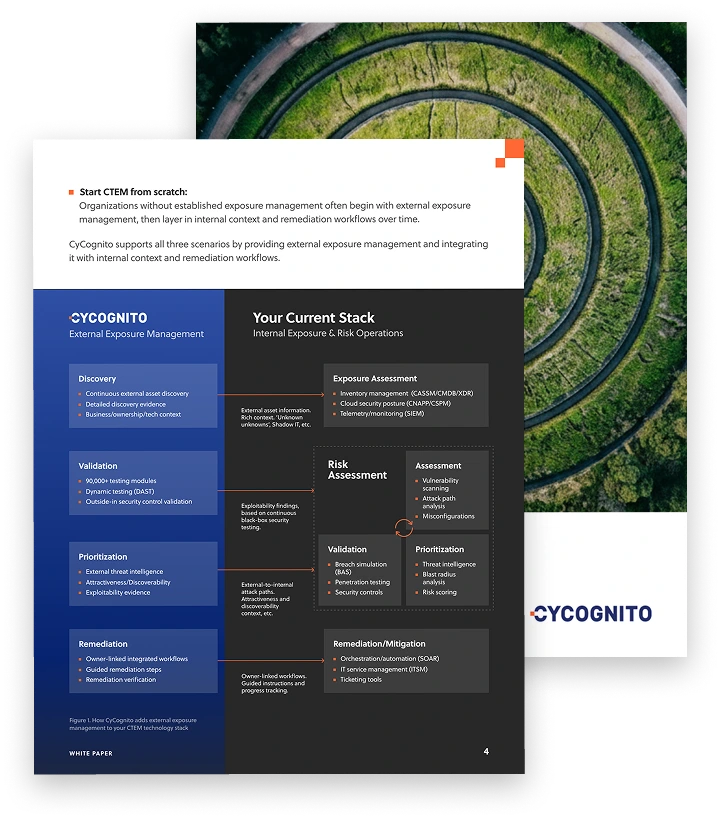
Operationalizing CTEM Through External Exposure Management
CTEM breaks when it turns into vulnerability chasing. Too many issues, weak proof, and constant escalation…
This whitepaper offers a practical starting point for operationalizing CTEM, covering what to measure, where to start, and what “good” looks like across the core steps.
Attack path analysis enhances red teaming and penetration testing by providing a realistic map of how adversaries might move within a system. Instead of relying on random probing or isolated exploits, red teams can simulate attacks that mimic likely adversary behavior based on known weak points and trust relationships.
Penetration testers use this analysis to validate theoretical attack paths by attempting to exploit them in controlled environments. This leads to more focused, high-value testing efforts and helps prioritize fixes for exploitable chains rather than isolated issues.
Compliance and Audit Readiness
Regulatory frameworks often require organizations to demonstrate control over privileged access, asset exposure, and network segmentation. Attack path analysis supports this by showing how well existing controls prevent unauthorized access to sensitive data or systems.
Security teams can use path insights to document risk mitigation strategies, justify compensating controls, and provide evidence of proactive security practices during audits. This reduces the burden of compliance reporting and helps identify gaps before regulators do.
Cloud Security Posture Management (CSPM)
In cloud environments, misconfigurations and overly permissive roles can create complex, hard-to-spot attack paths. Attack path analysis reveals these hidden connections by mapping how privileges, service identities, and network access interact across cloud services.
By visualizing attack chains in multi-cloud or hybrid setups, teams can reduce privilege sprawl, correct misconfigurations, and enforce least privilege principles more effectively. It supports continuous posture management by adapting to dynamic cloud environments in near real-time.
Third-Party Risk Assessment
Suppliers, partners, and contractors often connect to internal systems, expanding the attack surface. Attack path analysis helps identify indirect paths that may originate from third-party access points.
Organizations can assess how far an external actor could traverse if compromised and adjust segmentation, permissions, or monitoring to reduce exposure. This proactive assessment improves third-party risk management and strengthens overall supply chain security.
While attack path analysis is becoming an important part of threat modeling, it raises a few important challenges for organizations.
Dynamic Environments
Modern IT infrastructures are constantly changing, with frequent updates to systems, users, configurations, and assets. These changes can render previous attack path analyses outdated or incomplete. New software deployments, policy updates, or user role changes may introduce fresh vulnerabilities or eliminate old ones. As a result, attack paths must be re-evaluated continuously to maintain accuracy and relevance.
Security teams must implement automated discovery and real-time updates to capture changes across cloud, hybrid, and on-premises environments. Without dynamic tracking, organizations risk relying on stale data, which can give a false sense of security or miss emerging threats.
Data Accuracy
Accurate attack path analysis depends on high-quality data from various sources. Incomplete, outdated, or misconfigured data inputs—such as missing IAM settings or outdated asset inventories—can skew analysis and obscure real attack paths. Inaccurate data leads to either underestimating risks or chasing false positives.
Ensuring data quality requires integrating reliable sources, validating configurations, and regularly auditing data collection processes. Teams should also watch for blind spots in visibility, such as unmanaged devices or unmonitored external services, which can become starting points for attacks.
Complexity
Enterprise networks often involve thousands of assets, complex trust relationships, and layered access controls. Modeling these accurately at scale is computationally and operationally demanding. The more complex the environment, the harder it becomes to distinguish meaningful attack paths from benign configurations.
Overcoming this challenge requires simplification through risk-based prioritization. By focusing on paths to critical assets and eliminating unlikely scenarios, security teams can reduce noise and identify high-impact issues. Leveraging advanced graph algorithms and machine learning can also help process large datasets more efficiently.
Best Practices for Effective Attack Path Analysis
1. Identify and Prioritize Critical Assets
To conduct effective attack path analysis, organizations must first determine which assets are essential to operations, security, and compliance. These typically include domain controllers, key databases, authentication services, intellectual property, and systems with sensitive customer or financial data. Criticality can be assessed based on the asset’s role in business continuity, its data sensitivity, and the legal or regulatory impact of compromise.
Once identified, these assets should be tagged in asset management systems and incorporated into attack path models as high-value targets. Assigning risk levels and business impact scores to assets helps prioritize which paths require immediate attention. This also allows analysts to focus simulations and remediation efforts on high-impact scenarios, ensuring efficient use of limited security resources.
2. Implement Continuous Monitoring and Analysis
Given the fluid nature of modern IT environments, where infrastructure changes rapidly due to deployments, patching, and policy updates, continuous monitoring is essential for maintaining up-to-date attack path visibility. Static snapshots quickly become obsolete, missing newly introduced vulnerabilities or misconfigurations.
Organizations should automate data collection across cloud environments, on-premises infrastructure, and hybrid setups using tools that support real-time or scheduled synchronization. Event data from SIEMs, vulnerability scanners, identity providers, and configuration management systems should be fed into the attack path engine to detect changes that create or close paths.
Continuous analysis enables proactive defense, where threats are mitigated before they can be exploited. It also supports automated alerts and ticketing workflows when high-risk paths to critical assets are detected, streamlining incident response and reducing mean time to remediation.
3. Utilize Graph-Based Modeling
Graph-based models are central to modern attack path analysis due to their ability to represent and compute complex relationships at scale. In these models, nodes typically include users, systems, cloud resources, or service identities, while edges represent permissions, network access, or known vulnerabilities.
Graph traversal algorithms can simulate how an attacker might pivot from one asset to another, revealing viable chains of exploitation. Analysts can use shortest-path, centrality, and reachability analyses to discover critical junctions in the environment—such as misconfigured servers or overprivileged accounts—that facilitate lateral movement.
Advanced models incorporate edge weights to represent exploit difficulty or time-to-compromise, enabling risk-based path prioritization. Some platforms also support “blast radius” calculations to show how far an attacker can reach from a compromised node, helping justify segmentation or control changes.
4. Integrate with Threat Intelligence Frameworks
Static analysis of attack paths can miss key insights unless it’s informed by the tactics and tools used by real adversaries. Integrating threat intelligence provides context by mapping observed attacker behaviors—such as privilege escalation methods or known lateral movement tools—to your environment’s structure.
This integration allows analysts to simulate not just theoretical attacks, but those that closely resemble the playbooks of active threat groups. For example, paths that match MITRE ATT&CK techniques used by APTs or ransomware gangs can be prioritized for investigation or defensive action.
Additionally, threat intelligence feeds can highlight emerging vulnerabilities or zero-day exploits relevant to assets in your graph, prompting immediate reanalysis. This dynamic integration ensures the attack path analysis remains threat-informed and aligned with current adversary capabilities.
5. Regularly Review and Update Analysis
Even with automated tools, periodic manual reviews are essential to ensure accuracy and strategic alignment. These reviews should validate that critical assets are still properly defined, trust relationships are current, and threat models reflect organizational priorities.
Reviews should be scheduled after major infrastructure changes, cloud migrations, or mergers and acquisitions. They should also incorporate feedback from red teams, incident investigations, and audit findings to correct false assumptions or overlooked risks.
Additionally, the parameters used in modeling—such as risk scoring, privilege weights, or simulation thresholds—should be assessed and updated to reflect evolving business goals and threat landscapes. A strong review cycle ensures that attack path analysis remains relevant, actionable, and integrated into broader security governance efforts.
Attack Path Analysis with CyCognito
CyCognito helps organizations uncover and disrupt attack paths by continuously analyzing external-facing assets and their interdependencies. Unlike traditional tools that require agent-based telemetry or manual scoping, CyCognito operates outside-in—simulating the adversary’s perspective to map exposed assets, relationships, and risks across cloud, on-premises, and third-party environments.
Its platform automatically identifies attack paths leading to high-value assets by:
Discovering hidden and unmanaged assets across subsidiaries, cloud accounts, and partner networks
Mapping trust relationships and misconfigurations that create lateral movement opportunities
Building business context that help understand urgency and speed remediation efforts
Simulating attacker behavior to reveal exploitable chains of vulnerabilities, exposed services, and weak controls
Prioritizing remediation based on business impact and attacker accessibility, not just CVSS score
With real-time visibility and graph-based modeling, CyCognito empowers security teams to proactively close attack paths before they are exploited—helping reduce breach exposure, accelerate remediation, and demonstrate measurable risk reduction.
AI security covers prompt injection, model poisoning, insecure agents, MCP servers, shadow AI, and more. Learn the key risks and best practices for securing AI systems and infrastructure.
APIs, the unseen connections powering modern apps, can be vulnerable entry points for attackers. Weak API security exposes sensitive data and critical functions, potentially leading to breaches and disruptions.
Application security (AppSec) involves safeguarding applications against threats throughout their lifecycle. This encompasses the entire process from design to deployment, ensuring that applications remain resilient against cyber threats.
Attack surface management is the continuous process of identifying and reducing an organization’s exposed assets and vulnerabilities before attackers can exploit them.
Red teaming is a security assessment method where a team simulates a real-world cyberattack on an organization to identify vulnerabilities and weaknesses in their defenses. This helps organizations improve their security posture by revealing potential attack vectors and response inefficiencies.
Threat hunting is a proactive cybersecurity practice where security teams search for and isolate advanced threats that have bypassed traditional security measures. It involves actively searching for malicious activity within a network, rather than just responding to alerts from security systems.
Threat intelligence is the process of gathering, analyzing, and interpreting information about potential or actual cyber threats to an organization. It’s a proactive approach that helps organizations understand the threat landscape, identify risks, and implement effective security measures.