
When it comes to vulnerability management, consistency and thoroughness are key. The more systematically organizations search for, analyze, and respond to vulnerabilities within software systems, the lower the chances that critical risks will fall through the cracks.
Hence the value of vulnerability assessment frameworks, or guides that help structure the way security teams detect and manage vulnerabilities. A structured approach is essential for managing the overwhelming number of vulnerabilities (such as the tens of thousands reported every year in the NIST NVD) that organizations must address. While operating according to a vulnerability assessment framework certainly won’t guarantee that your business catches every risk, it can significantly improve cybersecurity outcomes, while also increasing the efficiency of security operations.
Read on for details as we explain what a vulnerability assessment framework is, why it’s important, the different types of frameworks available, and how to go about choosing and operationalizing a framework as the foundation for your organization’s vulnerability management strategy.
This is part of a series of articles about vulnerability assessment.
What Is a Vulnerability Assessment Framework?
A vulnerability assessment framework is a structured guide designed to help cybersecurity professionals take a systematic approach to identifying and managing vulnerabilities and identified weaknesses within information systems and infrastructure.
The process begins with identifying and cataloging vulnerabilities and weaknesses. Frameworks provide recommendations on the types of vulnerabilities organizations should search for, the processes they should follow to identify and respond to vulnerabilities, and the priority levels they should assign to different types of risks.
This does not mean that vulnerability assessment frameworks are rigid, step-by-step guides to vulnerability management. On the contrary, most provide only high-level guidance and leave it up to cybersecurity teams to decide how best to implement the recommendations.
Still, by setting priorities and defining an overarching approach to vulnerability management, assessment frameworks help to ensure that teams adopt a consistent, rigorous approach to handling security risks.

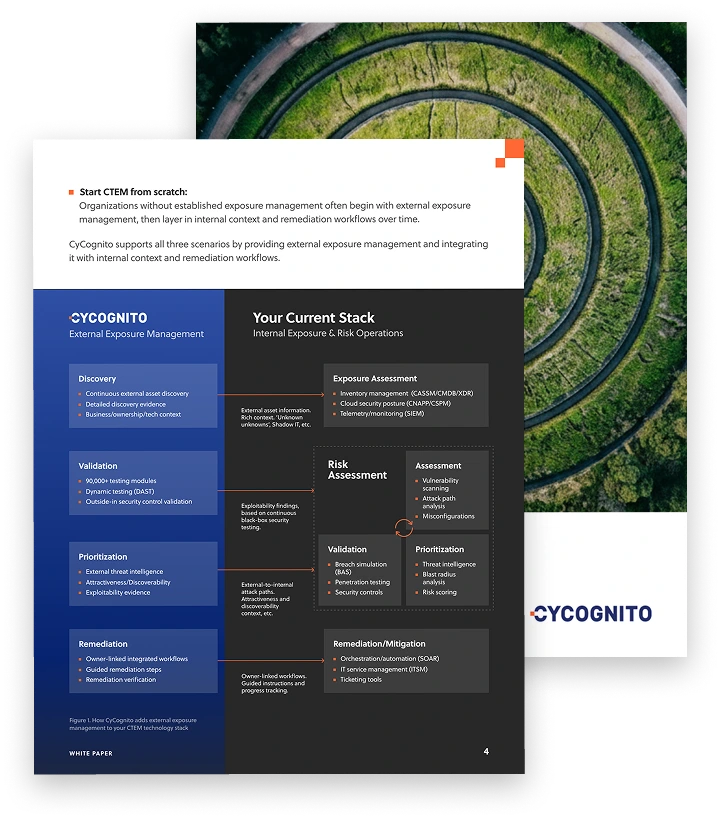
Operationalizing CTEM Through External Exposure Management
CTEM breaks when it turns into vulnerability chasing. Too many issues, weak proof, and constant escalation…
This whitepaper offers a practical starting point for operationalizing CTEM, covering what to measure, where to start, and what “good” looks like across the core steps.
Benefits of Vulnerability Assessment Frameworks
By systematizing vulnerability management, vulnerability assessment frameworks provide a number of important benefits:
- Comprehensive risk coverage: By defining the various types of risks and threats that an organization should watch out for, vulnerability assessment frameworks help ensure that teams don’t overlook any categories of vulnerabilities.
- Consistency: When teams use a vulnerability assessment framework to structure cybersecurity operations, they follow the same set of core processes and principles. This means that security operations are predictable and consistent, no matter which team member happens to be carrying them out.
- Proactive approach to vulnerability remediation: Vulnerability assessment frameworks encourage teams to adopt a proactive approach by identifying and responding to risks before they are exploited, enabling proactive risk mitigation and significantly reducing the likelihood of data breaches.
- Holistic approach and ongoing process: These frameworks promote a holistic approach to vulnerability management, considering technical, process, and human factors, and establish vulnerability management as an ongoing process that adapts to evolving threats through regular assessments and risk prioritization.
- Efficient operations: Teams that adhere to vulnerability assessment frameworks are more likely to operate efficiently and avoid pitfalls like performing the same type of vulnerability scan twice.
- Compliance enhancement: Following the recommendations of vulnerability assessment frameworks is a good way to generate the evidence necessary to pass compliance audits, especially in cases where compliance rules mandate that businesses follow consistent, systematic security processes. Thorough compliance reporting is also facilitated, reducing patch delays and gaps in security oversight.
Strictly speaking, no organization absolutely has to follow a vulnerability assessment framework. But doing so is a smart way to reduce risks, streamline security operations, and remain compliant.
Components of a Vulnerability Assessment Framework
While vulnerability assessment frameworks vary a bit with regard to what they include, most incorporate the following important components:
- Asset assessment: Under most frameworks, the vulnerability assessment process starts with ensuring that the organization systematically tracks the applications, databases, cloud services, and other IT resources it is responsible for managing. Asset discovery involves cataloging all hardware, software, cloud instances, and third-party integrations to enhance security protocols. You can’t protect assets that you don’t know about.
- Vulnerability scanning: Vulnerability scanning is the process of automatically looking for risks that attackers could exploit. Typically, teams carry out this work using scanning tools.
- Vulnerability assessment and prioritization: After detecting vulnerabilities, teams assess and categorize them based on the level of risk they pose. This process involves identifying weaknesses and cataloging all identified vulnerabilities within systems and assets. Severity scores (like those defined through CVSS) can help set a baseline, but since these are generic, it’s important to consider the level of risk that a given vulnerability poses to each specific organization. Teams should prioritize vulnerabilities, focusing on critical vulnerabilities and those that could have the highest impact, to determine which ones should be addressed first.
- Remediation: Remediation involves implementing measures to fix or mitigate identified vulnerabilities, categorized by urgency. Addressing critical vulnerabilities and high-risk issues promptly is essential to reducing potential threats.
- Governance: The governance component of a vulnerability assessment framework defines the steps that organizations should follow (such as adhering to the principle of least privilege and minimizing application attack surfaces) to harden systems against attack and reduce the risk that vulnerabilities will arise in the first place.
- Documentation and reporting: The documentation and reporting component of vulnerability assessment frameworks defines how organizations track their vulnerability management processes and outcomes. Being able to document the process and generate reports is important for compliance and auditing purposes, as noted above. It also provides a way for cybersecurity teams to assess their operations and find ways to improve over time.
To ensure effective implementation of security measures, organizations should incorporate regular training and accountability into their vulnerability assessment processes.
Tips from the Expert

Rob Gurzeev, CEO and Co-Founder of CyCognito, has led the development of offensive security solutions for both the private sector and intelligence agencies.
Consider these best practices to get the most from vulnerability assessment frameworks:
- Automate, but keep humans in the loop: Automating processes like vulnerability scanning is critical for making them efficient and scalable. However, adopting a comprehensive and systematic approach to vulnerability management ensures that automation is balanced with human oversight. For example, you may want a security engineer to sign off on an automated remediation action before a tool carries it out, to avoid scenarios where a tool makes the wrong decision.
- Tailor vulnerability assessment to your business: While part of the value of vulnerability assessment frameworks is that they standardize vulnerability management for businesses of all types, this doesn’t mean they always address the unique challenges facing a particular organization. For this reason, it’s critical to make sure you align assessment objectives and processes with the specific risks and priorities of your business. A proactive and holistic approach is necessary to address not only technical vulnerabilities but also process weaknesses and human factors.
- Integrate vulnerability management into IT processes: Vulnerability scanning and assessment shouldn’t happen as siloed processes. To ensure efficiency and enable rapid response to risks, aim to integrate vulnerability management processes directly into broader IT operational workflows (such as the CI/CD and application deployment processes). Focus on the most critical vulnerabilities, recognizing that not all vulnerabilities need to be addressed equally. Prioritize those that pose the greatest risk to your organization.
- Review results and strive for continuous improvement: Even for organizations that excel at managing vulnerabilities, there’s always room to reduce risks further or boost efficiency even more. To this end, perform periodic reviews of your overall vulnerability assessment process. Reviews are an opportunity to discuss what you’re doing well, where you’re falling short and how you can adjust tools and processes to enhance outcomes. Monitoring for new vulnerabilities and defending against threat actors is essential to maintaining a strong security posture.
- Validate vulnerability management outcomes: Saying that you’re following a vulnerability assessment framework and actually putting it into full effect are different things. Validate that your framework is actually moving the needle by assessing outcomes in an objective way. External audits or other third-party reviews are one way to do this. So is asking different teams within your organization to review each other’s vulnerability assessment work.
Types of Vulnerability Assessment and Management Frameworks
Vulnerability assessment frameworks can be categorized based on their overall focus and the types of vulnerabilities they address. These frameworks are adaptable to different types of assets, environments, operating systems, and so on, allowing organizations to tailor their approach to their unique IT environments.
Key examples of vulnerability assessment framework types include:
- Application-based: Frameworks in this category deal with application security risks. Application vulnerability scans are designed to identify weaknesses in software applications, including web-based and mobile applications, with a focus on code vulnerabilities such as SQL injection, XSS, and insecure authentication mechanisms, as well as security flaws within application logic.
- Network-based: Network-centric frameworks focus on vulnerabilities that attackers can exploit remotely over the network. They assess vulnerabilities in an organization’s network infrastructure, including routers, switches, and firewalls, and can be conducted from both external and internal perspectives to identify possible vulnerabilities.
- Host-based: These frameworks and scans focus on individual devices within an organization’s network. They evaluate installed software, configurations, and local vulnerabilities to assess the security posture of those devices.
- Other: Various other types of vulnerability assessment frameworks exist, such as those that focus on databases, cloud vulnerabilities, or vulnerabilities in AI systems.
Historically, it was common for vulnerability assessment frameworks to focus on a specific category of IT asset or risk. Today, however, many of the leading frameworks are broader, and are designed to enable comprehensive management of risks of all types.
Vulnerability Assessment Frameworks vs. Risk Assessment Frameworks
It’s important to avoid conflating vulnerability assessment frameworks with risk assessment frameworks – a related but distinct type of resource. As part of risk assessment frameworks, organizations often use threat modeling and threat intelligence to systematically identify potential threats and understand attacker behavior, which helps prioritize vulnerabilities based on the likelihood of exploitation by various cyber threats.
Risk assessment frameworks focus on identifying and managing problems that could disrupt business operations. These include cybersecurity attacks, but they can also extend to other types of issues, like supply chain disruptions or geopolitical turmoil. Most risk assessment frameworks aim to help business leaders think about risks like these and formulate response plans before problems actually strike.
In contrast, vulnerability assessment frameworks focus only on cybersecurity vulnerabilities. They’re also more technical in nature; rather than preparing the business as a whole to respond to risks, vulnerability assessment frameworks provide technical guidance to security professionals responsible for detecting and mitigating vulnerabilities, especially those that could be exploited by cyber threats. Recognizing potential threats through comprehensive assessments is essential for organizations to strengthen security measures and protect digital assets from evolving cybercriminal activities.
Because of these differences, most organizations can benefit from both vulnerability assessment frameworks and risk assessment frameworks.
Vulnerability Assessment Frameworks vs. Tools
It’s also important not to conflate vulnerability assessment frameworks with vulnerability detection or management tools.
Because vulnerability assessment frameworks are high-level guides, they rarely recommend specific tools. Instead, they define the types of processes that an organization should follow, leaving it up to individual teams to decide which vulnerability tools they’ll use to operationalize those processes. In practice, organizations typically use a combination of automated tools, such as vulnerability scanners, for rapid identification of known vulnerabilities and misconfigurations, alongside manual testing to uncover complex, logic-based security flaws that automated tools may miss.
From a tooling perspective, this is good news for security professionals because it means that no matter which vulnerability assessment framework or frameworks their business chooses to use, they can leverage tools of their choosing to put the frameworks into practice.
Popular Vulnerability Assessment Frameworks
Now that we’ve covered what vulnerability assessment frameworks do and how they work, let’s look at some leading examples of major security frameworks in use today.
NIST CSF
The NIST Cybersecurity Framework (CSF) is a comprehensive framework organized around six core processes: Governance, vulnerability identification, protection, detection, response, and recovery. It’s particularly prominent in North America (and the organization that maintains it, NIST, is a US government agency), but it is suitable for organizations of all types, in any location.
ISO 27001
ISO 27001 is an international standard that defines cybersecurity best practices. It’s similar in scope and focus to NIST CSF, but as a framework that is not explicitly linked to the US, it tends to be more popular with organizations that are based outside of North America.
CISA RVA
CISA is a US federal agency responsible for (among other things) addressing cybersecurity threats to critical infrastructure. As part of this effort, it publishes a Risks and Vulnerabilities Assessment (RVA) report every year. The report describes the most relevant types of vulnerabilities and recommends processes for mitigating them.
SANS CIS Controls
The CIS Controls (formerly known as Critical Security Controls) are a set of cybersecurity recommendations from the SANS Institute, a nonprofit cybersecurity research organization. It extends beyond vulnerability assessment to include other types of controls (such as those related to user privilege management), but it covers core vulnerability assessment requirements.
SANS also publishes a Vulnerability Assessment Framework (VAF) that focuses more narrowly on vulnerability management, but its recommendations are more generic than those of the CIS Controls. It’s also not updated as regularly.
CVSS
The Common Vulnerability Scoring System (CVSS) is not a vulnerability assessment framework per se, but it can assist in vulnerability management efforts. It provides a database that tracks and rates known vulnerabilities, including by assigning each one a severity score. As we mentioned above, however, it’s critical to consider how severe each vulnerability is for your particular organization, rather than blindly using the generic CVSS scores to guide response activities.
Key Considerations for Choosing a Framework
Given that most vulnerability assessment frameworks include the same core components, how can an organization determine which framework best fits its needs? There are several factors to weigh:
- Asset types: Since some frameworks (like application-based ones) only focus on certain types of IT systems or resources, it’s important to consider the types of assets that your business needs to protect. Most businesses today will benefit from broad frameworks that cover assets of all types, including both cloud and on-premises environments, but those with narrower portfolios (for example, organizations that don’t do any in-house software development and rely on third-party apps alone) may find it simpler to adopt a framework tailored to their specific type of IT estate.
- Compliance mandates: Regulatory compliance rules may recommend or require that organizations follow a certain framework. For instance, most US federal government agencies are required to use NIST CSF. In Europe, complying with the Digital Operational Resilience Act (DORA), an EU-specific risk and vulnerability management framework, is mandatory for most businesses that operate what the EU defines as critical infrastructure (like financial and telecommunications services). Protecting digital assets and maintaining organizational security are key objectives of these mandates, ensuring that valuable data and systems are safeguarded against threats.
- Industry and sector: Along similar lines, businesses that operate in certain sectors (like banking or manufacturing) may benefit from frameworks designed for their type of industry. It may also be the case that regulations specific to a sector (such as PCI DSS in the case of the finance sector) may recommend or require a specific framework.
- Security capabilities and resources: Some frameworks require more rigorous vulnerability management and reporting processes than others. To ensure that your business will actually be able to adhere to the recommendations of its framework, it’s important to consider how many operational resources it possesses. Trying to implement an overly rigorous framework without having enough cybersecurity staff on hand, or sufficient budget to invest in adequate tooling, is a recipe for failure; it’s better to adopt a less stringent but actionable framework than to pursue a more intensive one but come up short.
How to Put Vulnerability Assessment Frameworks Into Practice
Because vulnerability assessment frameworks define only guidance and high-level direction, not specific procedures or tools, responsibility for bridging the gap between goals and action lies with cybersecurity professionals. They’re the ones responsible for taking the guidance offered by a framework and putting it into practice.
Doing so involves the following essential steps:
- Identify relevant framework components: For starters, it’s important to assess your organization’s chosen vulnerability assessment framework to determine which processes and risk levels you need to follow. Some components of the framework (such as those that address a type of IT resource that you don’t use) may be irrelevant or low-priority.
- Plan processes: After deciding which parts of the framework to implement, determine which processes you’ll need to put into practice to achieve the framework’s objectives. The frameworks may include high-level process guidance (like “perform vulnerability scans at appropriate intervals”), but you’ll need to be more specific in deciding exactly how and when to carry out the processes.
- Choose and deploy tools: The next step is to identify and deploy the tools (such as vulnerability scanners and reporting software) you’ll need to operationalize your vulnerability management processes. During implementation, organizations may face challenges such as resource constraints or integration issues, making it essential to focus on addressing vulnerabilities by applying patches or deploying new security controls when necessary.
- Schedule check-ins and reviews: Once implemented using appropriate tools, vulnerability assessment processes should be largely automated. Still, it’s important to ensure that your team regularly takes stock of its vulnerability management processes to identify and mitigate shortcomings or inefficiencies. To this end, it’s advisable to schedule periodic assessments – ideally, at least once a quarter.
In short, putting a vulnerability assessment framework into practice requires careful planning, the right tools, and ongoing review to effectively respond to and address vulnerabilities. If vulnerability assessment frameworks are not properly managed, the process can devolve into a system of partial solutions and outdated scans, resulting in ineffective security measures.
Assessing vulnerabilities with CyCognito
A vulnerability assessment framework is only as strong as the asset inventory it runs on, and most inventories miss the assets attackers target first.
CyCognito is a leading exposure management platform that operationalizes the discovery, scanning, prioritization, and remediation components of a framework continuously across your entire external attack surface, starting from nothing more than your organization’s name.
- Builds a continuous, attacker-perspective asset inventory covering shadow IT, forgotten infrastructure, and inherited third-party exposure
- Runs 100,000+ active tests across 35+ threat categories on every asset, surfacing misconfigurations, exposed services, and unpatched software
- Validates exploitability continuously, reducing critical findings from 25% of identified issues to the 0.1% confirmed as actually exploitable
- Maps each finding to its business owner and attack path, routing real work to the right team with the evidence needed to act
- Tracks every finding through verified fix and generates the documentation needed for compliance reporting and framework audits
CyCognito typically uncovers an attack surface up to 10x larger than previously known, then continuous validation narrows it to the 0.1% of findings confirmed as exploitable.
If you want to see CyCognito in action, click here to schedule a 1:1 demo.
Frequently asked questions about vulnerability assessment frameworks
What happens during the engagement planning and validation phases?
Engagement planning sets the scope and objectives upfront: which assets are in scope, what vulnerabilities the team will look for, and what success looks like. The validation phase confirms remediation actually worked, with teams rescanning affected systems to verify the vulnerability is closed rather than trusting a ticket status.
How much can a proactive vulnerability program reduce breach costs?
Organizations with proactive security measures cut breach costs by around 48% on average compared to reactive postures. The savings come from avoiding the downtime, recovery work, and incident response expenses that dominate breach budgets. Fixing vulnerabilities before they are exploited is consistently cheaper than responding to the breach they would have caused.
Which regulations require regular vulnerability assessments?
PCI DSS, HIPAA, and GDPR all include provisions that effectively require regular vulnerability assessments, either by mandating them directly or by requiring the outcomes they produce. PCI DSS, for example, calls for both internal and external scans on a defined cadence. Aligning assessment activity with these requirements is one of the most reliable ways to keep compliance evidence audit-ready.