
No exploit is worse than a zero day exploit – meaning one that attackers start exploiting before patches or attack signatures are available to help defenders control the threat. What’s more, while zero day vulnerabilities have always posed a high-severity threat, they have grown even worse in the era of AI. AI has made zero day exploits faster because attackers can now use off-the-shelf models to find and weaponize security vulnerabilities quicker than organizations can patch them.
Hence the critical importance of prioritizing zero day risks in the context of vulnerability management. This article provides guidance by detailing what zero-day exploits are, how to respond to them, and how to keep pace with zero day vulnerabilities in the fast-evolving AI era.
This is part of a series of articles about application security.
What is a zero day exploit?
A zero day exploit is the abuse of a zero day vulnerability, meaning a software vulnerability unknown to the vendor and for which no patch exists. As a result, defenders have no warning before attackers can take advantage of zero day exploits. Typically, this happens because attackers discover a flaw within a software application or platform before the issue becomes publicly documented or reported within vulnerability databases like the National Vulnerability Database (NVD).
The term “zero day” reflects the fact that organizations have zero days to prepare for and block attacks before threat actors begin carrying them out.
This lack of prep time distinguishes zero day exploits from flaws that become publicly disclosed after a patch exists. Those risks are treated as n day vulnerabilities because organizations have some time (represented as n number of days) to deploy updates and mitigate the issue before malicious actors begin exploiting them.

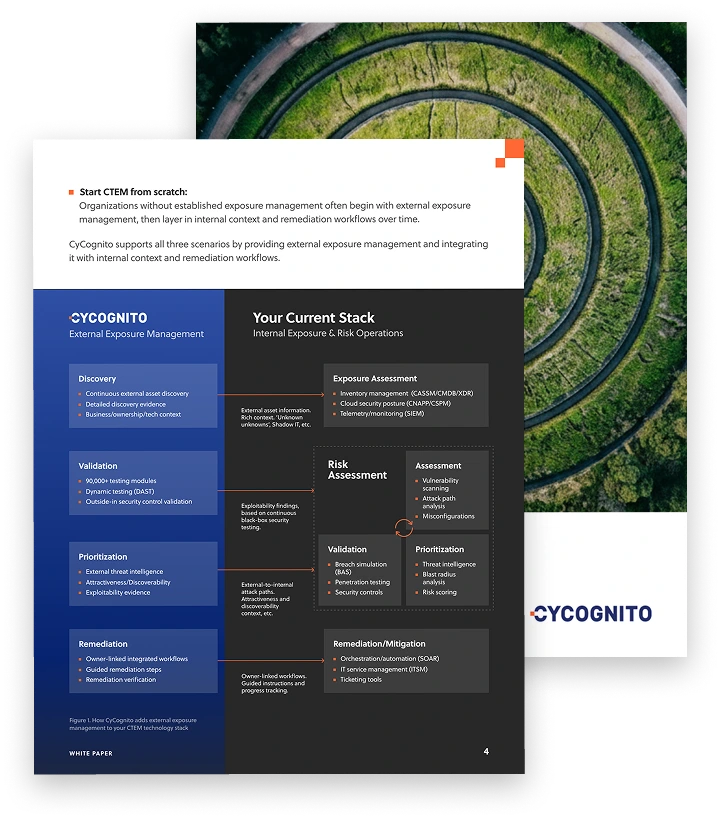
Operationalizing CTEM Through External Exposure Management
CTEM breaks when it turns into vulnerability chasing. Too many issues, weak proof, and constant escalation…
This whitepaper offers a practical starting point for operationalizing CTEM, covering what to measure, where to start, and what “good” looks like across the core steps.
The importance of zero day protection
Given that zero day exploits can cause major harm, detecting and mitigating them is a critical priority for cybersecurity teams. However, engineers face two major challenges in responding to zero day threats:
- By definition, cybersecurity professionals don’t know about zero day vulnerabilities ahead of time. What they can do, however, is continuously monitor for signs of intrusion. Doing so allows them to identify attacks early on, when they can minimize the impact.
- Often, remediations for zero day vulnerabilities are not immediately available when the attacks begin because software vendors need time to code, test, and release a security update or security patches.
As a result, it’s often not possible right away to resolve the underlying vulnerability completely. Nonetheless, engineers can often take other steps to stop attacks or minimize their effect; for instance, they can isolate the vulnerable system on the network so that attackers can’t reach it.
This isn’t a true “fix,” but it is an effective way to stem zero day threats while the organization waits on a patch or other remediation to become available. These intermediate remediation steps are valuable because attackers’ time to exploit newly disclosed flaws is now just a few days, while many organizations take 60 to 150 days to deploy patches.
It’s also worth noting that traditional security tools, such as signature-based antivirus software and other signature-based defenses, are useful for known threats, but no signature exists for a zero day threat. This means that conventional malware scanners can’t identify zero day risks.
In addition, although zero day exploits are in general high in priority because they enable threat actors to carry out immediate attacks, not every zero day exploit poses a threat to every organization. Often, zero day attacks can only be carried out if certain conditions are met; for example, a system might need to be configured in a specific way to be vulnerable.
For this reason, it’s critical to gather as much context as possible about how attackers are attempting to leverage a zero day exploit, then use it to make informed decisions about which risks to prioritize.
Zero day exploits in the age of AI
Zero day exploits have long been responsible for some of the most serious cybersecurity breaches. In the AI era, however, zero day vulnerabilities present even more of a threat to businesses. The reason why is that AI has made it easier and faster than ever for threat actors to detect zero day vulnerabilities, then turn them into zero day exploits.
Historically, carrying out zero day attacks required hackers to collect information about target software, identify security flaws within it, and devise ways of exploiting them. This approach required substantial time and expertise.
Now, however, AI models can do the hard work of probing software for vulnerabilities that are not yet known to the organizations that develop and use it – a feat demonstrated most famously by Mythos, the model from Anthropic that took just hours to discover vulnerabilities in a variety of major software systems. For now, Anthropic has not made Mythos available to the public, but it’s not difficult to imagine attackers using other, publicly available models to find and exploit zero day vulnerabilities.
In an age when AI has vastly accelerated zero day attack timelines, businesses must also accelerate their cyber defenses. They must embrace continuous exposure management, meaning the ability to detect and respond to risks on an ongoing, real-time basis. Periodic scans or audits simply don’t cut it when attackers can use AI to launch zero day attacks in a matter of hours.
Tips from the Expert

Dima Potekhin, CTO and Co-Founder of CyCognito, is an expert in mass-scale data analysis and security. He is an autodidact who has been coding since the age of nine and holds four patents that include processes for large content delivery networks (CDNs) and internet-scale infrastructure.
Conquer zero day attack risks with these expert tips:
- Cut the “fat” from your remediation process: Zero day exploits require especially rapid remediation. The more efficient your response and mitigation process, the more prepared you are to manage zero day attacks. To that end, leverage AI to shrink the exploitability window, make informed prioritization decisions, and focus remediation resources where they’ll make the greatest impact.
- Leverage business context: Alongside exploitability intelligence, business context – information like how your organization uses a vulnerable app and which types of data it stores – also plays an essential role in keeping zero day response efforts efficient.
- Validate security controls: Deploying a security control doesn’t guarantee it actually works. Validation is crucial for ensuring that your protections are doing what you think they are.
- Automate vulnerability management: From a velocity perspective, humans are the weakest link in zero day vulnerability response. Take advantage of automations to detect, assess, prioritize, and remediate zero day exploits.
How to track zero day attacks and exploits
As we mentioned, one of the unique challenges associated with managing zero day vulnerabilities is that there is no warning that they’re coming. Still, there are tactics businesses can adopt to gain as much insight as possible into zero-day exploit risks.
One key practice is continuous monitoring. By constantly tracking the status of software systems, security teams can use anomaly detection and tools like User and Entity Behavior Analytics (UEBA) to spot suspicious behavior that may signal efforts to discover or exploit zero-day vulnerabilities. Anomaly-based detection methods use machine learning to flag suspicious activity in real time, which can help catch attacks that evade traditional signature-based detection methods.
Also critical is following public vulnerability databases, like the NVD, along with threat intelligence feeds that can provide earlier indicators of compromise and emerging exploit information. As soon as security researchers become aware of an exploit, they publish information about it in these databases. This is usually after zero day attacks have begun; still, knowing about recently disclosed vulnerabilities that have affected other organizations may give a business time to address security flaws before it faces the same attack.
The zero day exploit response process
Faced with a zero day vulnerabilities, security teams typically work through the following process to resolve the issue.
Discovery
First, teams must identify that an attack is taking place. As noted above, attack indicators usually come in the form of anomalous activity that signals a breach or attempted breach of a software system, so detection should focus on unusual behavior rather than depend on prior knowledge of the exploit. As long as an organization continuously monitors activities within its systems and has real-time visibility into the state of its attack surface and exposures, it is in a strong position to discover zero-day exploits quickly. Endpoint protection can also surface early signs of zero day malware on affected hosts.
Assessment
The next step is to assess the exploit. Often, it’s not immediately obvious how the attack works, which assets it’s targeting, or how severe it may be. Security engineers, assisted by threat intelligence data and automated analysis tools, must evaluate the information available about the zero day attack to gain insight into these questions.
Prioritize
Once the team knows more about the nature of the attack, it can make an informed decision about prioritization. It should reflect the seriousness of the threat and the ability of threat actors to carry out a successful attack within the organization’s environment.
Since the exploitability of vulnerabilities can vary widely based on factors like environment configurations, exploit intelligence insights play an important role in helping organizations determine how much of a priority to place on a given zero day attack. The more rapidly security teams can determine whether and to what extent an exploit affects them, the faster they can make the right prioritization decisions.
Mitigate
Next, security engineers, often working in collaboration with developers and IT teams, work to mitigate the attack. Full mitigation may require a patch; when one exists, organizations should use a formal patch management process to deploy it quickly, and if no fix is yet available, teams should rely on interim controls. In the meantime, however, engineers can leverage other tactics, like preventing network connections to the vulnerable system, to block the attack or reduce its impact. A Web application firewall can also help protect organizations by filtering malicious HTTP/HTTPS requests aimed at internet-facing apps.
Validate
The final, crucial step in zero day attack response is validation, meaning the process of confirming that the mitigation the team applied successfully resolved the vulnerability. This is vital because engineers can sometimes forget to follow through on important parts of the mitigation process. It can also be the case that a mitigation step like a patch doesn’t actually resolve the vulnerability as expected.
By ensuring that the issue has actually been resolved, validation closes the zero day response loop.
Best practices for mitigating zero day exploits
The following best practices help to streamline zero day exploit management while also ensuring effective risk mitigation:
Prioritize based on exploitability
Again, not every zero day exploit poses the same level of risk to every organization. To determine which priority level to assign to an attack, teams must understand the exploitability of the vulnerability in question. Exploitability refers to the likelihood that attackers can successfully exploit a vulnerability, and it is affected by multiple factors, such as exposed assets, the assets’ configuration, and the sophistication of the exploit.
Note, too, that with help from AI, attackers can evolve exploits rapidly; an exploit that initially failed could be updated to succeed. This makes it critical for businesses to assess exploitability in real time, based on up-to-the-millisecond insights about their exposures and vulnerabilities.
Isolate affected resources
As we’ve noted, fully mitigating zero day attacks is frequently not possible right away. But that doesn’t mean teams should do nothing as they wait for a patch. They can instead isolate impacted resources. Isolation helps prevent attackers from exploiting vulnerabilities remotely, which is the most common approach. It also reduces lateral movement and helps protect sensitive data after attackers gain network access to an initial target.
In addition, cybersecurity experts can use proactive controls such as Endpoint Detection and Response (EDR), heuristic zero day malware detection, and network segmentation, and a zero trust architecture can further limit damage after compromise through continuous authentication and least privilege access.
Leverage behavioral risk detection
Detecting zero day attacks in real time requires more than traditional antivirus tools, which often miss unknown attacks, so teams need a nuanced understanding of activities and anomalies within software systems. This is where behavioral risk detection comes in. Behavioral risk detection identifies unusual requests or patterns, such as a string of connection attempts from unknown endpoints or a login event by an account that has been dormant for a long time, that could be a sign of an attack.
To work well, behavioral risk detection tools must leverage a variety of data points, including the state of the business’s IT assets, access logs, user location data, endpoint location data, and more. Threat intelligence data and business context can help, too, by providing insight into which types of attacks an organization is likely to face and which systems attackers may target. In addition, implementing attack surface management (ASM) tools helps security teams identify all assets in their networks, examine them for vulnerabilities, and improve response capabilities.
Defensive AI’s role: Fighting fire with fire
Given the vast amount of information at play when detecting and responding to zero day attacks, as well as the high velocity with which threat actors can carry them out in the age of AI, managing zero day exploits manually doesn’t suffice. Organizations aiming to keep a step ahead of attackers must leverage the same tooling behind the attacks – namely, AI. That matters in part because a market exists for zero day exploits, and governments may stockpile them as digital weapons for espionage or sabotage.
Indeed, businesses that take advantage of AI as a defensive cybersecurity tool have advantages that attackers lack. Legitimate actors generally enjoy access to better AI models and more resources that they can devote to discovering and assessing threats with help from AI, improving detection and response capabilities against these high-value attacks. It’s only by taking full advantage of these assets that businesses can gain the upper hand against zero day exploits.
Getting ahead of zero day attacks with CyCognito
The article makes one demand repeatedly: when attackers can weaponize a flaw in hours, you have to judge exploitability in real time, not on a periodic scan cadence. CyCognito works the exposure side of that problem, continuously discovering your external footprint and confirming, from the outside in, which assets are actually reachable and exploitable, starting from nothing more than your organization’s name.
- Discovers your full external footprint, including the forgotten and unmanaged assets attackers reach first, without seeds, agents, or prior asset lists
- Maps newly disclosed CVEs and in-the-wild attacker activity to your specific assets, so you know within hours which exposures actually put you at risk
- Prioritizes by real attacker reachability and exploitability rather than CVSS severity alone, so remediation effort lands on the exposures that can actually be reached
- Re-tests after mitigation to confirm the fix actually held, closing the validation gap where a patch looks applied but the exposure remains
- Runs continuously rather than on a scan schedule, shrinking the window between an exposure appearing and your team confirming whether it matters
Once real exploitability is factored in, CyCognito customers typically see the share of findings flagged critical fall from about 25% to 0.1%, which is the gap between chasing every disclosure and fixing the few that can actually reach you.
If you want to see CyCognito in action, click here to schedule a 1:1 demo.