![External Attack Surface Management (EASM): Ultimate Guide [2026]](https://www.cycognito.com/blog/wp-content/uploads/marquee-digital-27-desktop-1.webp)
What Is External Attack Surface Management (EASM)?
External Attack Surface Management (EASM) is a continuous, automated cybersecurity process that identifies, monitors, and analyzes an organization’s public-facing digital assets, such as websites, APIs, cloud services, and Shadow IT, to detect vulnerabilities, misconfigurations, and potential entry points. It provides an “attacker’s-eye view” of the digital perimeter to mitigate risks.
EASM is designed to provide continuous visibility into what external resources exist, how they are exposed, and where vulnerabilities may lie. By focusing on the organization’s outward-facing assets, EASM helps security teams understand their risk posture from the perspective of an external adversary.
The goal of EASM is to minimize the potential entry points for attackers and reduce the likelihood of successful breaches. It involves regular scanning, asset discovery, and ongoing assessment to capture changes in the attack surface as the organization grows or evolves. EASM tools automate much of this work, enabling organizations to quickly detect new assets, misconfigurations, and vulnerabilities before they can be exploited.
What Counts as External Assets?
External assets are any digital systems, services, or components that are accessible over the internet and not protected by internal network boundaries. These assets can be intentionally exposed for business operations or unintentionally exposed due to misconfigurations or shadow IT. Common categories include:
- Web applications and websites: Corporate domains, subdomains, marketing sites, portals, and any web-facing application.
- IP addresses and cloud infrastructure: Public IP ranges, cloud-hosted services (e.g., AWS, Azure, GCP), storage buckets, and virtual machines with internet exposure.
- APIs and microservices: Exposed endpoints that provide data or services to external users or third parties.
- Email and DNS infrastructure: MX records, SPF/DKIM/DMARC configurations, and external name servers.
- Certificates and TLS configurations: SSL/TLS certificates and their configurations, which may expose domain ownership, subdomains, or insecure setups.
- Shadow IT: Unmanaged or unknown systems deployed without IT approval, such as third-party SaaS accounts or cloud resources created by individual teams.
- Remote access points: VPN gateways, RDP endpoints, SSH servers, and other access interfaces that allow external connections.
All of these assets contribute to an organization’s external attack surface. They must be continuously discovered, validated, and assessed, since even a single forgotten or misconfigured asset can provide a foothold for attackers.
What Categories of Attacks Does EASM Cover?
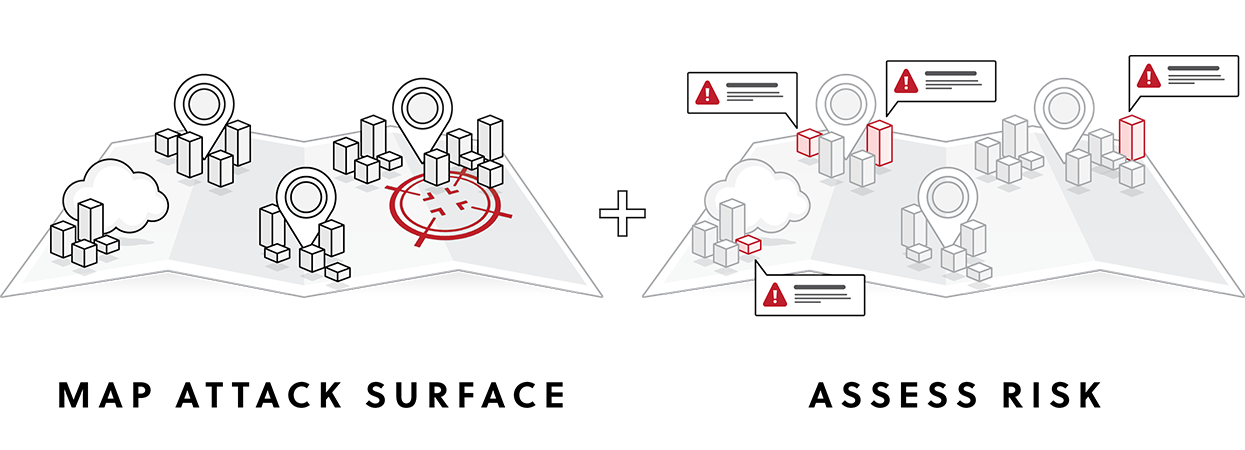
External Attack Surface Management focuses on risks that originate from the public internet. It helps security teams identify exposures that attackers commonly exploit during reconnaissance and initial access. While EASM does not directly block attacks, it reveals weaknesses that could enable them.
Common attack categories include:
- Exploitation of exposed services: Attackers scan the internet for publicly accessible services such as web servers, databases, APIs, and remote administration ports. If these services run outdated software or weak configurations, they can be exploited using known vulnerabilities.
- Web application attacks: Public-facing applications may contain vulnerabilities such as injection flaws, broken authentication, insecure file uploads, or cross-site scripting. EASM helps identify exposed applications and potential weaknesses before attackers discover them.
- Cloud misconfiguration attacks: Misconfigured cloud storage, exposed management interfaces, or overly permissive access controls can allow attackers to access sensitive data or take control of cloud resources.
- Subdomain takeover and domain attacks: These occur when DNS records point to services that are no longer active. Attackers can register the abandoned resource and host malicious content under a trusted company domain.
- Credential-based attacks: Exposed login portals, VPN gateways, and remote desktop services are common targets for brute-force attacks, credential stuffing, and password spraying.
- Shadow IT exploitation: Unmanaged or unknown systems deployed outside official IT oversight can introduce security gaps. Attackers often target these assets because they are less likely to be monitored or patched.
- Exposure of forgotten or legacy assets: Old servers, staging environments, or abandoned domains may remain accessible on the internet. These systems often contain outdated software that is easier for attackers to compromise.

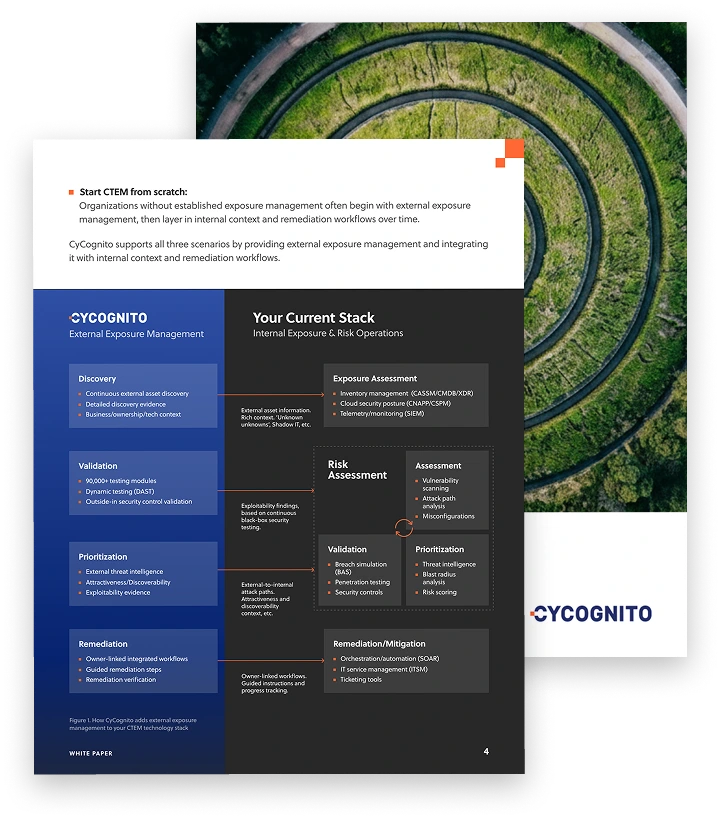
Operationalizing CTEM Through External Exposure Management
CTEM breaks when it turns into vulnerability chasing. Too many issues, weak proof, and constant escalation…
This whitepaper offers a practical starting point for operationalizing CTEM, covering what to measure, where to start, and what “good” looks like across the core steps.
Internal vs. External Attack Surface Management
Attack surface management can be divided into two main areas: internal and external. Both aim to reduce vulnerabilities, but they focus on different parts of an organization’s digital environment. Here is a quick summary of the differences:
| Aspect | Internal ASM | External ASM |
|---|---|---|
| Scope | Internal networks and systems | Internet-facing assets and infrastructure |
| Discovery Method | Agent-based, authenticated scanning | Unauthenticated scanning and passive data sources |
| Threat Focus | Insider threats, lateral movement | External attackers, bots, public exposure |
| Examples of Assets | Endpoints, internal servers, identity systems | Domains, APIs, cloud services, remote access |
| Perspective | Organization’s internal view | Attacker’s-eye view from outside |
Let’s explore the differences in more detail.
Internal Attack Surface Management
Internal attack surface management focuses on identifying and reducing vulnerabilities within an organization’s internal network and infrastructure. This includes systems, devices, and applications that are not directly accessible from the public internet.
The goal is to protect against threats that originate from inside the environment. These threats may include insider attacks, compromised employee devices, or malware that has already entered the network. Internal ASM often involves monitoring endpoints, internal servers, identity systems, and network configurations.
External Attack Surface Management
External attack surface management focuses on vulnerabilities in assets that are exposed to the public internet. These assets form the organization’s digital footprint and are accessible to attackers performing reconnaissance.
Examples include public websites, web applications, APIs, cloud services, internet-facing servers, and exposed infrastructure. EASM continuously discovers and monitors these assets to identify vulnerabilities, misconfigurations, and unknown systems.
The primary goal of EASM is to reduce risk from external threats such as hackers, malicious actors, and automated bots attempting to exploit weaknesses in publicly accessible systems. By providing visibility into the external environment, EASM helps organizations identify and secure potential entry points before they are used in an attack.
Core Components of the EASM Process
1. Asset Discovery and Inventory
The first step in EASM is identifying all externally facing assets associated with the organization. This includes domains, subdomains, IP addresses, web applications, APIs, and cloud resources. Discovery is typically performed using a combination of DNS enumeration, IP range scanning, certificate transparency logs, and integrations with cloud provider APIs.
The goal is to build an inventory of assets, including those not documented or managed, commonly known as shadow IT. Continuous scanning ensures that newly deployed or previously unknown assets are detected promptly.
2. Contextualization
Once assets are discovered, contextualization adds meaning to them by mapping each asset to a business unit, system owner, function, or risk category. This step helps determine which assets are production-facing, which are test environments, and which may belong to third-party vendors.
By understanding the context of each asset, security teams can assess its criticality and determine how it fits into the organization’s operations. This step supports triaging issues and aligning remediation efforts with business priorities.
3. Validation
Validation filters out false positives and verifies that identified assets and issues are accurate. For example, a detected subdomain may no longer be active, or an exposed port may be part of an approved configuration. Without validation, security teams risk wasting time on inaccurate findings.
Automated validation can confirm asset ownership, verify exploitability of vulnerabilities, and check whether misconfigurations are genuinely risky. In many EASM platforms, machine learning or rules-based logic supports this process.
4. Prioritization
After validation, findings are prioritized based on risk. This includes evaluating exploitability, exposure level, asset criticality, and business impact. For example, a vulnerable web server tied to a critical customer-facing application ranks higher than a similar issue on a non-production system.
Effective prioritization prevents alert fatigue by focusing remediation efforts on issues most likely to be targeted or cause significant damage. It also enables security teams to allocate resources efficiently.
5. Remediation
The final step is coordinating with asset owners or IT teams to remediate identified issues. This may involve patching vulnerable systems, reconfiguring cloud permissions, decommissioning unused assets, or securing exposed endpoints.
Remediation workflows are often integrated into ticketing systems to ensure accountability and tracking. Continuous EASM monitoring ensures that resolved issues do not reappear and that newly discovered risks are addressed promptly.
EASM Technologies and Techniques
External Attack Surface Management relies on several security technologies to discover exposed assets and identify weaknesses across an organization’s internet-facing environment. These tools work together to monitor the external footprint and highlight potential entry points attackers could exploit.
- Web application scanners: Analyze publicly accessible web applications for common security flaws such as SQL injection, cross-site scripting, data exposure, and insecure configurations.
- Network scanners: Examine internet-facing infrastructure to identify open ports, exposed services, and misconfigured systems across IP ranges and network endpoints.
- Threat intelligence platforms: Collect and analyze data about emerging threats, attacker techniques, and malicious infrastructure to add context to discovered assets.
- Vulnerability management systems: Track and organize security weaknesses, rank issues by severity, and support remediation workflows.
- Attack surface monitoring services: Continuously observe domains, subdomains, websites, and other internet-facing assets to detect changes and new exposures.
EASM vs. Vulnerability Management: What Is the Difference?
While External Attack Surface Management (EASM) and traditional vulnerability management (VM) both aim to reduce organizational risk, they differ in scope, perspective, and approach.
- Scope and visibility: EASM focuses on externally exposed assets visible from the internet, whether known or unknown. VM typically operates within the organization’s known environment, scanning managed assets using authenticated or agent-based methods.
- Discovery vs. assessment: EASM is discovery-driven and relies on external scanning and passive data sources to uncover undocumented or unmanaged assets. VM assumes an asset inventory exists and performs in-depth scans on known systems using internal access.
- Attack surface coverage: EASM provides an attacker’s perspective, identifying entry points visible during reconnaissance. VM focuses on internal risk, including patch management and software vulnerabilities on endpoints, servers, and internal applications.
- Complementary roles: EASM identifies what is exposed externally; VM assesses how secure known assets are.
- Integration points: Organizations often integrate EASM findings into VM programs so discovered external assets are assessed and managed consistently.
Related content: Read our guide to vulnerability assessment
Tips from the Expert

Dima Potekhin, CTO and Co-Founder of CyCognito, is an expert in mass-scale data analysis and security. He is an autodidact who has been coding since the age of nine and holds four patents that include processes for large content delivery networks (CDNs) and internet-scale infrastructure.
In my experience, here are tips that can help you better operationalize and elevate your External Attack Surface Management (EASM) efforts beyond the basics:
- Fingerprint and track third-party trackers and SDKs: Monitor web assets for embedded third-party scripts and SDKs (e.g., analytics, chatbots, social media pixels). These components can expand your attack surface indirectly and are often overlooked in EASM scans.
- Leverage DNS entropy analysis to uncover evasive shadow IT
Use entropy analysis on newly registered domains and subdomains to detect suspicious naming patterns (e.g., gibberish or typo domains) linked to rogue deployments or impersonation attempts. - Maintain “disposable” asset registries for ephemeral environments
Track ephemeral infrastructure (e.g., CI/CD test environments or short-lived cloud instances) in a separate registry with automated expiration rules. These often slip past traditional inventory management and become forgotten exposures. - Establish a kill chain mapping for discovered exposures: Don’t just catalog vulnerabilities; map each one to a stage in the MITRE ATT&CK kill chain. This will help prioritize issues based on potential attacker workflows, especially for entry-point exposures that lead to privilege escalation or data access.
- Use certificate transparency logs to monitor domain spoofing: Actively monitor CT logs for lookalike domains or unauthorized certificates issued for your brand. This helps detect early phishing infrastructure or typosquatting campaigns.
Under the Hood of EASM Solutions
Continuous Discovery
Continuous discovery is the engine behind EASM platforms. Instead of running occasional scans, the system constantly searches the internet for assets associated with the organization. This includes domains, subdomains, IP ranges, cloud resources, and exposed services.
EASM tools use multiple data sources for discovery. Common techniques include DNS enumeration, certificate transparency logs, internet-wide scanning datasets, WHOIS records, and cloud provider APIs. These sources help reveal assets that traditional inventories often miss.
Continuous monitoring is important because attack surfaces change frequently. New cloud resources, development environments, and third-party services can appear without security team awareness. Continuous discovery ensures these assets are identified as soon as they become externally accessible.
Business Context Mapping
After assets are discovered, EASM systems enrich them with business context. This process links technical assets to organizational information such as application owners, business units, environments, and system criticality.
Context helps security teams understand why an asset exists and how important it is. For example, a public API used by customers carries more risk than a temporary testing environment. Without context, all exposures appear equally important, which leads to inefficient prioritization.
Modern EASM platforms often integrate with configuration management databases (CMDBs), cloud inventories, and asset management tools to map discovered infrastructure to known systems and owners.
Active Validation
Active validation confirms whether discovered assets and vulnerabilities represent real risks. Raw scanning results often contain outdated records, inactive domains, or exposures that are intentionally configured.
EASM platforms verify findings using additional checks. These may include confirming that a service is reachable, validating that a vulnerability is exploitable, or verifying ownership of a domain or IP address.
This validation process reduces false positives and prevents security teams from chasing irrelevant alerts. It also improves trust in the platform’s findings and ensures remediation efforts focus on genuine exposures.
Threat Intelligence
Threat intelligence enriches discovered assets with external security context. EASM systems compare exposed services, domains, and infrastructure against known threat indicators and attacker activity.
For example, threat intelligence feeds may identify IP addresses associated with botnets, domains used in phishing campaigns, or vulnerabilities actively exploited in the wild. This information helps security teams understand which exposures are more likely to be targeted.
By combining asset discovery with threat intelligence, EASM platforms move beyond simple asset inventory and provide insight into real-world attacker behavior.
Dashboards and Risk Reporting
Dashboards provide a centralized view of the organization’s external attack surface. Security teams can see the total number of discovered assets, newly detected exposures, unresolved vulnerabilities, and overall risk levels.
Most platforms provide visual summaries such as asset distribution by type, exposure trends over time, and severity breakdowns. These dashboards help teams quickly identify high-risk areas in their external environment.
Risk reporting also supports communication with leadership. Security teams can generate reports showing attack surface growth, remediation progress, and critical exposures that require attention.
Integrations with Security and ITSM Tools
EASM platforms typically integrate with existing security and IT operations tools. These integrations allow discovered exposures to flow directly into established remediation workflows.
For example, findings may be sent to vulnerability management platforms, SIEM systems, ticketing tools like Jira or ServiceNow, or security orchestration platforms. This ensures that issues are assigned, tracked, and resolved through existing operational processes.
Integration also allows EASM data to be combined with other security signals. This improves correlation across tools and helps organizations manage external exposure as part of a broader security program.
Key EASM Challenges and How to Address Them
Complex and Dynamic Environments
Modern IT environments change constantly as new systems, services, and infrastructure components are deployed or modified. Cloud platforms, automated deployment pipelines, and distributed development teams allow assets to appear and disappear quickly across multiple environments. As a result, the external attack surface expands and contracts continuously, making it difficult for security teams to maintain an accurate inventory of internet-exposed resources.
How to address:
- Implement continuous external asset discovery rather than periodic scanning
- Integrate EASM tools with cloud APIs and infrastructure automation platforms
- Maintain a centralized asset inventory synchronized with deployment pipelines
- Monitor DNS records, IP ranges, and certificate transparency logs for new assets
- Use automated alerts when new internet-facing systems are detected
Shadow IT and Unknown Assets
Shadow IT refers to systems, applications, or services deployed outside the visibility of central IT or security teams. These assets often appear when teams adopt new tools or deploy infrastructure independently to accelerate development or operations. Because they are not included in official inventories or security processes, shadow systems may lack patching, monitoring, and proper access controls.
How to address:
- Perform continuous discovery of domains, subdomains, and externally reachable services
- Correlate discovered assets with internal asset inventories and ownership records
- Establish governance policies for new services and infrastructure deployments
- Decommission unused environments, test systems, and legacy endpoints
- Assign asset owners responsible for patching, monitoring, and lifecycle management
Security Controls
A visible asset on the internet does not always reveal which protections are applied to it. External scanning can identify open ports, services, and applications, but it often cannot determine the full set of security controls protecting those systems. Web applications may be shielded by web application firewalls, identity gateways, rate limiting, or network filtering mechanisms that are not immediately apparent from outside the environment.
How to address:
- Combine EASM findings with internal configuration and vulnerability management data
- Validate the effectiveness of security controls through controlled testing
- Monitor TLS configurations, headers, and response behavior to infer protection layers
- Integrate EASM results with SIEM, security monitoring, and asset management systems
- Continuously review firewall rules, WAF policies, and identity access controls
Third-Party Risk
Organizations increasingly depend on third-party vendors, service providers, and cloud platforms to support business operations. These external partners may host applications, manage infrastructure, or process sensitive data on behalf of the organization. When vendor-managed systems are exposed to the internet, they can become indirect entry points into the organization’s ecosystem.
How to address:
- Monitor vendor-owned domains, infrastructure, and externally exposed services
- Require security standards and reporting as part of vendor contracts
- Perform periodic assessments of partner infrastructure and configurations
- Track third-party assets as part of the organization’s external asset inventory
- Use EASM tools that support supply chain monitoring and vendor risk visibility
Best Practices for External Attack Surface Management
Take the Attacker’s Perspective
EASM efforts should begin with the mindset of an external adversary. Organizations need to evaluate their internet-facing footprint the same way attackers do, without prior knowledge of internal architecture or asset ownership.
By emulating attacker behavior, such as scanning for open ports, fingerprinting technologies, and checking DNS records, security teams can identify exposures early and prioritize remediation based on likely attack paths.
Attack Surface Reduction
Reducing the external attack surface is more effective than only monitoring it. Once assets are identified and validated, organizations should minimize unnecessary exposure. This includes decommissioning unused services, removing legacy systems, tightening access controls, and enforcing strict deployment policies for internet-facing assets.
Techniques such as network segmentation, tightening firewall rules, and disabling unused ports and protocols shrink exploitable entry points. Regular audits and architectural reviews help ensure new deployments do not unintentionally expand the external surface.
Learn more in our detailed guide to attack surface reduction
Using Exposure Data as Operational Intelligence
Exposure data collected through EASM should be used across security and IT functions. This data can help identify recurring misconfiguration patterns, high-risk business units, or process failures that lead to insecure deployments. Trend analysis can reveal whether external exposure is increasing or decreasing over time.
When integrated with vulnerability management, incident response, and risk management processes, exposure data becomes a strategic input rather than a stream of isolated alerts.
Third-Party and Supply Chain Risk Analysis
Many external exposures originate from vendors, partners, or managed service providers. EASM should extend to third-party assets that interact with or represent the organization online, especially those using shared branding, DNS records, or authentication paths.
This includes tracking exposed services on third-party infrastructure, monitoring certificate usage, and checking for subdomain delegation issues. Findings should feed into vendor risk management processes to address supply chain vulnerabilities.
Blending EASM Into Broader Security Workflows
EASM is most effective when integrated into existing security operations and IT workflows. This includes feeding validated findings into SIEM, SOAR, ticketing systems, and CMDBs for consistent triage and remediation. EASM data can also support compliance reporting, cloud security posture management (CSPM), and threat hunting activities.
Collaboration between EASM teams, DevOps, and cloud administrators ensures remediation aligns with business goals and does not disrupt operations. When EASM is treated as a continuous, embedded capability rather than a separate tool, it strengthens perimeter defense and situational awareness.
EASM and Continuous Threat Exposure Management (CTEM)
Continuous Threat Exposure Management (CTEM) is an operating model built around a repeatable cycle — scoping, discovery, prioritization, validation, and mobilization — designed to reduce business risk continuously, not assess it periodically. As Gartner notes, EASM tools “help organizations understand visibility and reachability, but must be combined with prioritization, validation and mobilization.” CTEM is that combination — and without continuous, outside-in visibility into what the organization is exposing to the internet, it starts from an incomplete picture and never fully catches up.
The entire cycle depends on EASM. Scoping can’t be grounded in business risk without knowing which internet-facing assets support critical functions. Discovery misses what internal tools structurally can’t see — shadow IT, forgotten infrastructure, inherited third-party exposure. Prioritization without external reachability data defaults to severity scores that don’t reflect what an attacker would actually target. Validation requires active testing against real external assets, not theoretical risk. And mobilization requires validated findings routed to the right owners with the evidence needed to act and verify the fix.
Without EASM feeding that data continuously into each stage, CTEM defaults to the same inside-out, inventory-dependent approach it was designed to replace.
EASM with CyCognito
Attackers don’t need your asset inventory to find what you’re exposing. CyCognito is a leading EASM platform that continuously discovers your full external footprint and validates what within it is actually exploitable — starting from nothing more than your organization’s name.
- Discovers assets you didn’t know existed — shadow IT, forgotten infrastructure, inherited third-party exposure — without seeds, agents, or prior asset lists
- Maps every asset to its business owner and environment, turning discovery into a finding someone is actually responsible for fixing
- Continuously validates exploitability on every discovered asset, so findings reflect real attacker opportunity, not theoretical severity
- Prioritizes using exploitability evidence, attack paths, and business context — not severity scores alone
- Routes findings to the right owners and tracks them through to verified closure
CyCognito uncovers up to 20x more assets, then continuously validated risk to reduce that universe to the 0.1% of findings confirmed as actually exploitable.
If you want to see CyCognito in action, click here to schedule a 1:1 demo.