
Imagine that you’re trying to secure your house against break-ins. You know the type of threat you face, but to figure out how best to protect against it, you might model how an intruder would actually go about breaking in. You’d consider, for instance, how your house is laid out, which entry points are most vulnerable, and how a thief might move after breaching the perimeter.
Cybersecurity professionals can follow a similar threat modeling process to help manage security risks. By assessing the architectures and designs of the systems they need to secure, while also considering how attackers could hypothetically exploit those systems, teams gain a structured, comprehensive means of assessing how threat actors might breach their IT estate. Leveraging this insight, security engineers can take informed action to mitigate risks.
Below, we explain what threat modeling means in cybersecurity, why it’s important, and how organizations can put threat modeling into practice to bolster security outcomes.
This is part of a series of articles about threat intelligence.
What Is Threat Modeling?
In cybersecurity, threat modeling is the process of comprehensively assessing and analyzing systems for security weaknesses from the perspective of a threat actor (meaning someone seeking to cause harm to an organization by breaching or abusing its IT systems).
The purpose of threat modeling is to bridge the gap between knowing that a threat exists and knowing how it could actually impact a given organization. This is important because, while it’s easy enough to anticipate the various types of cybersecurity threats (like malware attacks or phishing) that an organization might face, knowing in detail how those threats could play out within the organization’s specific IT systems is much more challenging.
Threat modeling is a critical component of application security and software security, as it helps protect software applications from security threats by identifying vulnerabilities early in the development process. It enables organizations to identify attack vectors and potential risks specific to their systems, allowing them to proactively assess, mitigate, and defend against security threats before attackers can exploit them.
Threat Modeling Example
As an example of threat modeling in practice, consider a business aiming to bolster its resilience against social engineering (meaning the psychological manipulation of employees or users as a way of breaking into IT systems)
The organization could model this type of threat by assessing which types of systems its employees can access, which actions they perform within those systems, and which types of information (like usernames and passwords) a threat actor would need to obtain from employees to abuse the systems.
Through this process, the business might identify employees who have greater access privileges than they should, leading it to modify permissions settings as one way of reducing exposure to social engineering threats. Likewise, an organization might decide to implement multi-factor authentication to mitigate social engineering risks (since an MFA process would help ensure that attackers would not be able to log into systems by convincing employees to share their usernames and passwords alone). These actions are guided by the organization’s security requirements, which help determine the appropriate countermeasures to address identified threats.

Operationalizing CTEM Through External Exposure Management
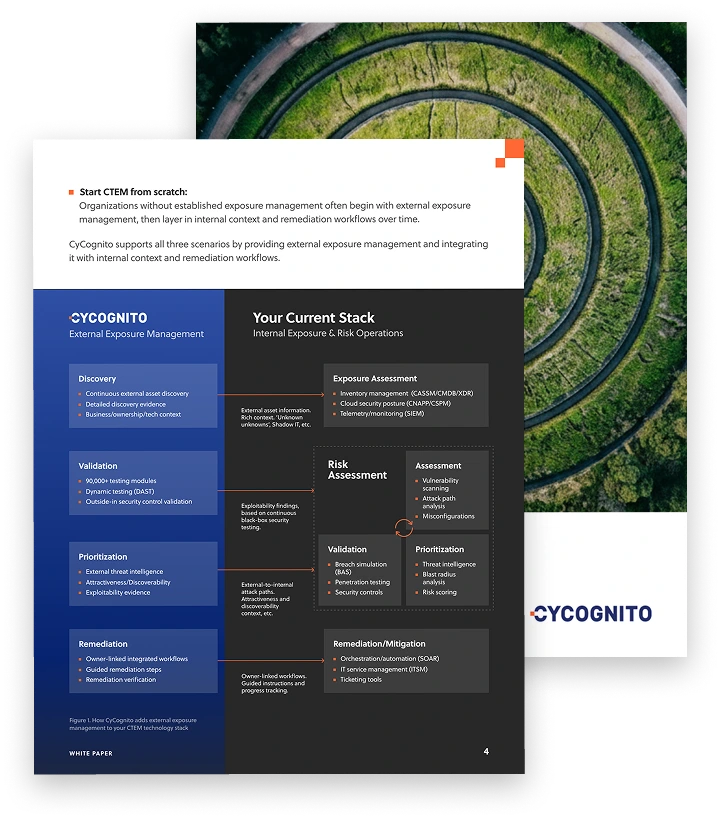
CTEM breaks when it turns into vulnerability chasing. Too many issues, weak proof, and constant escalation…
This whitepaper offers a practical starting point for operationalizing CTEM, covering what to measure, where to start, and what “good” looks like across the core steps.
Key Components of Threat Modeling
While the threat modeling process can vary somewhat depending on which types of threats a business seeks to manage and which categories of IT systems it needs to protect, core components usually include:
- Asset identification: First, cybersecurity professionals identify which assets they need to protect by analyzing their attack surface. Not all assets are necessarily subject to the same types of threats; for instance, systems that operate behind firewalls are not directly exposed to threats that originate from remote endpoints. To help in this process, data flow diagrams are often used to visualize how data moves through a system and to identify trust boundaries, which helps clarify where assets are located and how they interact.
- Threat identification and assessment: Based on the assets the organization needs to protect, cybersecurity teams determine which threats could impact them. They also use threat intelligence to assess the types of attackers, methods, and objectives associated with each threat. In addition, threat intelligence can provide insight into which threats are most relevant for a given business based on factors like its sector, size, or geographic location.
- Attack modeling: Through the attack modeling process, teams predict exactly how attackers might take action with the goal of executing a certain type of threat. Attack modeling covers how threat actors could initially gain access to a system, as well as what they’re likely to do once they are inside. Vulnerability assessment is also performed to evaluate how attackers might exploit weaknesses in the system.
- Countermeasures: Using findings from the attack modeling process, as well as knowledge of IT system architecture and design, teams identify and implement countermeasures like security controls and user education to mitigate the risk of attackers successfully acting on a threat. This includes integrating risk mitigation strategies to prioritize and manage risks effectively.
- Testing and validation: To confirm that countermeasures are effective, teams should test them by attempting to break into systems using the methods they anticipate threat actors employing. For even greater assurance, it can be helpful to hire external firms that will perform penetration tests without any insider knowledge of how the business’s systems are designed or which countermeasures are in place.
Tips from the Expert

Dima Potekhin, CTO and Co-Founder of CyCognito, is an expert in mass-scale data analysis and security. He is an autodidact who has been coding since the age of nine and holds four patents that include processes for large content delivery networks (CDNs) and internet-scale infrastructure.
Threat modeling is easy to talk about, but hard to put into practice effectively. Consider these tips to boost your team’s ability to excel at threat modeling:
- Focus on the practical, not the theoretical: There are an infinite number of hypothetical threats and attack scenarios, but only a fraction of them are likely to impact your business at a given time. Your goal as a threat modeler is to identify and assess the most relevant threats. Don’t waste time assessing risks that are purely theoretical and unlikely to cause an actual issue for your organization.
- Align threat modeling with system design: While you can add countermeasures to systems after the fact based on threat modeling findings, it’s more efficient to model threats during the design process. That way, you can implement architectural patterns that harden systems against threats from the start.
- Know your threat actors: The more you know about exactly who is most likely to carry out attacks against your business and how they will proceed, the more effectively you can block them. This is why threat intelligence adds crucial context to threat modeling.
- Seek objective assessments of threat management: The best way to validate threat modeling’s effectiveness is to ask people who weren’t involved in the process to analyze results. This allows you to avoid the inherent subjectivity that results from having engineers evaluate their own work. It also brings in a critical third-party perspective, which may help your teams identify threats they hadn’t thought about.
Benefits of Threat Modeling
Threat modeling offers two key, overarching benefits:
- Structured threat assessment: Modeling threats in a structured, systematic way provides a means of thinking about them consistently and holistically. By extension, the modeling process helps teams discover cybersecurity risks or weaknesses they might not otherwise have considered. It also provides a comprehensive, big-picture understanding of how threats map onto IT assets, which can be easy to miss when threat management is ad hoc. This structured approach enables a detailed analysis of threats and vulnerabilities, allowing for in-depth evaluation and more effective development of security controls and mitigation strategies.
- Proactive threat management: Threat modeling provides a way of getting ahead of threats by anticipating how attackers may exploit them. The result is the ability to detect and mitigate weaknesses before attacks occur. Not only does this approach reduce risk, but it’s also more efficient (because it typically requires fewer resources and causes fewer disruptions to prevent an attack than to respond to one after the fact).
Beyond these inherent benefits, threat modeling may also help meet compliance goals, especially in cases where regulations require businesses to assess risks systematically. For instance, regulatory frameworks such as the Health Insurance Portability and Accountability Act (HIPAA) Security Rule require covered entities to conduct a thorough risk assessment of potential risks and vulnerabilities to the confidentiality, integrity, and availability of electronic protected health information. Additionally, the National Institute of Standards and Technology (NIST) SP 800-53 includes the RA-3 (Risk Assessment) control, which requires organizations to identify threats to and vulnerabilities of organizational information systems, directly mapping to threat modeling activities. Threat modeling can help meet the risk analysis requirements of these regulations.
Steps in the Threat Modeling Process
To put threat modeling into practice, cybersecurity professionals typically implement the following core processes.
Define Objectives
First, teams decide which threats they want to defend against, and which systems they need to assess for vulnerability to those threats.
Assess Systems
Engineers build diagrams of IT systems’ architectures and components, including access points, and use visual indications to highlight critical areas in the diagrams. This information helps provide a comprehensive picture of how the systems work, where entry points exist, and how attackers can move within systems after breaching their perimeters.
Identify Potential Threats
In addition to analyzing systems for weaknesses, cybersecurity professionals must evaluate the nature of the threats they seek to protect against. Criminal profiling can be used to anticipate attacker behavior by developing a model of potential attackers’ motivations and capabilities. The threat assessment process involves taking stock of which types of damage a threat could cause, how attacks based on the threat typically play out, and which types of countermeasures are effective in stopping the threat.
Formulate Countermeasures
After assessing both systems and threats, teams can develop countermeasures that mitigate the threats. Countermeasures should be more than just generic mitigations (like enforcing perimeter-level authentication controls within an application); they should go deeper by considering how the unique architectural traits of the system in question can help protect against threats (for instance, in a microservices app, countermeasures might include service-to-service authentication as well as perimeter-based authentication, as a way of mitigating lateral movement).
Validate and Assess Results
The final step in threat modeling is to analyze the result of the process. As noted above, analysis often includes testing (either by internal teams or third-party “white hat” hackers) and conducting vulnerability evaluation to identify any remaining weaknesses, which evaluates the extent to which systems’ resilience against relevant threats has increased. It may also be important to consider whether threat mitigations and security controls align with relevant compliance requirements that affect the business.
Popular Threat Modeling Frameworks
To help structure the threat modeling process, businesses may choose to follow a threat modeling framework. These frameworks define key types of threats to consider, and some also include guidance on threat remediation.
Popular examples of threat modeling frameworks include:
- STRIDE: Developed by Microsoft, STRIDE is one of the oldest and most widely used methodologies for threat modeling. It focuses on six categories of threats: spoofing, tampering, repudiation, information disclosure, denial of service, and elevation of privilege.
- PASTA: Process for Attack Simulation and Threat Analysis (PASTA) is a seven-step, risk-centric methodology that aligns business objectives with technical requirements. It incorporates compliance issues and business analysis into the threat modeling process, providing a dynamic threat identification and scoring process that helps organizations respond to threats in ways that limit both technical risks and their impact on business goals.
- LINDDUN: LINDDUN focuses specifically on privacy threats, analyzing categories such as linkability, identifiability, non-repudiation, detectability, disclosure of information, unawareness, and non-compliance. It uses threat trees (graphical representations of how threat actors may pursue a goal) to help select relevant privacy controls, making it especially valuable for organizations that develop most of their software in-house and can modify internal architectures to mitigate threats.
Visual Representations in Threat Modeling
Visual representations play a pivotal role in the threat modeling process, enabling security teams to gain a clearer understanding of how potential threats could impact their systems. One of the most widely used visual tools is the data flow diagram (DFD), which maps out how data moves through an application or IT environment. By illustrating the flow of data between different components, DFDs help security professionals pinpoint potential vulnerabilities, such as areas where information disclosure might occur or where unauthorized access could be possible.
Another essential visual tool is the attack tree. Attack trees break down the various ways an attacker might exploit a system, presenting each possible attack vector as a branch in the tree. This approach allows security teams to systematically analyze potential threats and prioritize mitigation efforts based on the most likely or impactful attack paths. Attack trees are especially useful for identifying weak points in complex systems and for defining countermeasures that address specific attack scenarios.
The Microsoft Threat Modeling Tool is a leading example of a threat modeling tool that leverages visual representations, such as DFDs and attack trees. By providing intuitive diagrams and visual cues, the tool helps security professionals and non-security experts alike to identify potential threats, understand data flow, and develop effective strategies to mitigate security risks. These visual aids not only make the threat modeling process more accessible but also enhance collaboration across teams, ensuring that all relevant threats are considered and addressed.
Threat Modeling vs. Threat Intelligence
We mentioned threat intelligence above, but let’s talk about it and its relationship to threat modeling a little more.
Threat intelligence is information about threat actors’ motives, methods, and tools. It’s valuable because it is based on real-world information (typically drawn from threat actor activity on the Dark Web and evaluation of actual attacks carried out by specific threat actor groups) that provides insight into exactly what attackers are currently doing.
In this way, threat intelligence adds vital context that can help security teams predict which types of threats are most likely to turn into attacks against their organization, who is most likely to carry them out, and which techniques and tools the attackers will use. This information can be tremendously useful when planning countermeasures.
That said, threat intelligence data is often incomplete, since it’s impossible to know exactly what every threat actor is planning. Threat trends also change constantly, so attack methods that were popular at one point in time (and the countermeasures that worked against them) may be irrelevant today.
This means that it’s unrealistic to expect to be able to contextualize every threat modeling exercise with complete knowledge of threat actor behavior. But when available, threat intelligence is highly valuable for aligning threat modeling with up-to-date, real-world threat scenarios.
The Limitations of Threat Modeling
Using threat modeling to anticipate attacker behavior can be a very effective way of mitigating threats proactively. But it’s far from perfect.
The greatest limitation of threat modeling is that it’s only effective at modeling the threats and attack scenarios that teams are able to envision. There’s always a chance that threat actors will attack systems in ways that cybersecurity professionals didn’t consider.
Another drawback of threat modeling is that it’s a hands-on process that is difficult to automate fully. While some aspects of the process (like analyzing system architectures) can be largely automated, it still takes significant time and effort for security experts to sit down and think about the threats they need to manage and how best to mitigate them. Because of this effort-intensive process, threat modeling can be challenging to scale, and most organizations only have the capacity to model threats periodically (such as once every few months). Integrating threat modeling directly into fast-moving, continuous processes, like the software release cycle, is unrealistic.
Common Threat Modeling Challenges
Effective modeling of threats can be further hampered by the following challenges:
- Threat assessment bias: When identifying and assessing threats, engineers can have a tendency to focus on threat types of features that they are most familiar with. This leads to gaps in threat management.
- System assessment bias: Similarly, teams may have preconceived notions about how IT systems they manage are supposed to work, or which security controls the systems should have in place. Here again, the result may be a lower ability to consider vulnerabilities that attackers might notice, but that are not on the radars of the teams defending against them.
- System complexity: Modern systems, such as microservices-based applications, tend to be highly complex. Modeling threats and attack scenarios across the various components and dependencies within these systems is often very challenging.
- Specialized expertise requirements: Modeling threats effectively requires expertise not just in cybersecurity, but also in software design. Given that security and software engineering are often siloed domains within many businesses, it can be tough to source engineers who have the requisite skills to excel at threat modeling.
Best Practices for Reliable, Efficient Threat Modeling
The good news is that it’s possible to overcome challenges like those described above by adhering to key best practices:
- Automate threat modeling processes: While it’s not possible to automate threat modeling fully, some processes within threat modeling operations, such as identifying architectural components within systems and summarizing threat intelligence, can be automated to save time and improve consistency. When selecting a threat modeling tool, look for key features such as automation, integration with development tools, and scalability to support enterprise needs. Some tools also offer an enterprise version with advanced capabilities, security libraries, and enhanced support for larger organizations.
- Model threats regularly: Rather than treating threat modeling as a one-off or ad hoc activity, schedule regular threat modeling sessions.
- Include multiple types of stakeholders: Threat modeling shouldn’t be the purview of cybersecurity professionals alone. Software engineers, systems architects, and non-technical representatives of the business (who can weigh in on how threats translate to business risks) also have vital input to offer.
- Prioritize threats based on severity level: Not all threats pose the same level of risk to a business. Threat modeling efforts should focus on the most dangerous threats, based on factors like how much disruption they could potentially cause or how vulnerable systems are to them.
- Leverage free threat modeling tools: Tools like OWASP Threat Dragon run as both a web app and desktop application, providing flexibility for different user needs and making it easier for teams to adopt threat modeling practices.
Measuring the Effectiveness of Threat Modeling
Assessing the effectiveness of your threat modeling process is crucial for ensuring that you properly identify and mitigate security risks. One practical approach is to track the number of potential threats discovered and addressed over time, using metrics such as the Common Vulnerability Scoring System (CVSS) to evaluate the severity of each identified vulnerability. This quantitative analysis helps security teams prioritize their mitigation efforts and allocate resources where they are needed most.
Regular security audits and penetration testing are also vital for measuring the success of threat modeling. These activities can uncover weaknesses or vulnerabilities that may have been overlooked during the initial threat analysis, providing a feedback loop for continuous improvement.
Free threat modeling tools, such as OWASP Threat Dragon, further support this process by offering structured workflows for identifying and mitigating potential threats. These tools often include built-in reporting features that help security teams monitor progress and demonstrate improvements in their organization’s security posture. By consistently measuring and refining their threat modeling process, organizations can ensure that their defenses evolve alongside the ever-changing threat landscape.
Threat Modeling with CyCognito
Threat modeling can only protect what you know exists. Every unknown asset, forgotten subdomain, and inherited third-party exposure sits outside the model and outside the countermeasures it produces.
CyCognito is a leading exposure management platform that continuously discovers your full external footprint and validates what within it is actually exploitable, giving threat modeling exercises a complete and accurate picture of the attack surface to model against, starting from nothing more than your organization’s name.
- Discovers internet-facing assets across domains, cloud, APIs, subsidiaries, shadow IT, and third-party exposure, so threat models start from a complete external picture rather than a partial inventory
- Runs 100,000+ active security tests across 35+ threat categories, identifying the actual weaknesses an attacker would chain together rather than theoretical ones
- Validates exploitability continuously, reducing critical findings from 25% of identified issues to the 0.1% confirmed as actually exploitable
- Maps how exposures connect into attack paths from external asset to internal target, surfacing the chains threat models often miss
- Routes validated findings to the right business owner with the evidence needed to act, closing the loop between modeled threats and real fixes
CyCognito typically uncovers an attack surface up to 20x larger than previously known, exposing the unknowns most threat models never get the chance to consider.
If you want to see CyCognito in action, click here to schedule a 1:1 demo.
Frequently asked questions about threat modeling
What makes VAST different from other threat modeling frameworks?
Visual, Agile, and Simple Threat (VAST) modeling is built around automation inside CI/CD pipelines, which makes it a better fit for agile environments than frameworks designed for periodic, manual review. It scales with development velocity instead of slowing it down, and it embeds threat analysis directly into the same workflow developers already use to ship code.
Why is it cheaper to address security during design than after deployment?
Fixing a design flaw before a single line of code is written is dramatically cheaper than patching a live system after a breach. Pre-coding fixes are essentially free changes to a diagram.
Post-breach fixes involve incident response, downtime, customer notification, regulatory exposure, and the engineering cost of changing a system already in production. The earlier the flaw is caught, the smaller the bill.
What are attack trees and how do they support threat modeling?
Attack trees are diagrams that visualize the different paths an attacker might take to reach a specific goal, like stealing a database or compromising an admin account. Each branch represents a possible route, with sub-branches breaking down the steps required. They help security teams reason systematically about how an attack could unfold and prioritize the countermeasures that block the most likely paths.
How are threats prioritized after they are identified?
Identified threats are ranked by likelihood and impact using scoring systems like CVSS or DREAD. CVSS produces a severity score based on technical characteristics of the vulnerability. DREAD scores threats across five dimensions: damage, reproducibility, exploitability, affected users, and discoverability. Both give teams a structured way to focus remediation effort on the threats that pose the greatest real risk.