
Modern AI technology, such as large language models (LLMs) and AI agents, has created a raft of opportunities for threat actors to expand the speed, scope, and complexity of their attacks. As a result, organizations must now contend with a novel challenge: Offensive AI, meaning the use of artificial intelligence to accelerate cyberattacks.
Indeed, research from IBM found that a quarter of successful breaches are now assisted by AI, a figure that more than doubled in just a year’s time. This data point underscores how rapidly offensive AI has changed the cybersecurity landscape and the urgency for cybersecurity professionals and security teams of developing an effective response strategy.
To provide guidance, this article explains what offensive AI is, how its core components and workflows accelerate cyberattacks, and how defensive AI, practical defense strategies, and expert guidance can help security teams adapt to an evolving threat landscape.
What is offensive AI?
Offensive AI (also known as adversarial AI) is the use of artificial intelligence to help automate and scale cybersecurity attacks. Typically, threat actors who use offensive AI leverage three distinct types of resources:
- AI models, which can help detect risks and vulnerabilities, as well as develop exploits.
- AI agents, which are capable of autonomously testing systems for vulnerabilities, then carrying out attacks.
- Harnesses, which serve as orchestration layers for AI tools. In the context of offensive AI, harnesses can help turn generic AI models and agents into systems optimized for malicious hacking.
Threat actors often also use traditional, non-AI-based exploit kits and tools alongside offensive AI for reconnaissance and attack purposes. However, incorporating AI into the most complex stages of a cyberattack, such as the deployment of exploits or the creation of custom malware, allows threat actors to carry out attacks much faster.
Not only that, but offensive AI has also helped to lower the barrier to entry for aspiring threat actors. Whereas malicious hacking once required specialized cybersecurity and software development skills, offensive AI tools allow attackers with limited technical expertise to find and exploit vulnerabilities successfully.

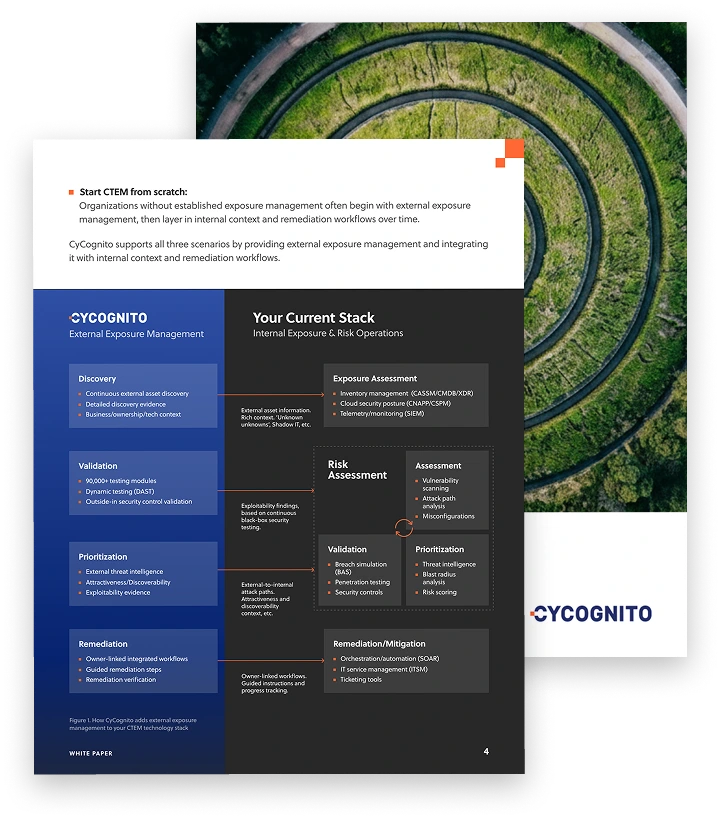
Operationalizing CTEM Through External Exposure Management
CTEM breaks when it turns into vulnerability chasing. Too many issues, weak proof, and constant escalation…
This whitepaper offers a practical starting point for operationalizing CTEM, covering what to measure, where to start, and what “good” looks like across the core steps.
Steps in the offensive AI process
The key steps in an offensive AI workflow resemble those of any malicious hacking process. The difference, however, is how they are carried out.
Here’s a look at how threat actors typically approach the main steps in the offensive AI process:
- Recon and enumeration: This step, which focuses on identifying systems to attack and locating exposure points, can be assisted by AI, although more traditional types of tools (like network and endpoint scanners) can also meet this need.
- Vulnerability discovery and analysis: During this step, vulnerability scanners, with help from AI models and agents capable of determining the exploitability of flaws and charting attack paths, identify security weaknesses in a target system.
- Exploitation and initial access: Next, attackers exploit a vulnerability to gain access to a system. If an exploit kit (which includes pre-made exploit code) exists for a target system or vulnerability, attackers will often employ it. If it doesn’t, they can use AI to create and deploy custom exploit code.
- Credential harvesting and data exfiltration: Once inside a system, attackers often harvest credentials, such as usernames and passwords, and other sensitive data. This is another area where they may rely on traditional tools, like infostealers, but where they can also leverage AI models and agents to engineer custom attacks if necessary.
- Privilege escalation: Attackers may also attempt to escalate their privileges inside a breached system to gain a higher level of access. Exploit kits can help with this process, as can AI models capable of identifying vulnerabilities in software configurations or authentication protocols.
- Lateral movement: By discovering and exploiting additional vulnerabilities — either using conventional methods or AI — threat actors move laterally within the breached system.
- Persistence and command-and-control (C2): Often, threat actors seek to establish a permanent presence within the system they have breached. AI can be useful here as well, especially in cases where establishing persistence requires the discovery and exploitation of previously unknown flaws.
How offensive AI accelerates AI-driven attacks and cyberattacks
Offensive AI can dramatically speed up virtually every aspect of the cyberattack process. Consider, for example, how attackers can employ AI to accelerate the following processes:
- Phishing and social engineering: Generative AI tools can create and deploy phishing content — including not just basic content like emails, but also voice or video impersonations. They can also support AI-powered reconnaissance by aggregating data from social sources and other external sources to tailor targeted social engineering campaigns, such as lures that use face swapping. Threat actors can then leverage this content as part of social engineering attacks in which they trick a business’s employees or customers into handing over sensitive information.
- Vulnerability discovery: While traditional vulnerability scanners are effective at detecting vulnerabilities that have been reported in public vulnerability databases, AI excels at identifying previously unknown vulnerabilities — which pose an especially serious risk to organizations because they are often not even aware that they exist. These offensive workflows can uncover additional attack vectors across an expanded attack surface.
- Exploit generation: Typically, exploiting a vulnerability requires the deployment of code that takes advantage of a flaw in a software system. Exploit kits that contain this code are often available on the Dark Web for known vulnerabilities. When dealing with unreported vulnerabilities, however, AI can help attackers generate custom exploits.
- Malware deployment: AI can also assist in the deployment of exploit code or other malware, including in ways designed to evade detection.
- Privilege escalation and lateral movement: Once inside an environment, attackers can use AI to map and optimize exploitation chains that support multi-step compromise.
- Persistence and command-and-control: AI can help automate stealthier footholds and communications. New threats now include attacks against AI assistants and other AI systems embedded in business workflows.
Put together, the use of AI to speed up processes like these means that offensive AI allows threat actors to operate at machine speed and launch advanced attacks with unprecedented levels of speed. Indeed, Booz Allen Hamilton has found that the typical window between initial access and extended system compromise is now just thirty minutes, with some attacks playing out in a matter of seconds. In the past, carrying out complex attacks might have taken days or weeks, even for experienced threat actors.
Note, too, that offensive AI tools are increasing the threat posed by inexperienced attackers. In the past, threat actors who possessed limited technical skills were often denigrated as “script kiddies” because they relied on scripts developed by others to find and exploit vulnerabilities. In the age of offensive AI, however, script kiddies with no coding skills and a primitive understanding of exploits have become capable of launching sophisticated attacks. Prompt injection is also an emerging attack vector against AI assistants because manipulated inputs can override or influence system prompts and change model outputs.
How to defend against offensive AI and enhance AI security
In a world where threat actors have access to powerful AI tools, how can organizations respond effectively?
The answer is to deploy defensive AI in ways that allow businesses to discover and remediate risks even faster than threat actors can exploit them. Doing so hinges on capabilities such as:
- Autonomous defense: Rather than relying on manual or deterministic, script-based processes to discover and mitigate risks, businesses must leverage AI models and agents capable of finding and patching flaws autonomously. Not only does autonomous defense speed remediation, but it also gives organizations the ability to find flaws they may not be explicitly searching for, since non-deterministic AI systems can operate effectively without requiring narrow, pre-scripted logic to guide them.
- Continuous threat modeling: Software systems change constantly, and attackers are constantly scanning them for risks. To keep pace, businesses must model threats continuously by evolving their threat models in real time. In this way, they ensure that the threats they prioritize always reflect the actual state of their systems, as well as emerging attack patterns tied to adversarial AI.
- Automated and continuous testing: In a similar vein, security tests should occur automatically and continuously. Every code or configuration change should trigger a new test to validate that the update hasn’t introduced a new vulnerability (or modified the exploitability of one that was previously known).
- Strategic risk prioritization: When attackers can discover and exploit vulnerabilities in minutes, patching every risk is not realistic. Instead, businesses must deploy defensive AI to help assess risks based on technical factors (such as their exploitability), as well as business considerations (like how much harm the exploitation of a given vulnerability would cause).
Offensive and defensive AI in the hands of defenders
Security teams gain these capabilities when they leverage the same types of offensive AI tools available to attackers as a means of defense. Specifically, security professionals should seek out AI solutions that deliver capabilities including:
- Real-world attack emulation: Using AI to drive techniques like AEV (Adversarial Exposure Validation) and CART (Continuous Automated Red Teaming), teams can simulate the efforts of real-world attackers. In turn, they can gain insight into the offensive AI techniques that threat actors may use to breach systems.
- Attack path analysis: AI can help to map and analyze attack paths, meaning the paths attackers are likely to follow as they move laterally within a breached system. AI is particularly valuable for predicting complex attack paths that involve multiple systems and/or multiple vulnerabilities.
- Exploit generation: Using AI-assisted exploit-development tools, legitimate security professionals can assess the feasibility of generating exploit code.
Although threat actors have access to these same types of offensive AI tools, security teams enjoy a couple of advantages in this context. One is that they are often able to leverage more advanced models, agents, and harnesses than those available to the typical threat actor, who often relies on generic AI systems.
Another key advantage is that businesses may be able to bear and justify higher token costs when using AI to detect and mitigate risks. For threat actors, carrying out attacks may simply not be worth the token price if the attacks are so complex as to require extensive use of AI models and agents.
For organizations seeking to improve their security posture, however, token spend is almost always justifiable if it helps prevent cyberattacks that could be very costly. This means that, by employing AI to close as many vulnerabilities as possible in real time, a business can make attacks so expensive (in terms of token costs) that threat actors will choose to move on to other targets.
Tips from the Expert

Rob Gurzeev, CEO and Co-Founder of CyCognito, has led the development of offensive security solutions for both the private sector and intelligence agencies.
CyCognito has been helping organizations adapt their security tools and strategies since the start of the modern AI era. Here are our tips for thriving in this brave new world:
- Know your threat actors: Knowing who is most likely to attack your organization, and which techniques they will employ, is critical for determining where to focus your defenses.
- Use AI for rapid defense and response: AI isn’t just a way to augment manual cybersecurity operations. Instead, businesses must embrace autonomous defensive AI solutions as a critical resource for ensuring that they can operate faster than attackers.
- Keep up-to-date with defensive AI tools and methods: The AI space is evolving rapidly, and the models and agents that were cutting-edge just months ago no longer are. It’s essential to monitor this landscape closely and adjust defensive AI tools and techniques as new solutions and best practices emerge.
Defending against offensive AI with CyCognito
CyCognito is an external exposure management platform that discovers every internet-facing asset from the outside in, tests each one continuously with 100,000+ deterministic checks, and runs AI agents on top that work the way an AI-equipped attacker does, finding and validating the attack paths scripted tests cannot.
This platform approach provides several key benefits, as the pentesting agents inherit everything the platform already knows about an asset: its business and tech context, how it connects to other assets, and more. That context makes each run more economical and more accurate, which, in turn, translates into broader coverage: the same kind of models, agents, and orchestration attackers use, applied to the whole attack surface continuously rather than to a handful of applications.
The key benefits include:
- Orchestrates models and agents through Target Graph™, a harness that plans each testing run based on factors like asset importance, history, tech attribution, and external threat intelligence
- Starts each AI run with the asset’s stack, exposed services, and business context already mapped, so no tokens go to reconnaissance and enumeration
- Skips known vulnerabilities and misconfigurations the deterministic layer has already confirmed or ruled out, and chains from the confirmed ones
- Reserves AI reasoning for complex work, such as multi-system attack paths, exploit chains, business-logic flaws, AI-specific issues (e.g., prompt injection against AI assistants), and more
- Delivers every confirmed finding prioritized by exploitability and business impact, with request, response, reproduction steps, and fix guidelines, routed to the asset’s owner
By keeping inventory and findings current with evidence, CyCognito cuts up to 90 percent of manual effort on reconnaissance and verification, and its AI agents inherit the same advantage. Connecting near-real-time exposure intelligence with AI pentesting also means rapid response, at machine speed, to shifts in the attack surface: new assets going live, config changes, emerging threats, and so on.
If you want to see CyCognito in action, click here to schedule a 1:1 demo.