
Generative and agentic AI introduce novel security threats, such as prompt injection, model data poisoning, and vulnerable AI agents. Conventional cybersecurity and governance frameworks don’t cover these risks, leaving many organizations struggling to secure modern AI systems.
Recognizing this gap, bodies like NIST, ISO, and OWASP built AI risk management frameworks to close it. Their recommendations give organizations a baseline for protecting AI assets and a common structure for assessing AI risk.
This article covers what these frameworks do, how they differ from conventional standards, which major ones exist today, and how to use Continuous Threat Exposure Management (CTEM) to put them into practice and comply with their requirements.
What is an AI risk management framework?
An AI risk management framework is a structured set of processes, controls, and governance practices designed to identify, assess, and mitigate risks in AI systems and infrastructure. This type of framework helps organizations understand the potential threats posed by AI technologies. It also guides them in establishing mechanisms for managing those risks throughout the development, deployment, and operation of AI applications.
Unlike traditional cybersecurity frameworks, AI risk management frameworks address risks that are unique to AI systems. These include threats such as prompt injection attacks, model poisoning, data leakage through large language models (LLMs), adversarial inputs, and unintended model behavior. Some AI frameworks also address broader concerns related to privacy, compliance, transparency, fairness, ethics, and accountability.
A well-designed AI risk management framework provides a consistent methodology for evaluating AI systems and determining whether they align with organizational security requirements, business objectives, and regulatory obligations. It enables organizations to move beyond ad hoc security practices to establish repeatable processes for managing AI-related risks at scale.
How risk management frameworks boost AI security
AI systems introduce new risks and attack surfaces that traditional security strategies are not able to address. AI risk management frameworks help organizations close this gap between conventional security and AI security by providing structured approaches for understanding and reducing AI-specific threats.
For instance, one key benefit of an AI risk management framework is improved visibility. Organizations often struggle to understand where AI is being used, what data AI systems can access, and how AI interacts with other critical systems. Frameworks help organizations inventory AI assets, document dependencies, and identify potential exposure points. This visibility serves as the foundation for effective security management.
Risk management frameworks also support proactive security measures. Rather than waiting for incidents to occur, organizations can continuously evaluate AI systems for vulnerabilities and emerging threats. Security teams can identify weaknesses before attackers exploit them, reducing the likelihood of successful attacks.
Another advantage is consistency. As AI adoption expands across departments and business units, security practices can become fragmented. A formal framework establishes common standards for risk assessment, governance, and mitigation, ensuring that all AI initiatives are evaluated according to the same criteria.
Finally, AI risk management frameworks help organizations align security efforts with compliance and governance requirements. As governments and industry bodies introduce new AI regulations, organizations increasingly face compliance mandates to document AI security processes and demonstrate responsible AI risk management practices. Frameworks provide the structure necessary to support audits, regulatory reviews, and internal accountability efforts.

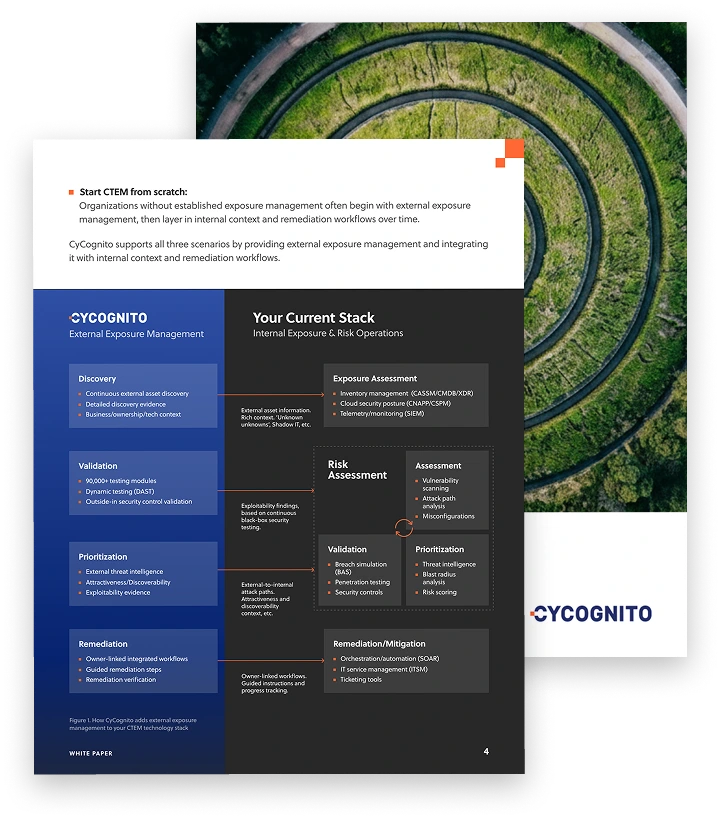
Operationalizing CTEM Through External Exposure Management
CTEM breaks when it turns into vulnerability chasing. Too many issues, weak proof, and constant escalation…
This whitepaper offers a practical starting point for operationalizing CTEM, covering what to measure, where to start, and what “good” looks like across the core steps.
Components of an AI risk management framework
Although specific frameworks vary, most AI risk management programs include several foundational components that work together to manage risk throughout the AI lifecycle.
Governance
Governance establishes the policies, roles, responsibilities, and oversight mechanisms required to manage AI risks effectively. It serves as the strategic foundation of an AI risk management program.
Effective AI governance begins with clearly defined ownership. Organizations should identify stakeholders responsible for AI development, deployment, security, compliance, and ongoing monitoring. Governance structures often include executive leadership, security teams, legal departments, compliance personnel, and AI practitioners.
Governance also involves developing policies that define acceptable AI usage, security requirements, risk tolerances, and compliance expectations. These policies help ensure that AI initiatives align with organizational objectives while maintaining appropriate safeguards.
Ultimately, strong AI governance promotes accountability and enables organizations to make informed decisions about AI adoption, risk acceptance, and resource allocation.
Detection
Detection focuses on identifying AI assets, vulnerabilities, exposures, and potential threats. Organizations cannot effectively manage risks that they do not know exist.
Detection activities often begin with creating an inventory of AI systems and associated assets. This inventory may include internally developed models, third-party AI services, open-source models, AI-powered applications, and supporting infrastructure. Importantly, detection mechanisms should be able to identify not just AI systems that an organization has officially adopted, but also “shadow AI,” meaning AI apps and services that employees may be using without the organization’s approval or knowledge.
In addition to detecting AI assets, businesses should also identify potential attack vectors and security weaknesses. Examples include exposed model endpoints, unsecured APIs, excessive permissions, sensitive training data, and vulnerable integrations with external systems.
Continuous monitoring is another critical aspect of detection. AI environments change rapidly, and new risks and exposures can emerge as models evolve, users interact in novel ways with systems, or threat actors develop new attack techniques. Ongoing monitoring helps organizations maintain visibility into their AI security posture.
Analysis and assessment
After identifying AI risks, organizations must evaluate their potential impact and likelihood. Analysis and assessment activities help security teams understand which risks pose the greatest threat to the organization.
Under AI risk assessment frameworks, analysis typically looks at multiple dimensions of risk, including security, privacy, compliance, operational resilience, and reputational impact. Teams may evaluate factors such as the sensitivity of data processed by an AI system, the potential consequences of model compromise, and the organization’s ability to detect and respond to incidents.
Consideration of exploitability is critical, too. Just because a vulnerability exists in an AI system doesn’t necessarily mean that attackers can take advantage of it. Teams should prioritize risks that are easily exploitable.
Comprehensive analysis provides the context necessary to make informed risk management decisions and allocate resources effectively.
Prioritization
Not all AI risks require the same level of attention. Prioritization helps organizations focus their resources on the risks that could cause the most significant harm.
AI risk prioritization typically involves evaluating both the severity of potential impacts and the likelihood of exploitation. Risks that could result in data breaches, regulatory violations, or critical business disruptions generally receive higher priority than lower-impact issues.
Organizations should also consider the business importance of the affected AI system. A vulnerability in a customer-facing AI application may warrant more urgent remediation than a similar issue affecting an internal experimental project, for example.
By establishing a structured prioritization process, organizations can reduce the risk of overlooking critical exposures while avoiding inefficient allocation of security resources.
Mitigation
Mitigation involves implementing controls and safeguards to reduce identified risks. This phase transforms risk assessment findings into actionable security improvements.
AI risk mitigation measures may include access controls, data protection mechanisms, model validation procedures, security testing, monitoring tools, and incident response processes. Organizations may also implement safeguards such as prompt filtering, output validation, model isolation, and secure development practices. Mitigation should not be viewed as a one-time activity. AI environments evolve continuously, requiring organizations to reassess risks and update controls as new threats emerge.
Also vital is validating that AI risks were successfully mitigated, and that the controls the organization implemented remain effective against evolving attack techniques and changing AI deployments.
AI risk management framework standards and examples
To date, several major frameworks and standards have emerged to provide guidance for organizations seeking to implement AI risk management programs. Here’s a look at three key frameworks.
NIST AI RMF
The AI Risk Management Framework (AI RMF) developed by the National Institute of Standards and Technology (NIST) provides a voluntary framework for managing risks associated with AI systems. It was released in early 2023.
The framework is organized around four core functions: Govern, Map, Measure, and Manage. Together, these functions help organizations establish governance structures, understand AI contexts, assess risks, and implement mitigation strategies.
One of the key strengths of the NIST AI RMF is its flexibility. Organizations can adapt the framework to different AI use cases, risk profiles, and operational environments. The framework also emphasizes trustworthiness, encouraging organizations to address security, reliability, privacy, transparency, and fairness concerns throughout the AI lifecycle.
ISO 42001
Released in late 2023, the International Organization for Standardization ISO/IEC 42001 is the first international management system standard specifically focused on artificial intelligence.
The standard provides requirements for establishing, implementing, maintaining, and continually improving an AI management system. It helps organizations integrate AI governance and risk management into broader organizational processes.
ISO 42001 places significant emphasis on accountability, documentation, conducting regular risk assessments, and continuous improvement. Organizations pursuing certification must demonstrate that they have formal processes for identifying AI risks, implementing appropriate controls, and monitoring the effectiveness of their AI management practices.
ISO 42001 is also notable because, unlike NIST AI RMF, it’s a certifiable standard. That means organizations can undergo third-party audits that examine their compliance with ISO 42001, providing a formal way of demonstrating strong AI governance.
OWASP AI security guidance
The Open Worldwide Application Security Project (OWASP) community has developed several resources (such as LLM risks guidance and agentic AI risks and mitigations) focused on AI and machine learning security. They’re not risk management frameworks per se, but they nonetheless provide guidance and standards for managing AI risks.
OWASP guidance emphasizes practical security risks affecting AI applications, including prompt injection, insecure model deployment, data poisoning, supply chain vulnerabilities, and excessive agency in AI systems. These resources help organizations understand how traditional application security concepts apply within AI environments.
Due to its technical depth, OWASP’s AI-focused guidance is particularly valuable for security practitioners and development teams seeking actionable recommendations for securing AI applications during design, development, and deployment.
Tips from the Expert

Rob Gurzeev, CEO and Co-Founder of CyCognito, has led the development of offensive security solutions for both the private sector and intelligence agencies.
Here are our tips for securing AI systems, based on real-world experience helping businesses protect AI at scale:
- Align AI governance with broader threat management processes: AI risk management and governance shouldn’t exist in a vacuum. They should be integrated into broader cybersecurity strategies, such as the use of CTEM to detect and mitigate security risks of all types on an ongoing, real-time basis.
- Establish AI-specific security and control requirements: Conventional cybersecurity tools and practices don’t cut it for protecting AI systems. Businesses need to evolve their security strategies and practices to address AI-specific risks.
- Continuously assess and validate AI-related exposures: One-off scans or periodic audits provide little assurance that organizations can detect and respond to risks in fast-changing AI systems before malicious actors exploit them. Instead, assessment and validation must take place in real time, using continuous exposure management processes.
- Validate AI systems through ongoing testing: Implementing risk mitigations doesn’t guarantee that they actually work. It’s critical to perform ongoing, automated security testing and adversarial validation to confirm that risks remain under control.
Challenges in implementing AI risk management frameworks
While AI risk management frameworks provide valuable guidance, organizations often encounter challenges when attempting to implement them effectively.
Lack of established standards
Although frameworks such as NIST AI RMF and ISO 42001 are gaining traction, AI governance remains a relatively young discipline. Organizations may struggle to determine which standards to adopt or how to integrate multiple frameworks into a cohesive program.
The evolving regulatory landscape further complicates implementation efforts, as organizations must prepare for changing requirements and expectations.
Novelty of AI security risks
Many AI security threats differ significantly from traditional cybersecurity risks. Prompt injection, model manipulation, adversarial attacks, and AI-specific data leakage scenarios require specialized expertise that many organizations are still developing.
Security teams may lack the tools, methodologies, and experience needed to identify and address these emerging threats effectively.
Fast-changing AI technology
AI technologies evolve at an extraordinary pace. New models, deployment architectures, and attack techniques emerge regularly, creating challenges for organizations attempting to maintain current risk assessments and security controls.
Risk management programs that are not designed for continuous adaptation can quickly become outdated.
Gap between traditional AppSec and AI security
Many organizations rely on established application security programs to protect software systems. However, AI applications introduce risks that traditional AppSec methodologies may not fully address.
For example, conventional security testing may identify vulnerable APIs or access control issues but fail to detect prompt injection vulnerabilities or model-specific weaknesses. Bridging this gap requires organizations to expand security practices, develop new expertise, and integrate AI-specific controls into existing security workflows.
Tailoring AI risk management for your organization
There is no universal AI risk management framework that covers every potential AI risk for every organization. While risk management frameworks provide a useful starting point for developing an AI security strategy, effective programs must be tailored to an organization’s specific business objectives, risk tolerance, regulatory obligations, and AI usage patterns.
Organizations should begin by developing a comprehensive inventory of AI assets and understanding how those systems interact with sensitive data and critical business processes. Risk assessments should reflect the unique threats and operational realities associated with each AI deployment.
They should also select security controls based on identified risks rather than applying them uniformly across all systems. High-risk AI applications may require extensive monitoring, validation, and governance measures, while lower-risk deployments may warrant a more streamlined approach.
Most importantly, businesses should treat AI risk management as an ongoing process rather than a one-time project. As AI technologies evolve and threat landscapes change, organizations must continuously assess exposures, validate security controls, and refine governance practices. By adopting a risk-based approach and aligning security efforts with organizational goals, businesses can maximize the benefits of AI while maintaining strong security and resilience.
Why AI risk management frameworks rely on exposure management
No matter how a business chooses to implement an AI risk management framework, Continuous Threat Exposure Management (CTEM) is an essential practice for mitigating AI risks.
CTEM allows organizations to scan for, identify, assess, and mitigate AI risks in real time. CTEM is valuable for protecting any type of IT asset, but it’s especially critical for securing AI, given the fast-changing nature of AI systems.
To put this another way, AI risk management frameworks can provide guidance on how to structure AI security strategies. But CTEM plays a vital role in putting AI security into practice by providing the capabilities necessary for actually detecting, assessing, and responding to risks as they arise across complex, dynamic AI systems.
Best practices for adopting an AI risk management framework
The following practices can help businesses leverage AI risk management frameworks to maximum effect:
Align AI risk management with organizational AI strategy
Ensure AI risk management efforts support broader business objectives, governance requirements, and AI adoption goals. Aligning risk management with organizational strategy helps prioritize resources and security controls based on the most important AI initiatives.
Plan for changes to AI systems or technology
AI technology is young and still evolving rapidly. To this end, establish processes for continuously reassessing risks as AI models, tools, and deployment environments evolve. Proactive planning helps organizations adapt security controls and governance practices to address emerging threats and changing business needs.
Integrate AI risk management into the SDLC
Embed risk assessment, security testing, and governance reviews throughout the software development lifecycle rather than treating them as separate, siloed activities. This approach helps identify and mitigate AI risks earlier, reducing the likelihood of security issues reaching production environments.
Leverage automation to streamline AI risk management
While AI risk management frameworks typically don’t require automation, the scale and complexity of AI systems make it very difficult to detect and address risks manually. Organizations should use automated tools to discover AI assets, monitor exposures, validate security controls, and detect emerging risks. Automation improves visibility, reduces manual effort, and enables organizations to manage AI risks more consistently and at scale.
Addressing AI security risks with CyCognito
NIST, ISO, and OWASP tell you how to structure AI risk management. None of them can tell you which AI systems your organization is exposing to the internet right now, or which of those exposures an attacker could actually reach. CyCognito is a leading external attack surface management platform that operationalizes an AI risk management framework, continuously discovering and validating every internet-facing AI asset you run, starting from nothing more than your organization’s name.
- Discovers AI assets across your external footprint, including model endpoints, unsecured APIs, MCP servers, and shadow AI, without seeds or a prior inventory
- Continuously validates whether discovered AI exposures are actually exploitable, giving the assessment phase evidence instead of theoretical severity
- Prioritizes findings by attacker reachability and business impact, so the highest-risk AI systems reach the top of the queue first
- Confirms that implemented mitigations still hold through ongoing adversarial testing, rather than assuming a one-time control remains effective
- Routes validated findings to the right owners and tracks remediation through to verified closure
Continuous validation reduces what appears critical from roughly 25% of findings to the 0.1% confirmed as actually exploitable, turning a framework’s guidance into an evidence-based decision about where to act first.
If you want to see CyCognito in action, click here to schedule a 1:1 demo.