
Threat modeling has long been a key practice for cybersecurity teams seeking to take a proactive approach to risk detection and mitigation.
In the era of generative and agentic AI, however, threat modeling has changed significantly. AI has introduced new challenges when modeling threats, as well as new imperatives to make threat modeling more continuous and proactive than ever before.
Read on for details as we explain what threat modeling means, the key steps in the process, and how organizations can derive the greatest value from threat modeling in the modern cybersecurity landscape.
What is threat modeling?
Threat modeling is the practice of systematically identifying, assessing, and remediating risks within software systems.
The major goal of threat modeling is to identify security weaknesses that arise from design flaws and oversights within a system, predict how attackers are most likely to exploit them, and take steps to mitigate them. In this way, threat modeling helps teams to respond to risks proactively, rather than waiting until an actual attack occurs.
When performed routinely and consistently, threat modeling plays a core role in enabling a secure software development lifecycle (SSDLC). Integrating modeling early in the software development life cycle is more cost-efficient because it allows teams to surface issues before they become harder to fix. It also enables the rapid discovery and management of risks whenever they arise due to changes in system design or configuration, which is simpler and less disruptive than managing them after system updates have been deployed into production.
Threat modeling vs. risk assessment
It’s important not to conflate threat modeling with risk assessment.
The latter term refers to any type of activity whose goal is to identify and manage security risks within systems. Threat modeling can be considered one form of risk assessment, but it’s not the only way of proactively checking for, assessing, and mitigating risks.
Pentesting and vulnerability scanning are examples of other risk assessment techniques. However, whereas those methods focus primarily on detecting risks that arise from issues like coding flaws, threat modeling centers on weaknesses that result from a system’s architecture, internal data flows, and integrations with other systems.
The insights that threat modeling reveals also typically inform different groups of stakeholders. Modeling threats can help system architects to implement more secure designs, while pentesting and vulnerability scanning are more useful for developers and security engineers tasked with remediating individual exploit risks.
Because threat modeling has a different focus from other forms of risk assessment, it’s best to employ the practice as part of a broader risk assessment strategy. Threat modeling is one major pillar of effective risk assessment, but it’s not the only one.

Operationalizing CTEM Through External Exposure Management
CTEM breaks when it turns into vulnerability chasing. Too many issues, weak proof, and constant escalation…
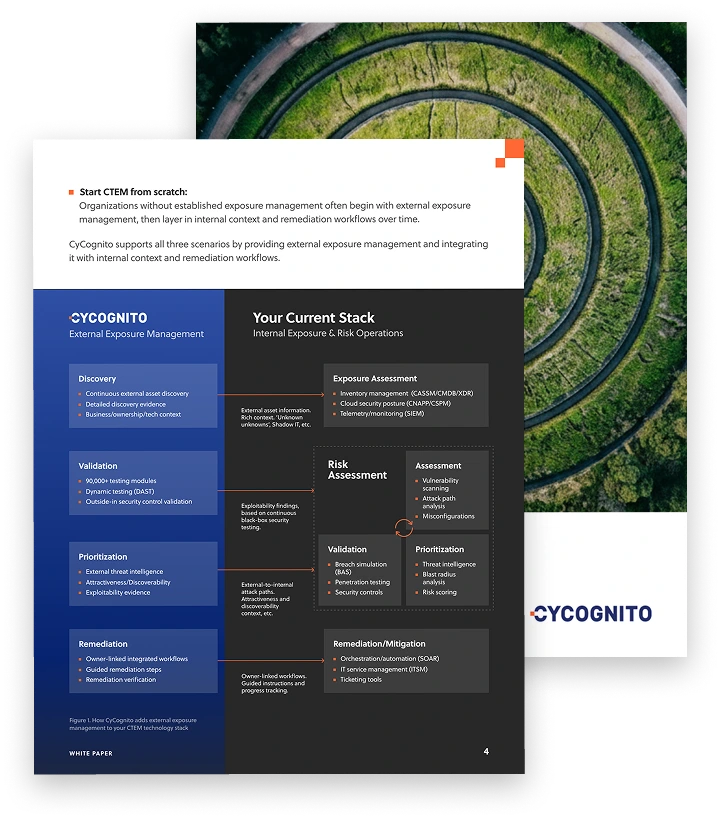
This whitepaper offers a practical starting point for operationalizing CTEM, covering what to measure, where to start, and what “good” looks like across the core steps.
The role of threat modeling in modern cybersecurity
While threat modeling has long been a valuable means of getting ahead of risks, it has become increasingly critical in recent years due to threat actors’ embrace of AI as a means of dramatically reducing the time it takes to exploit flaws. Whereas complex breaches once took weeks or months, they can now occur in a matter of minutes, making it vital for organizations to identify potential security risks and vulnerabilities in modern IT systems before attackers can exploit the flaws.
Threat modeling helps by empowering security teams with the following capabilities:
- Identifying security weaknesses before deployment: By modeling threats, teams can identify the most vulnerable facets of a system before it goes into production.
- Supporting secure-by-design development practices: Threat modeling helps breed a culture in which system architects and developers design software to be secure by default as a core part of the software development lifecycle, as opposed to building systems and managing security risks after the fact.
- Prioritizing security investments based on likely attack paths: With threat modeling, organizations can better understand not just where vulnerabilities exist, but also how attackers are most likely to exploit them and move laterally once they’re inside a system. This context helps inform risk prioritization decisions during the remediation process.
- Adapting to cloud-native, AI-driven, and rapidly changing environments: In a world where software updates can roll out daily or even hourly, threat modeling (especially when it’s deployed continuously) helps ensure that rapidly changing systems remain secure.
- Improving collaboration between diverse teams: Threat models can serve as the foundation for discussions around secure design principles and practices among diverse stakeholders, including system architects, developers, IT operations, and security teams.
Threat modeling process and steps
The threat modeling process is based on the following series of distinct steps that allow teams to find, evaluate, prioritize, and respond to risks:
- Define system scope: Establish the system’s components, boundaries, data flows, users, dependencies, and assets that the threat model will cover, and document them as the foundation of the security context.
- Identify sensitive assets: Determine which data, resources, and system functions require protection from compromise or misuse.
- Define trust boundaries: Identify where data or control moves between components with different levels of trust or security.
- Inventory potential threats: Identify plausible threats, attack vectors, and threat actors that could affect the system, then analyze threats across the design to enumerate potential threats systematically.
- Assess and prioritize threats: Evaluate each threat based on its ease of exploitability, the attack paths of which it could be part, and its potential impact on the business to determine which risks require the most attention.
- Define and deploy remediations: Select and implement security controls or design changes that reduce identified risks to an acceptable level. This process also includes defining countermeasures and documenting mitigations for each identified threat.
- Validate mitigations through testing: Test security controls and mitigations to confirm they effectively address the identified threats.
- Update the threat model: Regularly revise the threat model as the system, threats, dependencies, and security controls change. The goal is to produce a “living” threat model, along with living documentation, that evolves continuously with the system.
Major threat modeling methods and techniques
Threat modeling is most effective when organizations approach it in a standardized, consistent way. For that reason, most teams adopt a threat modeling framework, which defines core principles and practices to guide the threat modeling process.
The three main threat modeling methods include:
- STRIDE: Categorizes potential threats into common types such as spoofing, tampering, repudiation, information disclosure, denial of service, and elevation of privilege.
- PASTA: Takes a risk-centric approach that analyzes threats in the context of business objectives, application architecture and attacker goals.
- DREAD: Scores and prioritizes threats based on factors such as damage potential, reproducibility, exploitability, affected users, and discoverability.
Choosing the best threat modeling technique for a given organization requires weighing security goals, system complexity, team members’ expertise, and development processes. For example, STRIDE is a practical choice for development teams that need a structured way to identify common application threats, while PASTA is generally better suited to organizations that want to connect technical threats to business risks and attacker objectives. DREAD can help teams prioritize identified threats by severity, although its subjective scoring can make results less consistent.
Note, too, that organizations can, and often should, combine threat modeling techniques or frameworks. For instance, they could use STRIDE to identify threats and categorize them systematically, while also employing DREAD to help prioritize risks.
Common threat modeling mistakes
Beyond choosing the right method, getting the most from threat modeling requires avoiding missteps that can undercut the effectiveness of the process or the results it yields. In particular, it’s important to avoid mistakes like the following:
- Modeling on a periodic basis only: In the past, threat modeling was often an activity that took place only occasionally, with teams creating or updating models just a few times a year. Today, however, this approach is no longer effective, due both to the velocity of modern release cycles and to attackers’ ability to execute breaches much faster with help from AI. Organizations must now strive to model threats continuously by updating threat models whenever systems change.
- Detecting threats but failing to remediate: Finding risks and predicting attack paths doesn’t translate to proactive security unless teams also take the additional step of mitigating risks by changing system design parameters to drive actionable security improvements.
- Failing to consider threat exploitability: Just because a threat exists doesn’t mean attackers are likely to exploit it. Teams should instead use exploit intelligence to evaluate the probability that exploitation will actually take place, then prioritize risks accordingly.
- Failing to collaborate: Threat modeling is most impactful when it brings together key stakeholders, including system architects, developers, and security professionals, to instill a commitment to secure-by-design practices across all stages of the SSDLC. A common failure mode is treating the practice as solely a security responsibility, so it’s important not to limit participation to only one team or role.
Tips from the Expert

Dima Potekhin, CTO and Co-Founder of CyCognito, is an expert in mass-scale data analysis and security. He is an autodidact who has been coding since the age of nine and holds four patents that include processes for large content delivery networks (CDNs) and internet-scale infrastructure.
Maximize the value of threat modeling on your organization’s security posture by embracing these practices:
- Implement continuous threat modeling: Keeping pace with threats in an era when attackers can exploit risks in minutes requires continuous threat modeling. This works best when supported by a security process that keeps models current across releases by making threat modeling a core, integral part of the SSDLC.
- Prioritize threats based on exploitability and business impact: Threat modeling usually reveals more risks than teams can feasibly remediate before system deployment. Hence the importance of prioritizing threats based both on how exploitable they are and how much of a risk they pose to business operations.
- Systematize mitigation processes: To ensure that threat modeling translates to an actual reduction in risk, make remediation processes as systematic and automatic as threat discovery and evaluation. Doing so enables informed decision-making about application security risks and remediation priorities.
- Combine threat modeling with complementary techniques: Threat modeling is only one of several techniques that organizations should use to manage risks proactively. It’s most effective when combined with complementary practices, like AI pentesting and vulnerability scanning.
Optimizing threat modeling with CyCognito
CyCognito is an external exposure management platform that discovers every internet-facing asset from the outside in, tests each one continuously with 100,000+ deterministic checks, and runs AI agents on top to find and validate the attack paths scripted tests cannot.
For threat modeling, this provides a live, attacker’s-eye view of the system as it is actually deployed, which a design review alone cannot. The platform knows which components are exposed, what they run, how they connect to other assets and third parties, and which weaknesses are exploitable today, and it keeps that picture current as the system changes. A threat model built on it starts from real scope and trust boundaries instead of assumed ones, and stays a living model rather than a periodic snapshot.
The key benefits include:
- Grounds the scoping step in reality by discovering exposed assets, subsidiaries, and third-party connections the architecture diagram never included
- Shows where trust boundaries sit from the outside: which services are reachable, which lack authentication, and which expose sensitive data
- Ranks threats by real exploitability, using exploit intelligence and active validation rather than theoretical severity
- Maps validated attack paths across multiple assets and vulnerabilities, so prioritization reflects how an attacker would move
- Validates mitigations through continuous testing, confirming a fix actually closed the path rather than just the ticket
Customers typically see the share of findings rated critical fall from about 25 percent to 0.1 percent once exploitability is confirmed, which is the difference between a threat model that lists everything and one that tells architects what to fix first. And because discovery and validation never stop, the model’s inputs are refreshed whenever the system changes: new assets going live, config changes, emerging threats, and so on.
If you want to see CyCognito in action, click here to schedule a 1:1 demo.