
What Is Application Security Testing Software
Application security testing (AST) software encompasses a variety of tools designed to identify and address security vulnerabilities within applications throughout the software development lifecycle (SDLC). These tools can be broadly categorized by their approach to testing:
- Static Application Security Testing (SAST): Analyzes source code, bytecode, or binary code without executing the application. It identifies vulnerabilities like buffer overflows, SQL injection flaws, and cross-site scripting (XSS) during the coding phase.
- Dynamic Application Security Testing (DAST): Tests the running application from outside-in, simulating attacks to find vulnerabilities that manifest during runtime. It can detect issues like misconfigurations, authentication flaws, and session management problems.
- Interactive Application Security Testing (IAST): Function: Combines elements of both SAST and DAST. It analyzes the application’s code and behavior in real-time during execution, offering deeper insights into vulnerabilities and their root causes.
- Software Composition Analysis (SCA): Function: Identifies and manages security vulnerabilities in open-source components and third-party libraries used within an application.
- Penetration testing tools: Function: Used by security professionals to manually or semi-automatically simulate real-world attacks against an application to uncover vulnerabilities and assess its overall security posture.
Choosing the right AST software depends on factors such as the application’s technology stack, development methodology, compliance requirements, and the organization’s security maturity level. Many organizations utilize a combination of these tools to achieve comprehensive application security.
This is part of a series of articles about penetration testing.
Application Security Testing Software: Key Capabilities
Early Detection of Vulnerabilities in Code and Dependencies
Application security testing software excels at uncovering weaknesses as soon as code is written or new dependencies are added. By integrating directly into IDEs, CI/CD pipelines, and code repositories, these tools enable developers to catch errors before they progress further down the development lifecycle. This reduces the cost and complexity of remediation while minimizing the risk of vulnerabilities reaching production.
Achieving early detection is increasingly difficult due to modern development trends like shift left, continuous delivery, and the widespread use of AI-generated code. Shift-left testing pushes security earlier in the lifecycle, but this requires security tools to keep pace with rapid iteration and tight development loops.
Many tools struggle with the velocity and volume of changes in agile environments, leading to incomplete scans or outdated results. AI-generated code adds further complexity, because existing rulesets may fail to identify subtle or novel vulnerabilities.
Coverage Across Technologies and Environments
A robust application security testing solution supports a broad spectrum of programming languages, frameworks, architectures, and deployment models. With technologies ranging from legacy monoliths to microservices, containers, and serverless applications, coverage is crucial for maintaining a consistent security posture across diverse systems.
These tools also integrate with different cloud providers, on-premises environments, and hybrid infrastructures to ensure assessments are thorough and contextually relevant. By providing coverage across the full application stack—including APIs, front-end, back-end, and supporting services—they reduce gaps in security assurance and simplify risk management.
Prioritization, Governance and Reporting
Effective application security testing solutions provide prioritization mechanisms to help teams focus on the most critical vulnerabilities first. Advanced platforms utilize risk scoring, threat intelligence integration, and business context to rank findings according to exploitability and potential impact. Governance features enable organizations to establish policies, assign ownership, and enforce compliance procedures across teams.
Reporting capabilities are essential for regulatory audits, executive oversight, and demonstrating continuous security improvements. These tools generate comprehensive and customizable reports, track remediation progress, and provide actionable metrics. Good reporting and governance help security teams coordinate efforts, demonstrate risk reduction, and streamline communication with stakeholders.
Continuous Validation and Feedback
Effective application security testing extends beyond initial scans by incorporating continuous validation of vulnerabilities throughout the application’s lifecycle. Runtime testing enables teams to observe how vulnerabilities behave in live environments.
This helps verify whether a discovered issue is actually exploitable and reduces false positives. Validation in runtime also supports regression testing, confirming whether previously remediated flaws remain fixed in subsequent releases.
Continuous feedback loops are essential for development velocity and security assurance. By integrating with CI/CD pipelines, ticketing systems, and observability tools, modern AST solutions provide real-time alerts and remediation guidance as code changes are introduced.
Developers receive contextual security feedback directly within their workflow, enabling immediate triage and action. This shift toward continuous security validation ensures that vulnerabilities are not just discovered once, but tracked, validated, and re-verified over time.

Operationalizing CTEM Through External Exposure Management
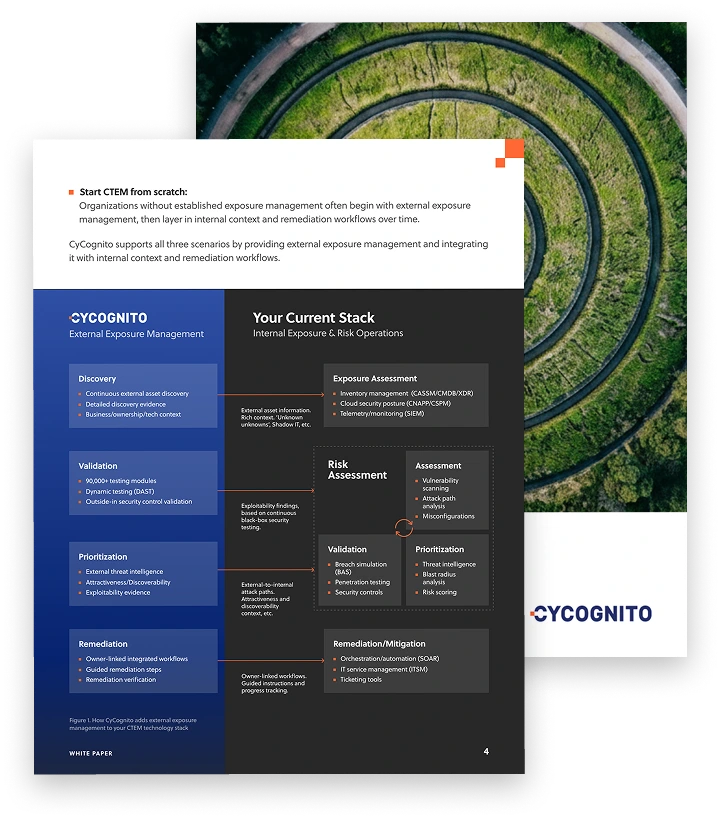
CTEM breaks when it turns into vulnerability chasing. Too many issues, weak proof, and constant escalation…
This whitepaper offers a practical starting point for operationalizing CTEM, covering what to measure, where to start, and what “good” looks like across the core steps.
Main Types of Application Security Testing Software
1. Static Application Security Testing (SAST)
Static application security testing (SAST) operates by scanning the source code, bytecode, or binaries of an application without executing it. SAST tools identify security vulnerabilities, coding errors, and adherence to best practices early in the software development life cycle (SDLC). This “white-box” methodology enables developers to find issues such as injection flaws, insecure cryptography, and mishandled user data before the code reaches production.
Integrating SAST into the development workflow improves code quality and developer accountability, as issues can be addressed at the source. However, SAST is limited by its lack of runtime context; it may yield false positives or miss vulnerabilities that only appear during execution. Despite this, it remains a fundamental building block in application security strategies, especially for catching logic errors and insecure patterns early.
2. Dynamic Application Security Testing (DAST)
Dynamic application security testing (DAST) evaluates running applications for security flaws. Unlike SAST, DAST interacts with deployed software, simulating real-world attacks against APIs, web interfaces, or other endpoints. This “black-box” approach is effective at detecting runtime issues like authentication flaws, misconfigurations, and cross-site scripting (XSS) that evade static analysis.
DAST tools do not require access to the application’s source code, making them suitable for legacy systems or third-party applications. However, they may miss vulnerabilities rooted within non-exposed code or internal logic. DAST is often used in later stages of development, pre-release testing, or production monitoring, complementing static analysis by capturing security risks observable only in a live environment.
3. Interactive Application Security Testing (IAST)
Interactive application security testing (IAST) combines elements of SAST and DAST by analyzing applications from within as they run. IAST solutions deploy agents directly into the application’s runtime environment, monitoring real-time interactions and execution flows. This approach offers deeper contextual awareness, correlating code, configuration, and runtime data to pinpoint vulnerabilities with high accuracy.
IAST tools typically provide more precise vulnerability identification with fewer false positives compared to traditional static or dynamic techniques. They are best suited for continuous integration and DevOps pipelines, where immediate feedback and in-depth context are valuable. Despite requiring access to the application’s execution environment, IAST bridges the gap between static and dynamic testing, delivering both breadth and depth for modern security needs.
4. Software Composition Analysis (SCA)
Software composition analysis (SCA) focuses on identifying vulnerabilities in third-party libraries and open-source components integrated into software projects. SCA tools scan dependency trees, flag outdated or vulnerable packages, and provide actionable insights for remediating risks tied to external code. Given the prevalence of open-source usage, SCA helps teams maintain visibility into their software supply chain and comply with licensing obligations.
SCA extends beyond vulnerability identification by highlighting legal risks due to non-compliant licenses or component misuse. Integrating SCA into development workflows reduces the chance of introducing known vulnerabilities or violating intellectual property requirements. Effective SCA is critical in today’s fast-paced development environments where rapid dependency adoption is common and supply chain attacks are increasingly sophisticated.
5. Penetration Testing Tools
Penetration testing tools simulate real-world attacks to assess the resilience of applications against threats. Unlike automated scanners, these tools are often used by security professionals to perform targeted assessments, uncover business logic errors, privilege escalation paths, and other complex weaknesses not typically detected by standard testing. They provide an adversarial perspective, mimicking threat actor techniques within controlled environments.
While automated penetration testing tools accelerate some aspects of this process, manual effort remains essential for identifying nuanced security flaws. The results help organizations understand the impact of vulnerabilities and prioritize remediation based on exploitability and risk. Penetration testing is often used alongside SAST, DAST, IAST, and SCA to validate the effectiveness of other controls and provide a holistic security assessment.
Tips from the Expert

Rob Gurzeev, CEO and Co-Founder of CyCognito, has led the development of offensive security solutions for both the private sector and intelligence agencies.
In my experience, here are tips that can help you better secure applications using testing software:
- Correlate findings across AST types for deeper insight: Create a system to correlate results from SAST, DAST, and SCA. Mapping a vulnerability identified by multiple tools often indicates higher severity or exploitability. Automate correlation where possible to accelerate triage.
- Build pre-production threat models from scan results: Use AST findings to feed into dynamic threat modeling. This allows teams to continuously refine their understanding of how the application could be attacked as it evolves, rather than relying on static, one-time threat models.
- Instrument code paths with telemetry for validation: After resolving a vulnerability, use lightweight instrumentation or observability frameworks to verify the affected code paths are hit in runtime testing and no residual weaknesses remain.
- Prioritize remediation based on code ownership and blast radius: Combine AST output with version control metadata to determine which developers or teams own vulnerable code, and assess the potential impact scope. Use this to guide remediation sequencing.
- Continuously fuzz inputs beyond DAST patterns: Supplement DAST with fuzzing tailored to application-specific protocols and data formats. This uncovers edge cases and logic faults that standard black-box scanning patterns might not reach.
Notable Application Security Testing Software
1. CyCognito

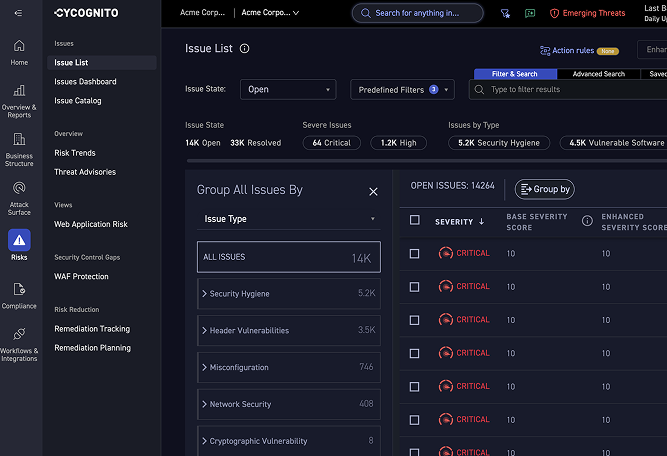
CyCognito is an external exposure management platform that delivers automated, continuous security testing across an organization’s externally accessible assets. Rather than relying on source code access or a scoped target list, CyCognito continuously discovers externally accessible systems and actively validates exploitable weaknesses from an outside-in perspective.
This is relevant for teams that need ongoing external validation between formal penetration tests, or that struggle with incomplete asset inventories.
Key features include:
- Autonomous asset discovery: Continuously identifies externally accessible applications, APIs, cloud environments, and subsidiary infrastructure, including shadow IT and unmanaged assets.
- Broad automated security testing: Executes continuous outside-in testing across exposed assets (DAST for web applications and APIs, exposed data detection, misconfiguration detection, authentication testing, encryption checks, and publicly known vulnerability validation).
- Exploitability validation: Confirms whether weaknesses are actually exploitable from an external attacker’s perspective, accounting for security controls and other mitigating factors.
- Context-driven prioritization: Ranks issues based on business context, asset exposure, attack paths, and threat intelligence so teams focus on what is most likely to be targeted and successfully exploited.
CyCognito complements SAST, IAST, SCA and point-in-time pentesting with always-on security testing across the full external footprint of the organization. It provides continuous external verification that deployed systems remain secure as infrastructure and applications evolve.
2. Veracode

Veracode is a cloud-based application security testing platform that helps organizations identify and remediate vulnerabilities across web, mobile, and third-party applications. The platform supports multiple testing methodologies, including static analysis, software composition analysis, and manual penetration testing.
Key features include:
- Cloud-based testing platform: Scalable and accessible solution for application security testing across various environments
- Static analysis security testing (SAST): Scans binaries to detect vulnerabilities without requiring source code access
- IDE integration: Veracode static analysis IDE scan detects issues as developers write code, promoting secure coding from the start
- Software composition analysis (SCA): Identifies risks in both open source and commercial components through a unified scan
- Manual web application pen testing: Offers expert-driven assessments to uncover complex and business logic vulnerabilities
3. Checkmarx

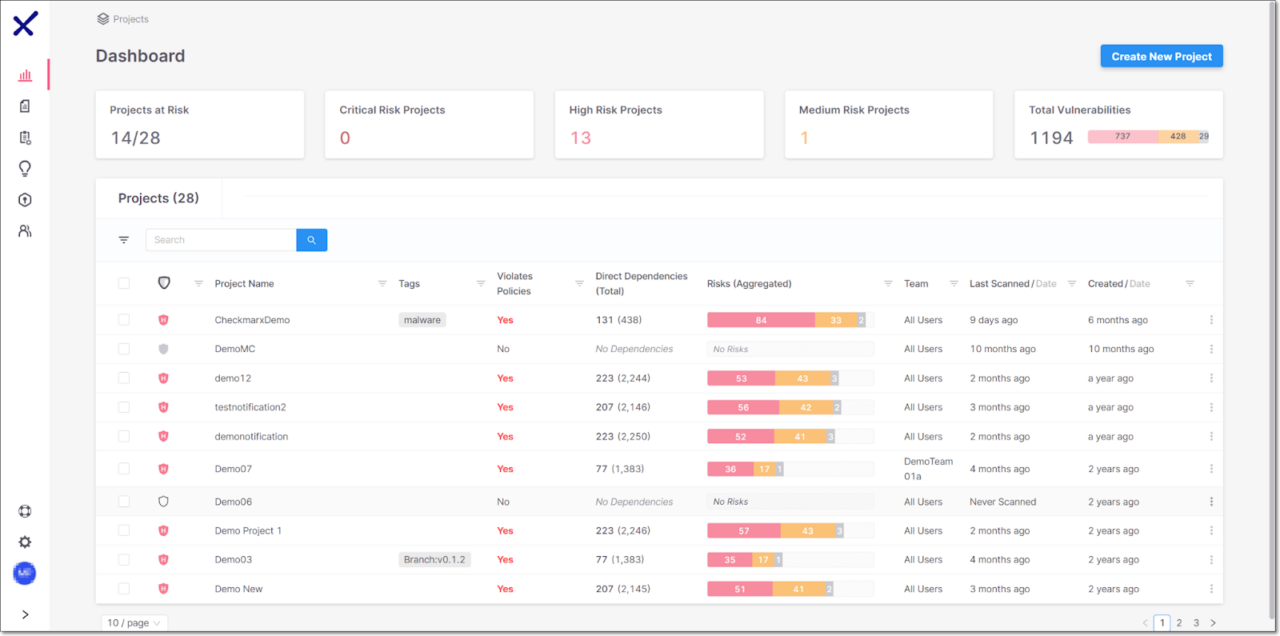
Checkmarx is an application security testing platform focused on delivering developer-friendly static analysis. Through its Checkmarx One solution, it enables security teams and developers to scan uncompiled code across a range of languages and frameworks. Checkmarx SAST emphasizes speed, reducing false positives and delivering results up to 90% faster.
Key features include:
- High-speed static analysis: Offers rapid scans with minimal performance trade-offs, ideal for both early-stage code and mission-critical applications
- Low false positives: Custom presets and AI-driven optimizations reduce noise, allowing teams to focus on real issues
- Uncompiled code scanning: Analyzes code without requiring builds, simplifying integration into development workflows
- AI query builder and security champion: Uses AI to craft queries and guide developers on secure coding practices
- Best fix location guidance: Pinpoints the optimal place in code to apply fixes, simplifying remediation
3. Invicti

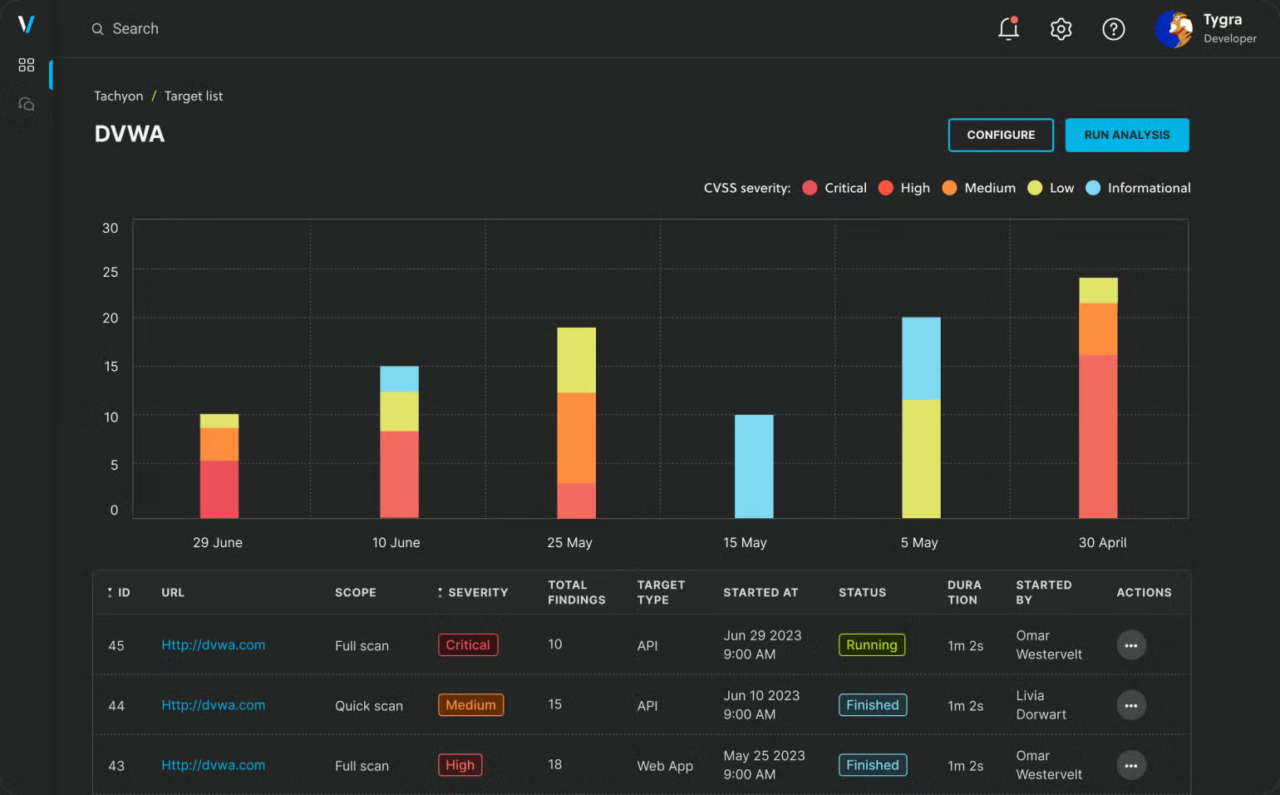
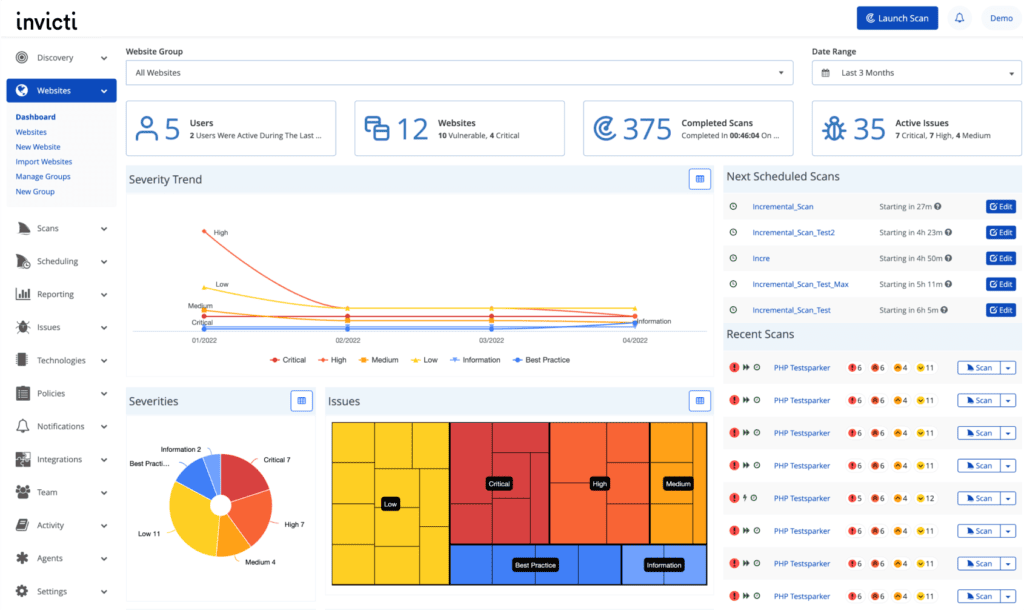
Invicti is a DAST platform to reduce noise, accelerate remediation, and keep up with development velocity. Invicti automates scanning, consolidates results across tools, and validates findings to deliver runtime-verified vulnerabilities. Its AI-powered correlation engine cuts through duplicate alerts and false positives.
Key features include:
- Runtime-verified DAST: Scans applications with 99.98% accuracy by validating exploitable issues during runtime
- Noise reduction and correlation: Consolidates alerts from multiple scanners, deduplicates findings, and suppresses false positives with custom rules
- CI/CD orchestration: Automates scans and workflows directly within continuous integration pipelines using CLI tools
- Developer workflow integration: Supports two-way syncing with Jira, GitHub, and Azure Boards for simplified issue management
- AI-powered remediation guidance: Provides developers with actionable, step-by-step instructions to resolve vulnerabilities
5. Burp Suite

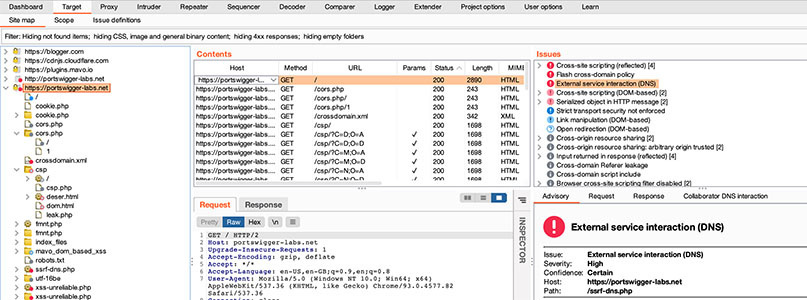
Burp Suite is a DAST solution to automate and scale vulnerability scanning across web applications and APIs. Built on the Burp technology from PortSwigger, it enables organizations to secure assets throughout the software development lifecycle without overburdening security teams. Its platform allows recurring scans across targets, helping teams reduce risk.
Key features include:
- Scalable DAST automation: Run recurring dynamic scans across large portfolios with bulk management or individual site setup
- Low false positives: Built on proven Burp technology to deliver high-accuracy results and reduce alert fatigue
- CI/CD and dev tool integration: Native support for Jira, GitLab, Trello, and compatibility with any CI/CD pipeline via GraphQL API
- Simplified setup and reporting: Initiate scans with just a URL and generate reports tailored to compliance standards or development needs
- DevSecOps support: Enables development without delays by embedding security checks directly into existing workflows
6. ZAP

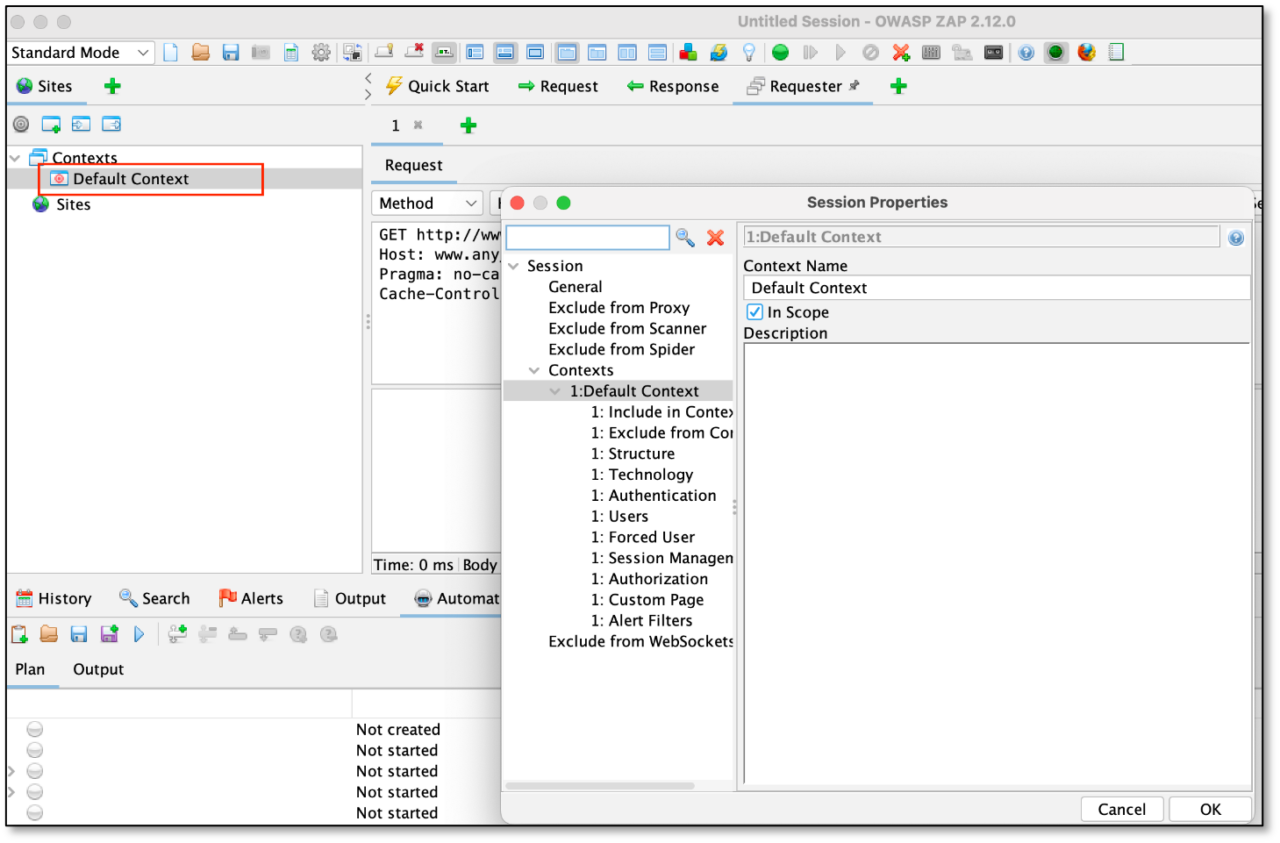
ZAP (Zed Attack Proxy) is a free, open-source dynamic application security testing (DAST) tool maintained by Checkmarx. Designed for testing web applications, ZAP acts as a proxy between the tester’s browser and the application, allowing it to inspect, intercept, and manipulate requests and responses. ZAP supports both automated scanning and manual exploration.
Key features include:
- Man-in-the-middle proxy: Intercepts traffic between browser and web app for inspection, manipulation, and analysis
- Automated scanning: Uses spiders and active scanners to automatically crawl and test applications for common vulnerabilities
- Dual spidering options: Includes a traditional HTML-based spider and an AJAX spider for JavaScript-heavy applications
- Passive and active scanning: Passively scans traffic and actively probes for known vulnerabilities with safe or aggressive testing modes
- Manual exploration tools: Supports manual testing with browser-based navigation and in-app request editing
7. Mend

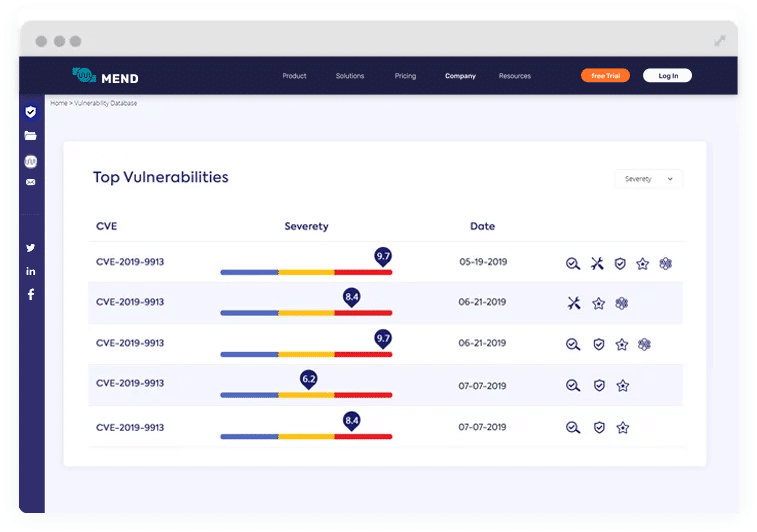
Mend offers an AI-native SAST solution that embeds into development workflows. Suitable for both human-written and AI-generated code, it delivers security feedback and automated remediation at the source. By integrating directly into repositories and pre-commit hooks, Mend allows developers to identify and fix vulnerabilities before the code is pushed.
Key features include:
- AI-native code scanning: Detects and remediates vulnerabilities in both human and AI-generated code
- Pre-commit integration: Scans code before it’s committed, preventing flawed code from entering the repository
- Real-time feedback: Provides immediate security insights and fix suggestions directly within the developer’s workflow
- AI-powered fixes: Offers automated remediation with high accuracy, reducing manual effort
- High scan performance: Runs scans faster than traditional SAST tools, supporting fast-paced development
8. SonarQube

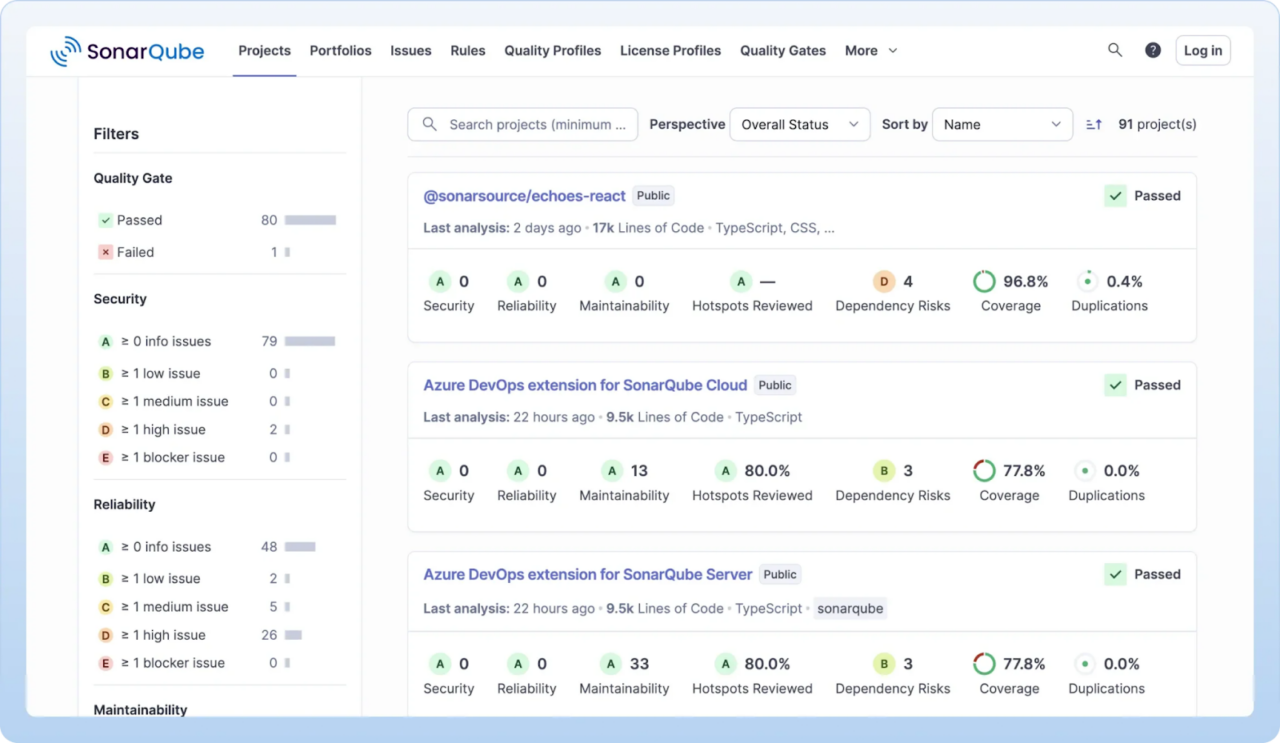
SonarQube is an integrated platform for code quality and security that brings static analysis directly into the developer workflow. With support for 35 languages and coverage across first-party, third-party, and AI-generated code, SonarQube helps organizations detect and remediate vulnerabilities early in the software development lifecycle.
Key features include:
- Static application security testing (SAST): Identifies vulnerabilities and code flaws early, with fast, accurate scanning for languages like Java, Python, C#, and more
- Taint analysis engine: Tracks untrusted user input across code layers to detect injection flaws and complex data flow vulnerabilities
- Advanced SAST: Analyzes interactions with third-party code to find hidden vulnerabilities that traditional tools miss
- Secrets detection: Prevents sensitive data like API keys and passwords from entering repositories, with detection in both IDEs and CI/CD pipelines
- Software composition analysis (SCA): Scans open-source dependencies for vulnerabilities and license risks, with SBOM support for supply chain transparency
Choosing Right Application Security Testing Software
Evaluating Tool Fit by Development Stack and Risk Profile
Selecting the appropriate application security testing software begins with a detailed assessment of your development stack—languages, frameworks, architectures, and hosting environments. Not every tool covers all technologies equally, so it is critical to align core capabilities with what your organization actually uses in production and development. Security needs will vary: web applications, APIs, containerized microservices, and desktop software present unique risk profiles and testing requirements.
Understanding your organization’s specific threat landscape and risk appetite will refine the tool selection process. For industries with strict data handling or those at high risk for targeted attacks, advanced testing (such as IAST or pen testing capabilities) may be required. Evaluate support for both legacy and emerging technologies, along with the ability to accurately identify vulnerabilities specific to your stack and risk context.
Integration with CI/CD and ITSM
Integrating application security testing into CI/CD pipelines enables vulnerabilities to be detected during development, before they make it into production. By embedding SAST, DAST, and SCA tools into build and deployment workflows, organizations can automate scans at key stages, such as during code commits, pull requests, or pre-deployment gates. This ensures that insecure code is flagged and blocked early, reducing remediation costs and minimizing security debt.
On the production side, integration with IT service management (ITSM) systems such as ServiceNow or Jira Service Management helps track and manage issues that are discovered post-deployment.
Vulnerabilities can be automatically converted into tickets, assigned to appropriate owners, and prioritized based on severity and impact. This improves accountability and accelerates response times. ITSM integration also enables closed-loop remediation by linking scan results with operational workflows.
Compliance, Regulatory, and Governance Requirements
Organizations in regulated industries must ensure that their security testing tools help maintain compliance with standards such as NIST, PCI DSS, HIPAA, GDPR, or SOX. Tools should provide audit-friendly reports, strong governance controls, and support for policy enforcement. Automated evidence collection, tracking of risk acceptances, and customizable workflows are valuable features for satisfying regulatory scrutiny.
Consider the ability to tailor testing policies and controls for different applications or business units. Security platforms with granular governance facilitate role-based access, approval workflows, and compliance mapping. Selecting tools that align with your organization’s audit, reporting, and risk management practices reduces administrative burden and mitigates the risk of compliance failures.
Open Source vs. Commercial Tools
Open source security tools like OWASP ZAP offer cost-effective entry points and community-driven innovation. These are suitable for organizations with in-house security expertise or where customization and transparency are priorities. However, open source tools may lack advanced features, technical support, or coverage breadth found in commercial alternatives.
Commercial tools, on the other hand, often include enterprise-grade support, frequent updates, advanced analytics, and broader integration options. They may offer superior usability, out-of-the-box compliance reporting, and scalability features. The choice depends on organizational resources, risk appetite, and whether long-term support, premium features, or regulatory guarantees are essential.
Support for External Attack Surfaces
Application security testing software should extend beyond internal code and environments to address vulnerabilities in externally exposed assets. This includes public-facing APIs, web applications, cloud environments, and third-party services.
Tools that perform continuous outside-in discovery and validation, help identify risks such as exposed sensitive data, unprotected admin interfaces,, encryption and security control issues and publicly known vulnerabilities in internet-facing services.
Some platforms include external exposure management capabilities to continuously discover, inventory, and monitor all public-facing assets associated with an organization. This visibility is critical for detecting shadow IT, unauthorized changes, or newly introduced risks to existing assets (e.g., assets impacted by emerging zero day threats).
Conclusion
Application security testing software plays a critical role in modern software development by enabling organizations to detect and mitigate vulnerabilities across code, components, and runtime environments.
By combining multiple testing methods, aligning tool capabilities with development workflows, and integrating continuous monitoring, teams can maintain strong security postures throughout the application lifecycle.
Successful adoption requires thoughtful selection based on technology coverage, integration depth, and risk exposure, ensuring that security becomes a seamless part of delivering reliable software.