
No matter how comprehensive and effective a penetration test is, it’s unlikely to yield a meaningful impact unless it’s coupled with an excellent penetration testing report.
This is because penetration testing reports bridge the gap between the testing process and security teams’ ability to react to the insights that tests generate. Without reports that include relevant findings, technical details, and recommendations, teams have little ability to translate pentesting insights into action.
Read on for guidance on what makes for a great penetration testing report, how to develop reports effectively, and best practices for getting the most value from pentesting reports.
This is part of a series of articles about penetration testing.
What is a penetration testing report?
A penetration testing report is a document that discusses the findings of penetration tests – meaning efforts by security professionals to discover and exploit vulnerabilities in IT assets of all types (including software applications, networks, hardware devices, cloud infrastructure and more), as a way of identifying weaknesses before attackers exploit them.
Penetration testing reports are critical because they are the medium by which testing teams communicate their findings and recommendations to the broader organization. Without effective reports, only the individual engineers who performed the tests would be aware of where security weaknesses lie. Through the reporting process, engineers can formally share what they discovered, allowing the rest of the organization to take steps to mitigate risks.
Pentest reports also often play a role in addressing regulatory compliance obligations. This is because they are a way of demonstrating to regulators and auditors that the organization takes proactive steps to identify and mitigate cybersecurity risks, a requirement of many compliance frameworks.

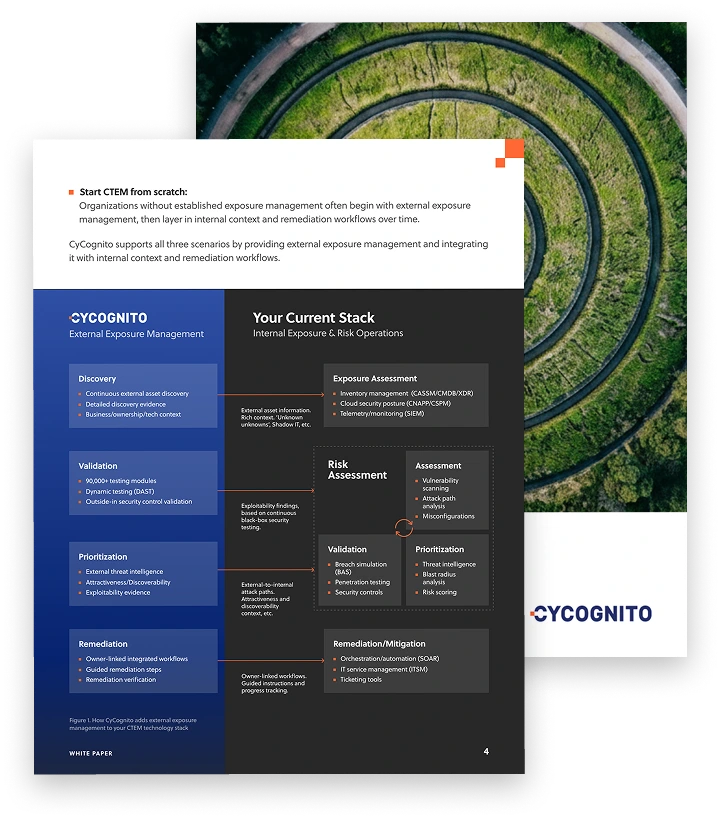
Operationalizing CTEM Through External Exposure Management
CTEM breaks when it turns into vulnerability chasing. Too many issues, weak proof, and constant escalation…
This whitepaper offers a practical starting point for operationalizing CTEM, covering what to measure, where to start, and what “good” looks like across the core steps.
Key components and characteristics of a pentest report
While there’s no official or universal structure for what to include in a penetration testing report, most contain the following key sections:
- An executive summary section that gives a quick overview of objectives, scope, timelines, critical issues, and business impact. It should be written in plain language for decision makers.
- A report section covering the testing process, including what the scope of the tests was and a summary of the attack chain (in other words, the methods the team used to find and exploit security risks or potential weaknesses).
- A technical findings section, or technical report portion, with the title, severity rating, affected systems, and attack path for each issue.
- Vulnerability assessment and severity information, which help stakeholders assess the seriousness of each risk. Ideally, this will consist not just of generic Common Vulnerability Scoring System (CVSS) ratings, but also detailed information about the exploitability of each vulnerability within the business’s actual software environment.
- Remediation recommendations, which should consist of specific, clear instructions for mitigating the vulnerabilities or other risks identified during testing.
- Appendices with supporting artifacts such as network diagrams, change logs, tool versions, scan results, and detailed logs. These should be referenced from the findings section rather than placed in the main body, since they support the report’s recommendations and audit trail.
The core contents of a penetration testing report are usually just one or two pages (although this can vary depending on how many risks the tests uncovered). Screenshots and code, however, could add many more pages to the document.
What not to include in a pentest report
In addition to noting what penetration testing reports include, it’s helpful as well to know what to avoid. Ineffective or confusing reports often include extraneous components like the following:
- Code or screenshots that lack context, making it difficult for readers to understand their relevance.
- A list of vulnerabilities without accompanying assessment information and risk ratings. Knowing which vulnerabilities exist is not very helpful without the context necessary to know which ones to prioritize; the best reports explain why a rating was assigned by tying it to business impact rather than only technical detail.
- Recommendations that lack an explanation of why they are relevant or how to implement them.
- Overly emphatic or impassioned language. A good pentest report is written in a concise, matter-of-fact way.
- Technical jargon that is difficult for non-specialists to digest. When writing a pentest report, it’s critical to keep the audience in mind and remember that the technical skills possessed by the report authors may be different from those of readers.
Tips from the Expert

Dima Potekhin, CTO and Co-Founder of CyCognito, is an expert in mass-scale data analysis and security. He is an autodidact who has been coding since the age of nine and holds four patents that include processes for large content delivery networks (CDNs) and internet-scale infrastructure.
Penetration tests are changing rapidly as security risks and tools evolve. To keep pace, organizations should follow these tips when preparing pentesting reports:
- Ensure that the scope includes AI risks: In an era when businesses increasingly rely on generative and agentic AI technology, it’s not enough for pentest reports to cover only the vulnerabilities that affect traditional applications. They must also discuss risks and recommendations for securing AI systems.
- Keep reports succinct, but comprehensive: When it comes to sheer word count, less is usually more within a penetration testing report. In other words, reports should be as concise as possible, focusing on communicating risks and priorities clearly. At the same time, however, it’s important not to skip relevant technical details or context; reports should be comprehensive. A good penetration testing report also clearly separates the key sections for executives and technical readers.
- Avoid assumptions about “tribal knowledge”: When authoring a pentest report, it can be easy to fall into the mindset of assuming that all readers are aware of the organization’s processes, systems, cybersecurity strategies, and so on. In reality, this is “tribal knowledge” that many stakeholders (like partners or newly hired engineers) may lack. The report should identify authorized attack targets and include enough context for readers to understand the environment without prior familiarity. A good report avoids making unreasonable assumptions about the knowledge of any reader.
- Define roles and responsibilities within remediation guidance: To encourage action, consider designating “ownership” for remediation actions within a report’s suggestions. In other words, identify which changes to implement, as well as who is responsible for implementing them. This approach helps avoid situations where stakeholders read pentest reports but fail to react to them effectively because everyone assumes someone else will implement the necessary risk mitigations.
Common use cases for penetration testing reports
So far, we’ve covered the essentials of what penetration testing reports are and what they should include. But the exact structure and contents of a report may vary based on the report’s intended use cases. These come in many forms, with key examples including:
- Improving internal cybersecurity: The most common pentest reporting use case is to help an organization’s own security teams to find and mitigate cybersecurity risks within their infrastructure. The goal of this type of report should be to highlight risks and recommend actions that teams can take to mitigate them, showing whether existing security controls successfully stopped the simulated attacks and noting that penetration testers often uncover weaknesses in infrastructure, applications, and networks that automated scanners miss.
- Regulatory compliance: If the goal of a report is to demonstrate proactive cybersecurity testing processes to regulators, the report should focus on aligning with relevant regulatory requirements and risk assessments.
- Third-party risk management: Customers or partners may request that an organization carry out penetration testing and prepare a report as a way of showing them that it has established healthy cybersecurity hygiene. In this case, the report should center on showcasing the status of systems that matter to the customer or partner.
- Security ROI assessment: The goal of some penetration testing reports is to help businesses determine how effective their security tooling is, and whether it’s generating a positive ROI. Reports that address this use case focus heavily on identifying and assessing gaps that security tooling fails to cover.
How often should you generate pentest reports?
Determining when and how frequently to create pentesting reports can be somewhat challenging because penetration testing schedules themselves vary widely. Some organizations carry out penetration tests as infrequently as once a year, which means they only have the opportunity to create reports at that pace.
Increasingly, however, security teams are shifting toward approaches that strive for continuous penetration testing – which means they are constantly running tests to identify vulnerabilities and weaknesses. This is critical in a world where AI tools have empowered threat actors to discover and exploit risks very quickly, making it more important than ever for organizations to test their systems on an ongoing basis.
For teams that test continuously, however, generating complete reports continuously is not practical; no team can create a new report every single hour or day. Instead, under a continuous pentesting strategy, it usually makes sense to create new reports whenever tests reveal significant new vulnerabilities or risks, or after significant changes to systems or infrastructure. That way, engineers don’t waste time generating reports that state that they haven’t found any new problems, but at the same time, they can quickly create reports when relevant risks do arise.
Common reporting challenges
While it’s vital to create penetration testing reports, it’s not always easy. Teams often face the following challenges:
Lack of standardized formatting
Unlike some other aspects of cybersecurity, where standardized frameworks or recommendations (such as the OWASP resources) guide teams as they search for and assess vulnerabilities, no standard exists for creating penetration testing reports. It’s up to each organization to decide which structure to use, as well as exactly what to include.
For example, formatting can differ for internet-facing external tests versus internal, web application, or hardware assessments because the evidence and risk framing change.
Limited guidance or actionability
Sometimes, report authors struggle to include effective guidance or recommendations about how to address vulnerabilities. This often happens when they’re not sure how to close security gaps; for example, it could be the case that they’ve discovered a vulnerability in a legacy system for which no patch exists. Good recommendations should help the technical team prioritize the issues identified by risk level and potential impact, so remediation efforts are not handled randomly.
Addressing challenges like this requires thinking creatively. For instance, if there is no patch available for a given vulnerability, a report could recommend other actions, like isolating the affected system to mitigate lateral movement risks in the event it is breached. Where possible, those recommendations should also address the root cause, not just the immediate symptom.
Low engagement with reports
You can create a great pentest report, but you can’t force stakeholders to read it. This problem tends to arise in organizations that lack a strong cultural focus on cybersecurity. It can also occur when each team operates in a silo, leading to low collaboration levels.
The solution to this challenge is to address the underlying organizational issues that contribute to low engagement with reports, which is more likely when they are not written for decision makers or the technical staff who must act on them.
Failure to follow up on reports
In a similar vein, stakeholders may read pentest reports but fail to take action in response to them. One potential cause is that reports lack actionable remediation guidance – in which case report authors should focus on offering more specific recommendations and ensure follow-up tracks whether a finding is verified fixed, risk accepted, or still open.
It could also be the case that the organization lacks sufficient cybersecurity resources to implement a report’s suggestions. The solution in that case is to expand cybersecurity tools and personnel if possible, or, if not, to include clear prioritization guidance so that teams can make the most of the limited resources available to them; tracking these statuses also helps focus remediation efforts and clarify ownership.
Best practices for optimizing penetration testing reports
To get the most out of pentest reporting, consider the following best practices:
Loop in all relevant stakeholders
As noted above, reports for stakeholders and audiences can vary depending on each report’s intended use cases. It’s important to ensure that all relevant parties are plugged into the reporting process so that they know when to expect reports, where to find them, and what they are expected to do in response.
Along similar lines, be sure that reports are written in ways that are digestible to all stakeholders. They should use plain language for decision makers, while the technical findings remain detailed enough for the technical team. If the readership includes people who are not in cybersecurity roles, for example, clear and concise language helps them understand the risks and necessary actions without being overwhelmed by jargon or recommendations they will struggle to implement.
Ensure executive-level support and buy-in
When organizational leaders take penetration testing reports seriously, it sends a signal to the organization as a whole that the reports (and the pentesting process they reflect) are priorities.
To this end, executives such as the organization’s Chief Information Security Officer (CISO), Chief Information Officer (CIO), and potentially even the Chief Executive Officer (CEO) should be aware of which reports security teams are producing and how the organization leverages them, and use the executive summary to help non-technical decision makers understand the organization’s security posture, the business impact of key findings, and how remediation efforts should be prioritized, including potential data exposure, breach costs, and regulatory penalties in clear business terms rather than technical detail.
They should also communicate about the reporting process where relevant to the corporate board, clients, partners, and regulators, all of whom are likely to benefit from knowing which process the business uses to find and report on its security risks.
Include actionable recommendations in reports
We said it before, but we’ll say it again because it’s absolutely critical: Penetration testing reports must include recommendations that are specific and actionable, giving the technical team clear, vendor-agnostic steps where possible. Readers should come away from reports with a firm understanding not just of which risks exist, but also what the business needs to do to address them.
This is essential because knowing which risks exist is not very useful if the organization lacks clear insight into how to address the problems, especially when recommendations should reflect the blast radius of an issue and whether it could expose sensitive data or affect critical infrastructure.
Treat reports as action items (not summaries)
It can be easy to fall into the routine of approaching pentesting reports as a pro forma step within the broader penetration testing process. When this happens, engineers think of reports as summaries that don’t really matter, instead of documents that capture attack chains and post-exploitation outcomes.
A healthier mindset is to leverage reports as action items. Security teams and other stakeholders should conceptualize reports not as mere descriptions of which tests took place, but as mandates for mitigating the risks identified during testing. This approach helps ensure that reports are actionable and drive meaningful improvements to the organization’s overall risk posture and strengthen the broader security program.
Getting the most from penetration tests with CyCognito
The article’s through-line is that a report only matters if it drives action, and that means findings carry exploitability context, an owner, and a way to track whether the fix held, not just a list of vulnerabilities and CVSS scores. CyCognito produces those ingredients continuously, so the underlying findings are always current rather than a snapshot from last quarter’s engagement. It starts from nothing more than your organization’s name.
- Discovers the full external footprint an attacker would target, including exposed AI services, so reports cover assets a scoped engagement never reached
- Rates each finding by real exploitability and business impact, not CVSS alone, so severity reflects what an attacker can actually reach
- Attaches evidence, attack paths, and a named owner to every finding, turning a vulnerability list into work someone is accountable for fixing
- Tracks each finding through to verified closure, so a report shows what is actually fixed instead of what was merely marked done
- Keeps findings current between formal reports, so a new report can be produced the moment a material risk or system change appears
CyCognito’s own data shows up to half of ticketed issues get closed without the underlying flaw being resolved, which is why every finding stays open in the platform until a re-test confirms the fix.
If you want to see CyCognito in action, click here to schedule a 1:1 demo.