
The best way to get ahead of cyberattacks is to think like a malicious actor – which is precisely what black box testing helps teams to do. Black box testing evaluates systems for risks based purely on input and output data. It avoids leveraging insider information that attackers usually lack, such as data about a system’s architecture, design, or code.
Keep reading for a deep dive as we explain what black box testing means, how it works, and how organizations can take advantage of black box tests to boost cybersecurity in the age of AI.
This is part of a series of articles about penetration testing.
What is black box testing?
Black box testing is a cybersecurity testing strategy that checks for vulnerabilities based purely on system inputs and outputs, rather than knowledge about how a system is “supposed to” work or what the weak points in its architecture are.
For example, a team that performs black box testing might check an application for injection risks by feeding malicious input into the app and seeing how it responds. The testers would do this without knowing if or how the app attempts to sanitize input as a way of blocking injection attacks.
In contrast, a team with insider access to the app could inspect its code, assess how it sanitizes input, and then try to find gaps or loopholes in the sanitization algorithm. This would be a very different approach than a pure black-box test that operates without any understanding of the system’s internal design.
Black box testing vs. white box testing
The opposite of black box testing is white box testing. The latter refers to tests that incorporate insider information – such as an application’s source code or execution paths.
As a software testing approaches, black box testing checks functionality and external behavior from the user’s perspective without access to internal code. In contrast, white box testing examines logic, structure, and other internal workings. White box testing is also called clear box testing, and it is closely related to structural testing. Between the two, grey box testing sits in the middle by using partial system knowledge to design more targeted checks.
White box testing is valuable because it allows teams to home in on specific types of risks that they believe are most pertinent based on an application or system’s internal workings. It usually requires programming knowledge and is often performed by software developers or other technically skilled testers, whereas black box testing is accessible to less technical testers.
But at the same time, black box tests provide a more objective way of probing a system for vulnerabilities in the same way that outside attackers would. They are also often less expensive because they do not depend on specialized code-level expertise and can reduce developer bias.
Most organizations can benefit from a testing strategy that includes both black box and white box techniques.

Operationalizing CTEM Through External Exposure Management
CTEM breaks when it turns into vulnerability chasing. Too many issues, weak proof, and constant escalation…
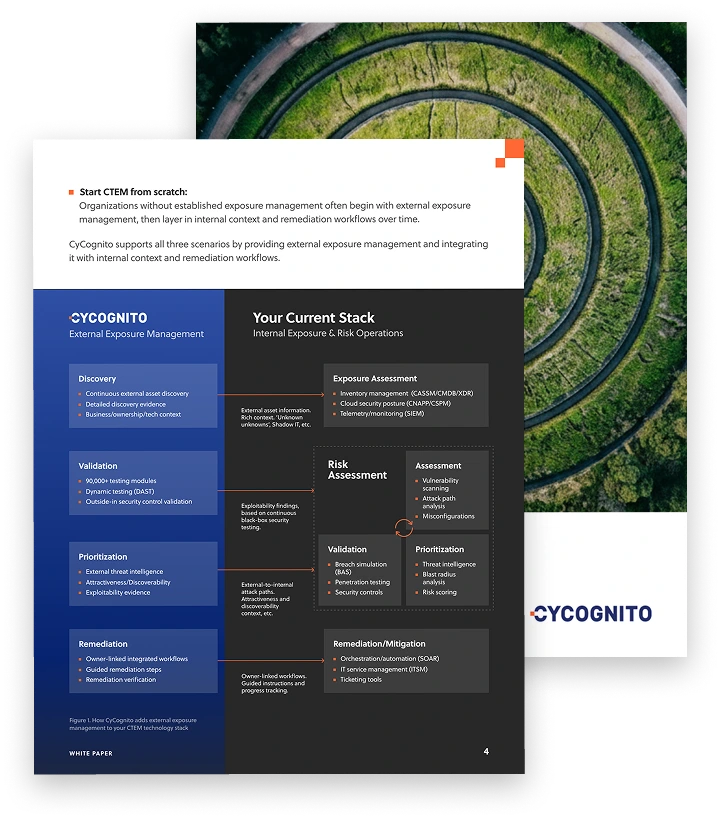
This whitepaper offers a practical starting point for operationalizing CTEM, covering what to measure, where to start, and what “good” looks like across the core steps.
How black box tests work
Black box tests can vary depending on the type of system being evaluated and the types of risks that testers want to check for.
In general, however, the black box testing process involves testing methods used to assess a software application from the outside, including practices like the following:
- Scanning applications to identify unpatched vulnerabilities that attackers could exploit.
- Feeding malicious input into applications to discover code injection risks.
- Assessing whether an application is vulnerable to the brute-forcing of credentials (meaning repeated attempts to login using different username and password combinations).
In all of these cases, as we’ve noted, testers ignore any insider knowledge that they may possess about the systems they are testing. They strive to find and exploit vulnerabilities based purely on information that is externally discoverable.
Tips from the Expert

Dima Potekhin, CTO and Co-Founder of CyCognito, is an expert in mass-scale data analysis and security. He is an autodidact who has been coding since the age of nine and holds four patents that include processes for large content delivery networks (CDNs) and internet-scale infrastructure.
Here are our tips for getting the very most from black box testing in the age of AI:
- Start with exposure mapping: Risk accumulates in assets that teams fail to see, and which, by extension, they don’t test. Good black box testing teams think systematically about which exposures their applications face and how external attackers might discover and exploit vulnerabilities.
- Prioritize AI assets: As mentioned, incorporating AI into the application development process can massively reduce organizations’ visibility into their own code. For that reason, it’s crucial to ensure that black box tests cover systems that include AI-generated code or designs.
- Consider asset interconnections: Applications don’t exist in a vacuum, and black box tests should not, either. In other words, tests should consider how applications connect to and share data with other applications, in addition to evaluating apps in isolation.
- Validate remediation efforts: Our research shows that as many as 50% of issues tracked via tickets are not actually fixed when the tickets are closed. This is a huge problem because it means organizations may think they’ve mitigated risks discovered during black box testing when in fact they still exist. Solving this issue requires investment in rigorous validation processes that confirm that flaws have actually been resolved.
The role of black box testing in cybersecurity
While black box tests can’t identify every type of risk in a software system, they are a valuable component of modern cybersecurity.
The main reason (as we’ve mentioned) is that black box tests simulate the real-world conditions under which threat actors typically operate. Black box tests evaluate system behavior and functionality without knowledge of a system’s internal structures, which external attackers usually lack.
Black box testing is also valuable because it allows testing teams to engage in multi-step attack simulations – another strategy that real-world attackers might adopt. They can begin by probing an application for weak points, then dig into them further as a way of seeing which types of harm they can actually cause.
In addition, because black box tests are based on external application behavior, they can reveal ambiguous, contradictory, or missing requirements in a system’s original documentation.
Black box tests also offer the advantage of being relatively inexpensive compared to white box testing because they don’t require specialized knowledge of how a system works. This means that any security engineer can carry out black box tests without having to study the subject system first.
Paired with other types of tests, like white box testing and fully automated vulnerability scans (which are less sophisticated but easier to execute), black box tests are a key step toward establishing strong overall cybersecurity hygiene.
Blackbox pentesting in the age of AI
Blackbox testing has existed for decades, but it has become especially important in the era of generative and agentic AI.
This is because, today, many organizations rely on AI to help design and create applications – which means that even an organization’s own developers may lack deep insight into how an application’s code works. Under these circumstances, black box testing is essential for identifying vulnerabilities or flaws that might exist within AI-generated code. It can also help identify vulnerabilities and uncover security vulnerabilities even when teams do not fully understand the generated logic.
This is not to say that black box testing can guarantee that AI-generated code is free of risks, but it’s a valuable way of helping to validate applications that organizations deploy without fully understanding how they work or where their weaknesses may lie. Applying black box testing effectively is poised to become increasingly important as AI-assisted coding changes how teams validate applications.
Key steps in the black box testing process
The major steps in black box testing usually include the following:
Define scope
First, the testing team decides which applications or systems it wants to evaluate and which types of risks it will check for. This is important because black box tests require manual effort, so it’s not practical to try to test every system for every potential risk. Organizations must define a clear testing scope. That scope should align with system requirements, fit tests into the broader software development lifecycle, and involve collaboration with software development teams so testers can prioritize what matters most.
Reconnaissance and probing
The next step is reconnoitering the target systems to identify potential exposures and weaknesses. Testers can use scanning and probing tools to collect technical information about the systems they are testing and identify potential points of entry or vulnerabilities that they can exploit, like an insecure network port or unpatched software that is subject to a known vulnerability.
Implement test cases
Test cases are the specific interactions that the team plans to undertake to discover risks. Teams create test cases from finalized functional specifications and user requirements, often before coding begins, without relying on knowledge of how the system works internally. To ensure comprehensive test coverage, predefined test cases should be prioritized around the most critical end-user workflows and software functionality.
Exploitation
The next step is to carry out exploits via test execution. This can be a multi-stepped process because testers may first exploit vulnerabilities that allow them to gain initial access. From there, they can engage in additional interactions that aim to take advantage of them. Exploratory testing can complement structured test execution when teams need to adapt quickly to observed system responses and user behavior.
Assess and report on results
Finally, the team evaluates its discoveries. It determines which risks it uncovered and what their severity level is. It may also suggest remediations to mitigate the vulnerabilities.
Challenges and limitations of black box testing
Black box testing is not without its drawbacks. Here’s a look at common limitations:
Incomplete code and risk coverage
Because black box testing teams don’t factor in knowledge about application structure, they may not test all application code or components. This limited code coverage creates risks because internal paths may go untested, potentially leaving security flaws and bugs undiscovered.
Risk of redundant or repeated effort
When testers lack knowledge of how a system works, they may distinct craft test cases that evaluate the same types of risk. This can lead to redundant effort, with multiple tests revealing the same underlying risks. In contrast, white box testing tends to be less redundant because testers can design tests such that each attack simulation focuses on a different area of risk.
One way to mitigate this issue is to use equivalent partitioning. This method divides input data into sections (or “partitions”) of inputs that will yield similar application output or behavior. By deploying at least one test case for each partition, testers can reduce the number of test cases they write while still covering all relevant areas of risk (a similar method, known as decision table testing, represents categories of test inputs via tables).
High effort requirements for test setup and execution
Designing black box tests requires significant time and expertise. Effective test cases require carefully crafted input specifications, which can be difficult to generate quickly if testers lack deep knowledge about how a system works or which input it will respond to.
In addition, although automated testing tools can help streamline the process of actually executing the tests, manual effort may still be necessary to craft initial malicious input, analyze exploratory test results, and decide how to proceed.
In this sense, black box testing is less efficient than simple security scans, which automatically check for risks using preconfigured routines that require minimal setup effort on the part of engineers.
Challenges in mapping vulnerabilities to root causes
Because black box testers operate as outsiders, it can be difficult to trace surface-level vulnerabilities to their root cause. This is a challenge because mitigating vulnerabilities typically requires developers to be able to pinpoint which application component or code triggers the risk. But it’s not always obvious from external test results where the root cause of vulnerabilities lies.
This is especially true given that AI-generated code is becoming increasingly common, which means that even the software engineers who oversee application development may struggle to map vulnerabilities onto their root causes.
Best practices for structuring and optimizing black box tests
To streamline black box testing techniques and maximize the impact of results, consider the following best practices.
Prioritize high-risk systems and components
Comprehensively testing every system or function using black box techniques is not realistic due to the manual effort required. Instead, it’s critical to define a testing scope that prioritizes the components that matter most, such as those that handle the most sensitive data or support mission-critical services.
Collaborate with developers to make testing results actionable
Black box testing insights are only useful if they lead to changes that enhance a system’s security. And given that testers usually don’t know how a system works internally, they need to collaborate with developers to help map vulnerabilities onto code, then implement appropriate mitigations.
Again, this process can be tough in the AI era, when it’s not always clear to developers exactly how an application works internally. Still, developers are closer to the code than security testers, so collaborating with them is a critical step in mitigating risks.
Automate tests where possible
Although not every aspect of the black box testing process can be automated, teams should take advantage of automations where feasible. For example, they can use AI tools to help generate input that simulates malicious activity. They can also use automated scanners to identify weak points within an application’s attack surface.
Document tests
To ensure visibility into the testing process while also helping teams to repeat tests in a consistent way, it’s a best practice to document testing workflows. Documentation should record test scope, test cases, and previously discovered risks. Based on this information, testing teams can run new test iterations that check for additional types of risk, or that reevaluate an application following a code update to determine whether known vulnerabilities still exist.
Getting the most from black box tests with CyCognito
Black box testing works because it forces you to see your systems the way an outside attacker does. Its limitation, as the article notes, is effort: doing it by hand means you test a slice of your systems once and hope the rest holds. CyCognito runs black-box testing autonomously and continuously across your entire external surface, starting from nothing more than your organization’s name.
- Maps your full external attack surface first, including the apps no one put on the test plan, so testing covers what you actually expose
- Runs autonomous black-box testing across 100,000+ scenarios and 35+ threat categories, removing the manual setup that caps how much any team can cover
- Tests exposed AI services the same way it tests anything reachable, surfacing flaws in AI-generated code and endpoints that developers may not fully understand
- Traces how exposures chain across connected systems and dependencies, mapping external-to-internal attack paths instead of judging each application in isolation
- Re-tests after a fix to confirm the issue is actually gone, catching the tickets that get closed while the underlying flaw is still exploitable
Running black-box testing continuously and at scale is how CyCognito narrows the findings flagged critical from about 25% to the 0.1% confirmed exploitable, without the manual ceiling that limits a hand-run engagement.
If you want to see CyCognito in action, click here to schedule a 1:1 demo.