
From a threat actor’s perspective, APIs are a highly attractive target. They sit directly on top of an application’s data and business logic, with fewer of the guardrails that protect a normal web UI. This is why it’s critical for organizations to discover vulnerabilities in their APIs before the bad guys do.
This is where API penetration testing – a method for detecting security risks associated with APIs -comes in. Read on for details as we explain what API penetration testing means, why it’s important, how to perform penetration tests on APIs, and best practices for optimizing API penetration testing.
This is part of a series of articles about penetration testing.
What is API penetration testing?
API penetration testing is the practice of simulating cybersecurity attacks against APIs. The goal is to uncover API security vulnerabilities and risks so that engineers can mitigate them before attackers exploit them to gain unauthorized access.
To understand fully what API pentesting entails, it’s helpful to know a bit about APIs and API security. An API is a framework that allows applications, web services, or other software systems to communicate and support data exchange with each other. APIs can enable app-to-app interactions, and they can also be used internally (such as within a microservices-based app) for service-to-service communication.
To operate securely, APIs in modern web applications and mobile apps must be able to authenticate the endpoints or resources with which they share information, especially because they often expose backend logic, sensitive data, and core business functions directly to clients. They must also be capable of preventing various types of abuse – such as high-volume resource requests designed to disrupt an API from operating normally, or requests for information that shouldn’t be available to a given application or service, since APIs are increasingly prime targets for cyberattacks by malicious actors. User input must be sanitized and validated, too, as a way of preventing injection attacks.
API penetration testing allows organizations to uncover risks like these within APIs they develop themselves, as well as third-party APIs that they use to integrate their systems with external services or platforms, helping them identify vulnerabilities before attackers exploit sensitive information flows. API testing is an essential component of overall cybersecurity because APIs often facilitate the exchange of sensitive information, making them a prime target for modern cybercriminals.
API penetration testing can help businesses meet compliance obligations as well. Compliance frameworks such as PCI DSS and HIPAA require organizations to test for vulnerabilities in their systems. Routine API audits based on pentests are one way of demonstrating compliance with these rules.
API penetration testing vs. scanning
It’s important not to conflate API penetration testing with API scanning.
Scanning is a type of API security testing that automatically analyzes APIs for security vulnerabilities and risks. In contrast, API penetration testing is a primarily manual approach (although pentesting teams can leverage a variety of automated penetration testing services and tools to streamline the process).
API security scanning is typically simpler to implement and requires fewer resources. However, the advantage of API security pentesting is that it can uncover sophisticated risks that simple scanners might miss. For example, a pentest can combine automated tools with manual testing techniques to assess real-world attack scenarios and reveal hidden vulnerabilities that simple API scanners are unlikely to catch.

Operationalizing CTEM Through External Exposure Management
CTEM breaks when it turns into vulnerability chasing. Too many issues, weak proof, and constant escalation…
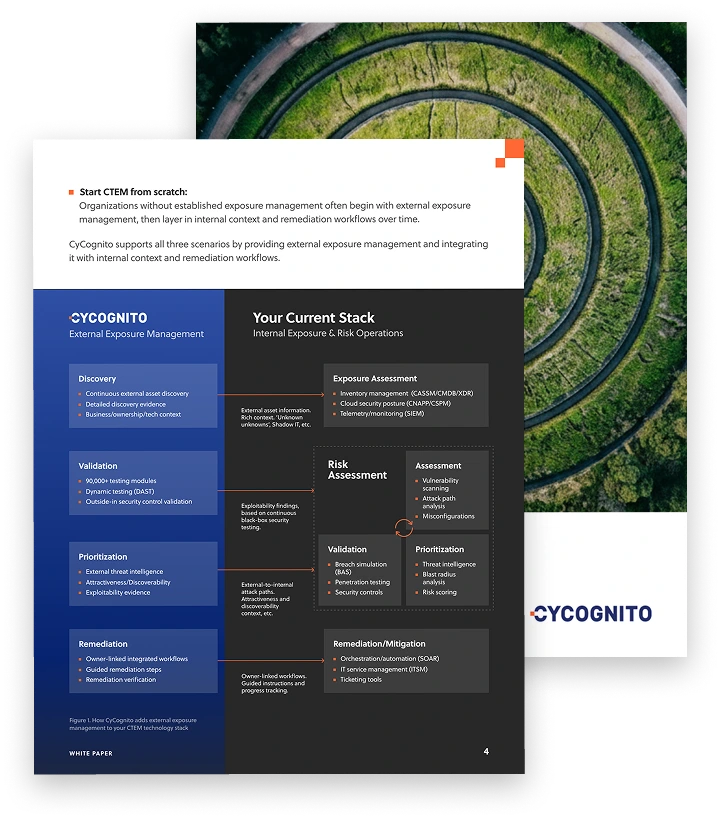
This whitepaper offers a practical starting point for operationalizing CTEM, covering what to measure, where to start, and what “good” looks like across the core steps.
Steps in the API pentesting process
Every API pentesting workflow is unique (indeed, the ability to customize tests based on organizational priorities and risk tolerance levels is part of what makes API penetration testing valuable). In general, however, the API penetration testing process typically includes steps like reconnaissance, endpoint analysis, and scanning.
Here’s a more detailed look:
Define scope
First, pentesting teams determine the scope of the target API and which types of risks they’ll check for. It’s usually not practical to analyze every API that an organization uses, so the team must make strategic decisions based on factors like which APIs it relies on most extensively, the API’s attack surface, and, where relevant, the internal network those APIs can reach or the sensitivity of the data they expose.
Perform reconnaissance and map API endpoints (including “shadow” APIs)
After determining which APIs and security risks to test, the team takes an inventory of the API endpoints (meaning URLs where an API is accessible), helping them understand the entire attack surface. These are the connection points that testers will focus on when simulating attacks. They’re often identified through API documentation that shows endpoints, request methods, and parameters.
Importantly, the inventory should cover not just approved API endpoints, but also “shadow” APIs, or ones that employees are using without official permission. Tests can detect these by scanning for undocumented or unmanaged endpoints that expose APIs, such as a deprecated version of an application that is still running.
Simulate attacks
With endpoints identified, the pentesting team can begin simulating attacks against them. This process typically involves sending malicious API requests while analyzing authentication mechanisms and authorization mechanisms, including checks on OAuth 2.0, API keys, or JSON Web Tokens for structural or cryptographic bypasses.
For instance, a test may aim to check for susceptibility to brute force or credential stuffing attacks against a login endpoint by checking whether rate limiting controls are in place. With no rate limiting in place, an attacker can run unlimited password guesses until one lands. Rate limiting plus lockout prevents that, and it ties to weak credentials (this aligns with the OWASP API2: Broken Authentication risk guidance).
As another example, testers may simulate broken object-level authorization attacks to check whether resources can be changed without proper ownership validation or access controls.
Evaluate results
After completing the attack simulations, the API penetration testers take stock of what they discovered. They usually generate a list of API vulnerabilities, using frameworks such as the OWASP API Security Top 10 list as a benchmark for categorizing findings in line with standardized guidance. They also generate an analysis that includes the severity ratings of each vulnerability
Challenges and limitations of API pentesting
While API penetration testing is a valuable way to identify risks before attackers exploit them, it is also subject to certain challenges and limitations.
Here’s a look at the most notable:
Subjective testing
By its nature, penetration testing is subjective in the sense that security teams must decide what to prioritize. There is a risk that they’ll overlook key types of risks simply because they don’t feel they’re important or are not aware of them.
To be fair, even fully automated types of security tests (like API scanning) are subjective to a degree as well because they are based on the parameters and configurations that engineers apply to them. However, because penetration testing is more manual, there is greater room for subjectivity in the way testers think and act.
Incomplete coverage
Due to the primarily manual nature of API penetration testing, it is unrealistic to test for every possible API security vulnerability or risk. Testers must instead decide what to prioritize.
The result can be situations where certain key types of risks are left unevaluated – and if the organization doesn’t understand this inherent limitation of API pentesting, it may come away with a false sense of security.
High time and resource requirements
API penetration testing requires a significant investment of time and resources because testers must plan and implement the tests by hand for the most part.
As we mentioned, certain automated penetration testing tools and techniques are available that can streamline some aspects of the process, such as generating malicious API requests. However, effective API security testing still depends on combining automation with manual techniques, such as inspecting and manipulating requests by hand, in the way that real-world attackers might.
Risk of overlooking hidden or shadow APIs
While penetration testers should check for hidden or shadow APIs, there is no guarantee that they’ll catch every one. Indeed, there is often no easy way of discovering all shadow APIs within use by an organization (especially in the case of third-party APIs, whose endpoints are hosted externally and therefore can’t be easily identified via scans of the business’s own systems).
This problem is exacerbated by the fact that hidden or shadow APIs have a tendency to be especially insecure. If there is no formal oversight of them, they likely do not conform with organizational governance and security policies – so testing these APIs is especially important, but also especially hard due to the difficulty of identifying them.
Tips from the Expert

Dima Potekhin, CTO and Co-Founder of CyCognito, is an expert in mass-scale data analysis and security. He is an autodidact who has been coding since the age of nine and holds four patents that include processes for large content delivery networks (CDNs) and internet-scale infrastructure.
Here are our tips for optimizing API penetration testing:
- Include AI-specific assets: Traditionally, API pentesting focused on conventional applications. But AI systems also frequently use APIs, and they do so in novel ways, which can widen the overall attack surface. For instance, AI agents usually make heavy use of APIs to perform actions autonomously. For this reason, it’s critical for modern API pentesters to test for vulnerabilities associated not just with traditional API interactions, but also with those that involve AI systems.
- Think like an outsider: Penetration testers often work for the organization whose systems they are testing, so they have insider knowledge of how they work. But the best penetration tests approach systems in the way that an external attacker would. Pentesters should therefore think like malicious actors as they probe for common vulnerabilities such as broken authentication, excessive data exposure, and improper access controls, which can lead to data breaches and unauthorized access.
- Follow-through on remediation: Finding vulnerabilities in APIs is of little value if no one fixes them – and too often, developers don’t follow through on mitigating risks. Integrating API security directly into the CI/CD pipeline can help close this gap by ensuring that code isn’t released until vulnerabilities are mitigated.
- Consider context: When assessing API pentest results, context is everything. Stakeholders should think about factors such as which assets connect to each other and how that affects the exploitability of each vulnerability, as well as the types of harm that it could cause.
Is it possible to automate API penetration tests?
As noted above, automating every single aspect of API penetration testing is not realistic. But many core parts of the process can be automated, including:
- API discovery: API scanning tools can automatically identify most APIs and endpoints in use within an organization.
- Vulnerability scans: Scanning tools can automatically run tests such as injection attacks to test how APIs respond. Tools like Burp Suite, and OWASP Zap are useful in this regard because they can automatically exchange data with APIs.
- Assessment and mitigation: Tools with generative or agentic AI capabilities can evaluate API vulnerabilities discovered during testing and suggest mitigations.
- CI/CD integration: Integrations that make API penetration testing a routine part of CI/CD workflows allow organizations to trigger and execute tests whenever they release or update an API. This helps ensure that pentests keep pace with the velocity of software delivery.
Best practices for API penetration testing
To get the greatest value from API penetration testing, consider the following best practices:
Define a clear scope
It’s critical for testing teams to know which types of vulnerabilities they will and won’t evaluate, as well as which APIs they plan to test. These determinations should align with business priorities and risk tolerance levels. For example, teams might choose to prioritize APIs that drive mission-critical services, while deciding not to test APIs that don’t serve sensitive data.
Keep testing processes repeatable
To ensure consistency and efficiency, it’s a best practice to keep API testing processes repeatable. Testing teams should standardize around a set of tools and practices that they use every time they run a set of API security tests. The incorporation of automated penetration testing solutions helps in this area by allowing engineers to leverage the same tooling regardless of who is responsible for overseeing API security tests.
Test continuously where possible
Automation is also valuable because it opens the door to continuous API security testing – meaning the process of checking for vulnerabilities on a real-time, ongoing basis. This is possible when organizations integrate automated API penetration testing services into the software development process such that changes to APIs trigger new tests, based on the testing scope the organization has established.
Optimizing API penetration tests with CyCognito
Optimizing API penetration tests with CyCognito
The article names the hardest part of API pentesting honestly: you can only test the endpoints you can find, and shadow or third-party APIs are both the easiest to miss and the most likely to be exposed. CyCognito works that problem from the outside in, continuously discovering the API endpoints your organization exposes, including the ones that never made the documentation, and testing them the way an attacker would. It starts from nothing more than your organization’s name.
- Discovers exposed API endpoints from the outside, including undocumented, deprecated, and third-party APIs that internal scans and test plans routinely miss
- Actively tests endpoints for authentication bypass, data exposure, and OWASP API risks continuously, rather than in a single point-in-time engagement
- Covers the APIs that AI systems and agents rely on, where autonomous, high-volume calls widen the attack surface in ways traditional pentests overlook
- Prioritizes by exploitability and how each API connects to other systems, so effort goes to the endpoints that actually reach sensitive data
- Re-tests after a fix to confirm the endpoint is actually secure, catching the roughly half of tickets that close while the flaw remains
Starting from the outside with no asset list, CyCognito routinely surfaces an attack surface up to 20x larger than teams had inventoried, which is exactly where shadow APIs and forgotten endpoints tend to live.
If you want to see CyCognito in action, click here to schedule a 1:1 demo.