
What Is IT Asset Inventory Management?
Asset inventory management is the process of tracking, monitoring, and maintaining an organization’s physical and digital assets throughout their lifecycle, from acquisition to disposal. This practice is crucial for optimizing resource use, reducing costs by avoiding unnecessary purchases, improving accountability, and ensuring compliance with policies. Tools like barcoding, RFID, GPS, and cloud-based software are used to effectively manage assets like IT equipment, MRO supplies, and vehicles.
Key aspects of asset inventory management include:
- Asset lifecycle management: This involves managing assets through all stages: planning, acquisition, operation, maintenance, and disposal.
- Asset tracking and monitoring: It requires tracking assets’ location, status, and condition, often using unique identifiers.
- Maintenance and optimization: The process includes scheduling maintenance, managing repairs, and making informed decisions about replacements or upgrades based on asset health and predictive data.
- Financial management: It involves calculating depreciation and using the data to inform purchasing decisions and control costs.
- Compliance and risk management: By maintaining a clear inventory, organizations can enforce security policies, reduce risks, and ensure legal compliance.
- Technology integration: Modern systems often use cloud-based solutions and mobile-enabled tools for real-time tracking and reporting, with integration capabilities for other business software like ERP.
MRO inventory: This specifically tracks maintenance, repair, and operations supplies, such as spare parts, lubricants, and tools, to ensure operational continuity.
IT asset inventory management is like having a comprehensive map of all the technology resources within an organization. This includes knowing what assets you have, where they are located, how they are used, when changes were made to them, and whether they represent a risk to the organization.
This is part of a series of articles about attack surface.
Why Is Asset Inventory Management Important?
IT assets are the backbone of a modern organization. They are the tools that power day to day business operations, and must be managed effectively to ensure they are used optimally and minimize risk. Two primary reasons organizations engage in IT asset management are:
- Cost management: By understanding what assets you have and how they are used, you can avoid unnecessary purchases and make more informed decisions about procurement. This can lead to significant cost savings, as IT budgets are often one of the largest expenditures for businesses.
- Risk management: With a clear inventory of assets, you can ensure that all your assets are up-to-date and protected against security threats, identify vulnerabilities if they exist, and remediate them.
Asset Management vs. Inventory Management
Asset management and inventory management are closely related but serve distinct purposes.
Asset inventory management, or just inventory management, focuses on tracking the physical details of IT assets—such as location, serial numbers, ownership, and lifecycle status. It’s primarily concerned with the “what” and “where” of assets, often used to maintain accurate records for audits, compliance, and logistics.
Asset management takes a broader view. It includes inventory data but extends to managing the value, usage, maintenance, and risks associated with IT assets. This encompasses tracking software licenses, monitoring asset performance, managing lifecycle costs, and ensuring assets align with business goals and security policies.
Key Questions to Ask About Your Asset Inventory
Before an organization can effectively manage or secure its IT assets, it must be able to answer some key questions about them. These questions help uncover visibility gaps, compliance risks, and operational inefficiencies.
What assets do we have?
A complete and up-to-date inventory is the foundation. This includes hardware (laptops, servers, network devices) and software (applications, licenses, cloud services).
Where are these assets located?
Knowing the physical or virtual location of assets helps ensure accountability and facilitates response in case of incidents.
Who owns or uses each asset?
Ownership and user assignments clarify responsibility, usage patterns, and potential misuse.
Is each asset properly configured and updated?
Unpatched or misconfigured assets increase exposure to security vulnerabilities.
Are any assets unauthorized or unmanaged?
Shadow IT and rogue devices can introduce risks. Identifying and addressing them is critical for asset management.
What is the lifecycle status of each asset?
Understanding whether assets are in use, decommissioned, or approaching end-of-life helps plan maintenance and replacements.
Do we have license compliance for all software assets?
Over- or under-licensing can result in legal or financial penalties.
Are any assets exposed to the internet unnecessarily?
Publicly accessible assets should be intentional and secured. Accidental exposure is a common entry point for attackers.
Elements of an IT Asset Inventory
There are several key elements that make up an IT asset inventory:
Asset Lifecycle Management
Effective asset lifecycle management involves tracking IT assets from acquisition through retirement. This includes documenting purchase details, deployment dates, usage history, maintenance records, and disposal actions. By maintaining this data, organizations can plan upgrades, reduce downtime, and extend asset lifespan. Lifecycle tracking also helps forecast budget needs and improves accountability across departments.
Asset Tracking and Monitoring
Tracking and monitoring focus on maintaining real-time visibility into asset location, status, and configuration. This is typically achieved using unique identifiers like asset tags, barcodes, or IP addresses, alongside automated tools. Continuous monitoring ensures organizations can detect unauthorized changes, quickly locate assets, and respond to incidents or audits more effectively.
Maintenance and Optimization
Regular maintenance is critical to sustaining asset performance and reducing failure rates. Inventory systems should support scheduling of preventive maintenance, recording of repair histories, and tracking of performance metrics. With optimization data in hand, IT teams can prioritize upgrades, retire underperforming assets, and ensure alignment with operational goals.
Financial Management
Asset inventory systems contribute to financial management by tracking costs, depreciation, and asset utilization. This helps finance and procurement teams assess total cost of ownership (TCO), plan future purchases, and comply with accounting standards. Financial tracking also aids in justifying budgets and identifying underused assets that can be redeployed or decommissioned.
Compliance and Risk Management
Maintaining a well-documented inventory supports compliance with regulatory standards and internal policies. It helps identify unmanaged or non-compliant devices, detect potential license violations, and ensure sensitive systems are properly secured. Accurate inventory data is essential for audits, security assessments, and responding to data breach investigations.
Technology Integration
Modern asset inventory systems integrate with other tools like IT service management (ITSM), configuration management databases (CMDB), and security information and event management (SIEM) platforms. Integration enables data sharing across teams, streamlines workflows, and ensures a unified view of IT environments. APIs and connectors are key features to support these capabilities.
MRO Inventory
MRO inventory tracks maintenance, repair, and operations supplies, such as spare parts, cabling, batteries, and tools, that support core IT systems. Managing MRO items ensures critical components are available when needed, preventing service disruptions. Including MRO in asset inventories helps align IT maintenance activities with operational needs and reduce downtime.
Types of IT Asset Inventory Tools
1. Manual / Spreadsheet-Based Inventory
Manual inventory methods typically use spreadsheets, word processing documents, or simple databases to log IT asset information. Asset details—such as serial numbers, asset tags, purchase dates, locations, owners, and software licenses—are entered and updated manually by IT staff. This approach is common in smaller organizations or those with limited resources.
The main advantage is low cost and ease of use, as it doesn’t require specialized tools or software. However, it’s highly labor-intensive and error-prone. There’s no real-time visibility, and updates depend entirely on human intervention. Assets can easily be missed, duplicated, or incorrectly recorded. Moreover, as the organization grows or assets become more distributed, manual systems quickly become unmanageable and unreliable. They also provide little to no support for compliance reporting or integration with other IT or security systems.
2. Semi-Automated / Agentless Discovery
Semi-automated tools rely on scanning technologies and network-based discovery protocols (e.g., SNMP, WMI, SSH, Nmap) to identify and collect information about IT assets across the network. These tools do not require installing software agents on endpoints. Instead, they use credentials or passive network listening to extract data such as device types, OS versions, running services, and open ports.
Agentless discovery is useful for quickly generating a snapshot of the IT environment with minimal setup. It is especially helpful in environments with strict device policies where agent installation is not feasible. However, its visibility is limited to devices currently connected to the network and responsive to scans. It may miss mobile, remote, or intermittent devices, and is less effective for tracking configuration drift or changes over time. Regular rescanning is needed to maintain current data, and integration with other tools may require customization.
3. Fully Automated / Agent-Based Inventory
Fully automated inventory systems use lightweight agents installed on endpoints (servers, desktops, laptops, and sometimes mobile devices) to collect asset data continuously. These agents report detailed information such as hardware specifications, installed software, license usage, patch status, configuration changes, and user activity. Some platforms also include endpoint detection capabilities, compliance checks, and real-time alerts.
Agents enable persistent, high-fidelity monitoring—even for assets that are mobile, off-network, or intermittently connected. They support automation of lifecycle tracking, incident response, and integration with security tools, ITSM platforms, and compliance frameworks. This approach is more resource-intensive to implement and maintain, especially in environments with high asset turnover or strict endpoint security policies. However, it provides the most accurate, complete, and actionable view of the IT asset landscape, making it essential for organizations with complex infrastructure or stringent governance requirements.
Tips from the Expert

Dima Potekhin, CTO and Co-Founder of CyCognito, is an expert in mass-scale data analysis and security. He is an autodidact who has been coding since the age of nine and holds four patents that include processes for large content delivery networks (CDNs) and internet-scale infrastructure.
In my experience, here are tips that can help you better manage IT asset inventory:
- Integrate ITAM with your security operations center (SOC): Connect your IT asset inventory with your SOC to enable real-time monitoring and alerting of anomalies in asset behavior. This integration ensures that any changes or potential threats to assets are immediately flagged for investigation.
- Implement network segmentation based on asset criticality: Categorize your assets based on their criticality to the business and apply network segmentation accordingly. This reduces the attack surface by limiting access to high-value targets, even if other parts of the network are compromised.
- Regularly audit third-party and supply chain assets: Extend your asset inventory management to include third-party vendors and supply chain partners. Regularly audit these assets to ensure they adhere to your security and compliance standards, mitigating risks from external dependencies.
- Develop a rapid asset onboarding and offboarding process: Create a streamlined process for quickly adding and removing assets from the inventory. This is especially crucial during mergers, acquisitions, or large-scale deployments to ensure all assets are accurately tracked from day one.
- Continuously update your asset discovery tools: Ensure that your asset discovery tools are regularly updated to detect the latest types of assets, including IoT devices and cloud-based resources. Keeping these tools current is essential to maintaining an accurate and complete asset inventory.

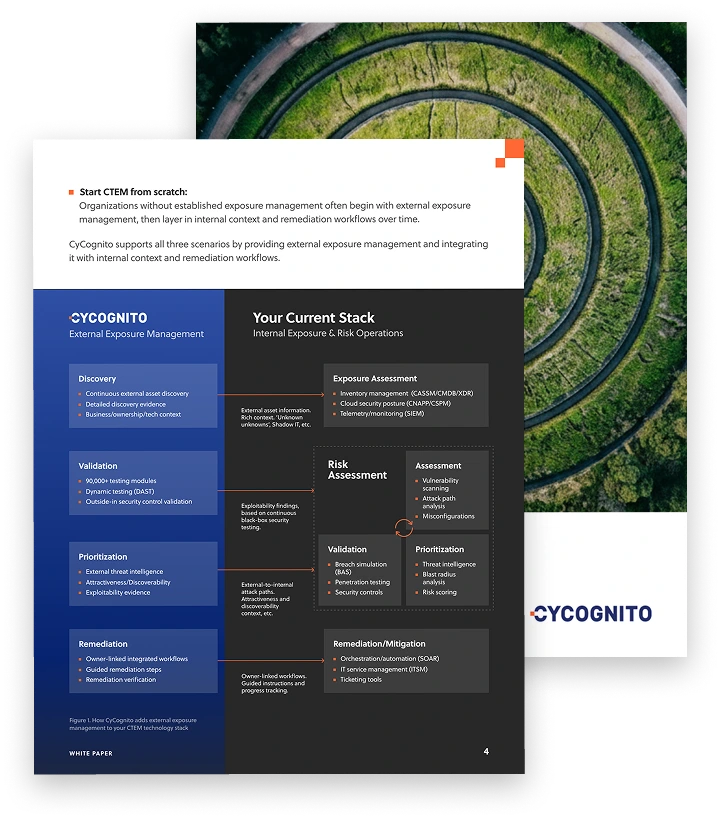
Operationalizing CTEM Through External Exposure Management
CTEM breaks when it turns into vulnerability chasing. Too many issues, weak proof, and constant escalation…
This whitepaper offers a practical starting point for operationalizing CTEM, covering what to measure, where to start, and what “good” looks like across the core steps.
The Challenge of Modern IT Asset Inventory Management: Proliferation of Internet-Connected and Shadow Assets
In the current digital landscape, the proliferation of internet-connected assets, including IoT devices, and the existence of shadow IT assets (set up and used without the knowledge or permission of the organization) pose significant challenges for asset inventory management. The sheer volume and diversity of these assets, coupled with their often decentralized nature, make it difficult for organizations to maintain a comprehensive and up-to-date inventory.
Internet-connected assets are not confined to the traditional network perimeter but are spread across various locations, including remote and mobile environments. This dispersed nature makes it challenging to identify, track, and manage these assets effectively. Shadow IT compounds these challenges by introducing unauthorized devices and applications into the environment, potentially exposing the organization to security risks due to lack of oversight and control.
To address these challenges, organizations must adopt advanced discovery methods, implement strict governance policies, and ensure that their asset inventory management processes are robust and agile enough to adapt to the ever-evolving IT landscape.
Discovering IT Assets Exposed to the Internet
To address this challenge, many organizations are taking a different approach to IT asset management, trying to identify assets exposed to the internet, wherever they are. Here are a few ways your organization can broadly discover IT assets:
- IP Addresses: Scanning IP addresses and DNS entries from domains owned by your organization can help discover a range of assets, some of which might be unknown to the IT department. A scan can discover what ports and services, and whether they are currently “alive” or responding to pings.
- IP Ranges: It is possible to discover entire IP ranges with an owner/ASN record corresponding to the organization. This can help the organization discover a list of active IP addresses which might represent IT assets.
- Domains: Domain assets can be found by cross-referencing the domain registrant and the organization, and looking for names matching brands of the organization and its subsidiaries. They include information about the registrant, organization, registered DNS names and their respective IP addresses.
- Certificates: Identifying certificates registered by the organization can also be a way to detect IT resources. Certificates include a signature, common name, and the IP addresses currently serving them.
- Web applications: Web applications have at least an IP address serving on ports related to web application services. By scanning IP addresses, it is possible to identify active web applications.
Learn how CyCognito enables automated discovery of IT assets, as part of its attack surface management platform.
Best Practices for IT Asset Inventory Management
Use an Automated Asset Discovery Process
Manual asset tracking can be a time-consuming and error-prone process. An automated asset discovery process, on the other hand, can help you save time, reduce errors, and maintain an up-to-date inventory.
With an automated system, you can easily discover and record new assets in your network. This system can also help you track the lifecycle of each asset—from procurement to disposal—making it easier to plan for replacements and upgrades.
Advanced discovery systems that leverage IP, domain, and certificate scanning can help identify assets exposed to the internet and shadow assets that might not be visible by other techniques.
Eliminate Ghost and Zombie Assets
Ghost and zombie assets—terms used to describe unused or unrecorded assets—can take a toll on your organization’s finances and productivity. Ghost assets are those that are lost, stolen, or difficult to trace, but still appear on your inventory record. On the other hand, zombie assets are those that are in your inventory but not recorded in your asset register.
Eliminating these ghost and zombie assets is an essential step in effective asset inventory management. Regular audits and advanced automated testing can help you identify these assets and remove them from your system. This will not only help you maintain an accurate record of your assets but also prevent unnecessary spending on asset maintenance and upgrades.
Establish a Process for IT Asset Disposition
IT asset disposition (ITAD) refers to the process of disposing of unwanted or obsolete IT assets in a safe and environmentally friendly manner. Proper ITAD practices can help you prevent data breaches, comply with regulations, and even recover value from your old assets.
When disposing of IT assets, it’s important to ensure that all sensitive data is completely wiped from the devices. You should also consider donating or selling your old assets to recover some of their value. Moreover, make sure to dispose of your assets in a way that complies with local and international environmental regulations.
Use Structured Documentation for Asset Data
Structured documentation is an essential part of asset inventory management. It involves maintaining a detailed record of each asset, including its specifications, location, status, and any associated maintenance and repair history.
This can help you track the lifecycle of each asset, plan for replacements and upgrades, and quickly identify and resolve any issues. Moreover, structured documentation can provide valuable insights into your IT operations, helping you make informed decisions about your IT strategy.
How to Choose Asset Inventory Management Software
Choosing the right asset inventory management software is critical for maintaining accurate records, reducing operational risks, and supporting long-term IT planning. Here are key criteria to guide your selection:
- Discovery capabilities: Look for asset management software that can automatically discover assets across on-prem, cloud, and hybrid environments. It should support agentless scans, agent-based monitoring, and integration with external data sources (e.g., cloud providers, certificate registries).
- Real-time visibility and updates: The tool should provide real-time or near real-time visibility into asset status, configurations, and changes. Continuous monitoring ensures your inventory reflects the current state of the environment.
- Integration with other systems: Select tools that integrate with your existing ITSM, CMDB, security, and compliance platforms. This enables data sharing and coordinated workflows across teams.
- Customization and scalability: Ensure the asset management system is flexible enough to adapt to your asset types, naming conventions, and metadata requirements. It should also scale with your infrastructure as it grows.
- Lifecycle tracking: Good asset inventory tools track the full lifecycle from acquisition through deployment, maintenance, and disposition. An automated asset tracking system supports better budgeting and risk management.
- Security and compliance features: Look for features like vulnerability detection, patch tracking, and software license compliance. These help align inventory management with security operations and regulatory requirements.
- User access control and audit trails: The asset management software should offer granular access control and maintain audit logs to support governance and accountability.
- Ease of use and deployment: Choose a solution with a clear user interface, fast deployment options (cloud-based or on-prem), and minimal training overhead.
- Reporting and analytics: Robust reporting helps monitor asset utilization, identify gaps or anomalies, and generate compliance-ready documentation.
- Vendor support and community: Consider the level of support offered, the frequency of updates, and the availability of a knowledge base or user community for troubleshooting and best practices.
How CyCognito Extends IT Asset Inventory Into External Exposure Visibility
Traditional IT asset inventories are built from internal telemetry (agents, authenticated scans, CMDB inputs). That model is incomplete for external exposure because it depends on credentials, network access, and prior knowledge of what should exist. As cloud and distributed infrastructure grows, assets can become externally reachable without ever being enrolled in internal inventory systems.
CyCognito builds inventory from the outside in.
It continuously enumerates an organization’s external footprint by starting from known identifiers (for example, corporate domains) and expanding through observable relationships such as DNS records, IP allocations, certificate metadata, and service fingerprints. This surfaces externally reachable assets including domains and subdomains, hosts and IPs, web applications, and exposed services across cloud and hybrid environments.
Because discovery is based on what is externally observable, it does not require endpoint agents or authenticated access. CyCognito can identify assets that are off-network, unmanaged, intermittently connected, or created outside standard IT processes, including shadow assets and forgotten infrastructure.
CyCognito then enriches assets with security-relevant attributes, including reachable services (ports and protocols), technology signals (where fingerprintable), evidence-based ownership mapping, and change tracking to detect exposure drift over time. From there, it prioritizes what matters by highlighting assets that are externally reachable, unintentionally exposed, or likely to be exploited based on their observable attack surface.
In practice, CyCognito complements internal inventory systems as an external validation and coverage layer, helping teams reconcile what internal systems record with what is verifiably exposed, then drive remediation based on exposure and risk rather than asset count.
Learn more about asset discovery in the CyCognito attack surface management platform.