
What Is Cloud Security Testing?
Cloud security testing evaluates cloud-based applications, infrastructure, and configurations to identify weaknesses, vulnerabilities, and risks that could be exploited by attackers or result from operational errors.
The focus spans everything deployed within public, private, and hybrid cloud environments, including virtual machines, storage, APIs, and network components. This covers both technical flaws, such as software vulnerabilities, and misconfigurations, which can arise due to the flexible, scalable nature of cloud setups.
The scope of cloud security testing is broader than traditional on-premises assessments because it takes into account shared responsibility models, third-party services, and automation tools such as infrastructure-as-code (IaC).
Testing methods here include vulnerability scanning, penetration testing, and compliance checks, all tailored to the specifics of cloud environments. As organizations increasingly migrate workloads to the cloud, security testing ensures continuous alignment with evolving risks and regulatory requirements.
Why Cloud Security Testing Matters
As organizations continue shifting to cloud-native architectures, the complexity and scale of these environments introduce new attack surfaces and risks.
Cloud security helps enterprises keep pace with their expanding digital footprint and evolving threat landscape, with continuous testing driving validation and evidence-based prioritization and remediation.
Here are several that make this important:
- Complex attack surface: Cloud environments expose multiple interfaces (APIs, storage, virtual machines, and containers) that can be targeted if not properly secured.
- Misconfiguration risks: Many cloud breaches result from misconfigured assets, such as publicly exposed storage or overly permissive access controls, which testing can help catch early.
- Shared responsibility model: Testing helps clarify and verify which security controls fall under the provider’s domain and which are the customer’s responsibility.
- Dynamic infrastructure: With frequent deployments and the use of infrastructure-as-code, continuous security testing ensures configurations remain secure over time.
- Compliance and governance: Many industries require regular cloud security assessments to meet regulatory standards such as HIPAA, GDPR, or SOC 2.
- Cost of breach: Identifying and fixing vulnerabilities before exploitation helps avoid the financial and reputational damage of a data breach.

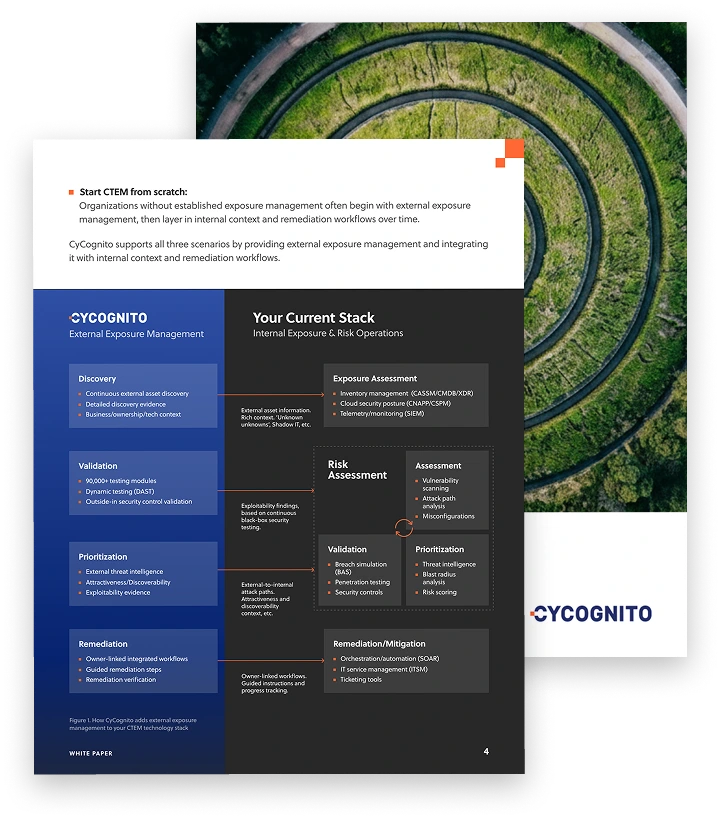
Operationalizing CTEM Through External Exposure Management
CTEM breaks when it turns into vulnerability chasing. Too many issues, weak proof, and constant escalation…
This whitepaper offers a practical starting point for operationalizing CTEM, covering what to measure, where to start, and what “good” looks like across the core steps.
Common Cloud Security Threats and Vulnerabilities
Misconfigurations and Insecure Defaults
Misconfigurations are a leading cause of cloud security incidents, often resulting from incorrect settings or a lack of attention to secure configuration practices.
Cloud platforms offer numerous configuration options, and default settings are sometimes left unchanged, granting excessive permissions or exposing resources to the public internet. Attackers actively seek out misconfigured storage buckets, databases, and security groups, exploiting them to gain unauthorized access or exfiltrate data.
Credential Leaks and Privilege Escalation
The compromise of API keys, access tokens, or logins often leads to unauthorized access and privilege escalation attacks in cloud environments.
Risks increase when credentials are stored in plaintext within code repositories, inadvertently exposed in logs, or shared across multiple systems. Attackers use automated tools to scan public repositories for secrets and escalate privileges once an initial foothold is gained.
Insecure APIs and Unpatched Services
Cloud services depend heavily on APIs to automate provisioning, integration, and management activities. Insecure API endpoints—lacking proper authentication, authorization, or input validation—are common attack vectors for data breaches and remote code execution exploits. Attackers also exploit known vulnerabilities in cloud-hosted applications and underlying services that have not been promptly patched.
Data Exposure and Loss
Data is a prime target in the cloud, and accidental exposure—such as public S3 buckets or misconfigured databases—often leads to the loss or theft of sensitive business information. Encryption at rest and in transit, access controls, and proper data classification are fundamental safeguards, but these are not always implemented uniformly across all cloud resources.
Insider Threats and Human Error
Insider threats, either malicious or accidental, remain a significant concern for cloud security. Employees, contractors, or service providers often have legitimate access to critical cloud resources. Changes made in error, unintentionally shared links, or deliberate misuse of privileges can lead to damaging incidents, such as service disruptions or data leaks.
Types of Cloud Security Testing
1. Vulnerability Assessment
Vulnerability assessments systematically scan cloud resources (including virtual machines, containers, and serverless functions) for known security weaknesses. Automated tools map the environment, identify outdated packages, misconfigurations, and exposed services, and generate risk-based prioritization for remediation efforts. This process forms the foundation of a proactive security program.
Routine vulnerability assessments are critical as cloud assets change frequently, with new services spun up and down in response to business needs. By running assessments on a regular schedule, organizations can address new risks swiftly and reduce the window of opportunity for attackers. Integrating these scans into CI/CD pipelines enhances shift-left security and maintains continuous awareness of the environment’s threat posture.
2. Penetration Testing
Penetration testing extends beyond finding vulnerabilities by actively simulating attacks against cloud systems. These tests uncover exploitable weaknesses, such as privilege escalation paths, insecure APIs, and exposed secrets, which are not always detected by automated scanners. Pen testers mimic real-world adversaries using understanding of cloud-specific threats, focusing on the unique characteristics of SaaS, PaaS, and IaaS platforms.
Penetration testing combines manual and automated approaches to gauge the impact of successful exploitation and to validate the effectiveness of incident detection and response controls. Unlike vulnerability assessments, pen tests are targeted and goal-oriented, providing actionable intelligence on how attackers might move laterally or escalate privileges within a cloud environment, enabling organizations to harden key defenses.
3. Configuration Audits
Cloud configuration audits evaluate the setup and settings of cloud resources against secure configuration baselines and best practices to uncover insecure or non-compliant configurations. In cloud environments, configuration drift, where settings change over time from a known secure state, is a common risk that can expose services, data stores, or network paths to attackers.
Audits typically leverage automated tools such as Cloud Security Posture Management (CSPM) solutions to continuously assess configurations for issues like overly permissive identity and access management (IAM) roles, open storage or database access, insecure network rules, and missing encryption settings.
Findings are mapped to established frameworks and benchmarks (e.g., CIS Cloud Benchmarks), which guide remediation and help ensure that cloud infrastructure remains robust against misconfiguration-based exploits.
4. Compliance Testing
Compliance testing in cloud security verifies that cloud deployments adhere to internal policies and external regulatory requirements relevant to the organization’s industry and data sensitivity.
Cloud adoption often involves shared responsibility models and third-party services, so this testing must go beyond merely checking technical configurations. It assesses governance controls, encryption policies, access audits, logging and monitoring practices, and data residency controls against standards such as ISO/IEC 27017 for cloud security, PCI-DSS for payment data, HIPAA for health information, or GDPR for personal data protection.
Compliance testers use automated assessment tools and reporting frameworks to identify gaps and generate evidence that proves ongoing conformity, which is critical for audits, certifications, and risk management programs.
5. Red Team and Purple Team Exercises
Red team exercises are advanced simulations where security professionals emulate real-world adversaries to test cloud systems, applications, and operational processes in ways that traditional penetration tests may not cover.
These exercises attempt to breach cloud assets, evade defenses, and challenge detection and response capabilities in realistic scenarios, helping organizations understand how their cloud environments stand up to sustained attack pressure. The objective is to identify exploitable weaknesses and measure defensive maturity.
Purple team exercises build on red and blue team practices by fostering close collaboration between offensive testers (red team) and defensive practitioners (blue team). In a purple team engagement, findings and tactics are continuously shared so that defenders gain real-time insights into attack techniques and can adapt controls accordingly.
This iterative, coordinated approach enhances detection rules, incident response playbooks, and overall cloud security posture, making the organization’s defenses more resilient over time. Purple team testing is especially valuable in cloud environments where rapid changes and automation demand tight integration between attack scenarios and defensive feedback loops.
Key Focus Areas for Cloud Security Testing
Identity and Access Management (IAM)
IAM is the cornerstone of cloud security, controlling who can access what resources and at what privilege level. Testing efforts should extensively review user accounts, roles, policies, and permission boundaries to prevent excessive access and role sprawl. Key tests include validating least-privilege enforcement, verifying MFA coverage, and identifying orphaned or unmanaged identities.
Attackers commonly target weak IAM implementations to escalate privileges or exfiltrate data from cloud environments. Security assessments should focus on role mappings, access review logs, and conditional access policies. Automating IAM checks and integrating them with change management processes ensures that access permissions remain both current and secure as cloud environments evolve.
Network and Perimeter Controls
Network segmentation and perimeter controls remain vital in cloud environments to restrict attacker movement and contain breaches. Testing includes reviewing firewall rules, virtual private cloud (VPC) configurations, segmentation boundaries, and ingress/egress policies. Security teams assess both internal and external exposure points to discover overly permissive rules and unexpected internet connectivity.
Continuous network security assessments should monitor for open ports, misconfigured security groups, and improper network peerings. Validating virtual appliances, VPN gateways, and traffic flows ensures that intentional segmentation is upheld. As cloud-native environments lack traditional network perimeters, automated network mapping and anomaly detection tools are essential to maintain perimeter security.
API and Microservices Security
Cloud-native architectures rely heavily on APIs and microservices, introducing new opportunities for exploitation. Security testing should include endpoint enumeration, authorization checks, and fuzzing for input validation weaknesses. Unauthorized access to APIs can facilitate data theft, remote code execution, or lateral movement within microservices environments.
Automated API security testing tools help detect hidden endpoints, insecure dependencies, and missing authorization checks early in the development lifecycle. In addition, regular source code reviews and dynamic analysis techniques uncover flaws that could be exploited post-deployment. Ensuring robust authentication, rate limiting, and version management is central to securing interconnected cloud microservices.
Infrastructure-as-Code (IaC) and DevSecOps Integration
IaC has transformed cloud operations by allowing infrastructure deployment through code, but misconfigured templates can rapidly propagate vulnerabilities. Security testing of IaC involves static code analysis for configuration flaws, secrets exposure, and non-compliant resource definitions. Tools like Terraform and CloudFormation scanners help enforce security policies at the code review stage.
DevSecOps practices embed security checks into CI/CD processes, automating the identification of security issues before code reaches production. Testing needs to cover all stages of the software delivery pipeline, including dependency scanning, environment provisioning, and runtime monitoring. By integrating testing with DevOps workflows, organizations can shrink attack surfaces and respond quickly to emerging threats.
Container, Serverless, and Kubernetes Security
Containers, serverless functions, and Kubernetes introduce unique security challenges related to isolation, orchestration, and ephemeral resources. Cloud security testing must evaluate container images for vulnerabilities, unsafe permissions, and misconfigurations. Kubernetes assessments involve auditing RBAC settings, network policies, and cluster component hardening.
Serverless functions, being short-lived and event-driven, require special focus on input validation, sensitive variable protection, and least-privilege execution policies. Automated tools and security frameworks designed for container and Kubernetes environments help maintain compliance and uncover risks that can spread rapidly due to the speed and scale of cloud-native deployments.
Cloud Storage and Data Protection
Securing cloud storage against unauthorized access and accidental exposure is a top priority. Tests should verify proper encryption settings, access controls, bucket/object permissions, and logging policies for all storage services. Persistent misconfigurations, such as public buckets or unencrypted volumes, frequently lead to high-profile data breaches.
Data protection assessments must address data residency, backup/restore processes, and integrity checks to safeguard against corruption or loss. Automated monitoring and data classification help ensure that sensitive files are not exposed or misused. Constant vigilance is required given the dynamic, self-service nature of cloud storage, where resources can be created or made public at any time.
Supply Chain and Third-Party Integrations
Cloud environments regularly interface with external vendors and SaaS products, multiplying the attack surface through third-party connections. Testing should enumerate and validate all third-party integrations, reviewing permissions, authentication tokens, and security event logging. Risks include vendor compromise, insecure APIs, and reliance on unmanaged third-party components.
An effective supply chain security strategy incorporates dependency checks, contract assessments, and ongoing monitoring of third-party risk. Automated tools flag outdated libraries, malicious packages, or changes in vendor security posture. By focusing on integration points during security testing, organizations can prevent cascading risks that originate outside their direct control.
Related content: Read our guide to cloud security challenges
Cloud Security Testing Tools and Technologies
1. Vulnerability Scanners and Pentesting Platforms
Automated vulnerability scanners identify software flaws, misconfigurations, and outdated packages in cloud infrastructure. These tools provide broad coverage, quick deployment, and compliance mapping, enabling continuous visibility into the security posture of cloud assets. Commercial pentesting platforms add attack simulation capabilities, testing for actual exploitation scenarios beyond simple vulnerability identification.
Integration of these tools with cloud-native APIs simplifies asset discovery and streamlines testing processes. However, automated scanners should be supplemented by manual reviews to identify business logic vulnerabilities, privilege escalations, and platform-specific risks that automated routines might miss. As cloud environments evolve, keeping scanners regularly updated is essential to detect newly published vulnerabilities and emerging threats.
Learn more in our detailed guide to penetration testing
2. External Attack Surface Management (EASM)
External attack surface management (EASM) tools continuously discover, inventory, and assess all internet-facing cloud assets (including domains, subdomains, APIs, storage, and exposed infrastructure) that may not be tracked internally. These tools emulate attacker reconnaissance to identify shadow IT, misconfigured services, and forgotten assets that expand an organization’s external exposure.
EASM platforms help prioritize remediation by correlating discovered assets with known vulnerabilities, misconfigurations, and policy violations. When integrated with security operations, EASM reduces the time to detect unknown exposures and supports incident response by maintaining an up-to-date map of the organization’s digital footprint across multiple cloud providers and third-party services.
3. Cloud Security Posture Management (CSPM)
CSPM solutions continuously monitor cloud environments to detect misconfigurations, compliance violations, and deviations from best practices. These platforms offer real-time visibility, automated policy enforcement, and comprehensive reporting, making them essential for managing risk in complex, multi-cloud deployments.
By integrating CSPM tools with incident response workflows and DevSecOps pipelines, organizations transition from reactive to proactive cloud security management. CSPM automates much of the configuration audit process, identifies policy drift, and delivers actionable insights for remediation. When paired with vulnerability and compliance scanning, CSPM provides a consolidated approach to cloud security posture monitoring.
4. Cloud Workload Protection Platforms (CWPP)
CWPP focuses on securing workloads across virtual machines, containers, and serverless functions. These solutions provide runtime protection, vulnerability management, and behavioral monitoring for cloud-native resources. Key features include host- and container-level threat detection, micro-segmentation, and automated response to anomalous activity.
CWPP is particularly effective for hybrid or multi-cloud environments, where unified visibility and control over diverse workloads is necessary. These tools complement traditional security controls by focusing on the elastic and ephemeral nature of cloud workloads, detecting attacks that may bypass endpoint defenses or exploit vulnerabilities unique to dynamic cloud assets.
5. Cloud Infrastructure Entitlement Management (CIEM)
CIEM tools specialize in managing, analyzing, and securing identity and permission relationships in cloud environments. They help organizations discover excessive, unused, or risky privileges, map access entitlements, and enforce least-privilege policies at scale. CIEM platforms deliver continuous assessment of IAM configurations and generate recommendations for right-sizing permissions.
Effective use of CIEM technology reduces the attack surface by limiting unnecessary access and simplifying the enforcement of separation-of-duties policies. These platforms also provide critical insights into permission creep, cross-account access risks, and anomalous entitlements that could be leveraged in targeted attacks. Integrating CIEM with broader cloud security strategies is vital for maintaining secure and compliant cloud operations.
How to Perform Cloud Security Testing Effectively
1. Define a Cloud-Specific Threat Model
Before starting cloud security testing, build a threat model tailored to your specific cloud architecture. This includes mapping out assets, trust boundaries, data flows, and entry points across IaaS, PaaS, and SaaS layers. Account for identity systems, third-party integrations, and administrative interfaces.
Unlike on-premise environments, cloud systems depend heavily on APIs, automation, and shared resources. Your threat model should reflect cloud-native attack paths such as privilege escalation via IAM misconfigurations, lateral movement through flat network structures, or abuse of metadata services. A well-defined threat model helps prioritize testing activities and identify high-impact scenarios specific to your cloud usage.
2. Use Hybrid Pentesting Methodologies
Combining automated and manual techniques is key to effective cloud penetration testing. Automated scanners help quickly identify known vulnerabilities and misconfigurations, but manual testing uncovers complex issues like chained exploits, privilege abuse, and logic flaws that tools miss.
Hybrid approaches should also incorporate cloud-specific tactics such as abuse of serverless triggers, IAM escalation paths, insecure cross-account roles, and reconnaissance via cloud asset metadata. Testing should reflect real-world attack behaviors and validate the effectiveness of monitoring, detection, and response mechanisms in place.
3. Integrate Tests Into Your DevOps Pipelines
Cloud security testing must be continuous and integrated into development pipelines to keep pace with rapid deployment cycles. Embed security checks in CI/CD workflows to scan infrastructure-as-code, container images, and dependencies before reaching production. Use pre-deployment gates and automated testing tools to enforce security controls.
Incorporate feedback loops so developers receive actionable findings early and can remediate before issues become embedded in live environments. Shift-left testing reduces the cost and complexity of fixing vulnerabilities and ensures security becomes a shared responsibility across engineering teams.
4. Treat Identity and Access Management as the Top Priority
IAM misconfigurations are one of the most common and damaging issues in cloud environments. Prioritize testing of identity roles, permission boundaries, and federated access setups. Validate that least-privilege principles are enforced and that excessive or unused privileges are removed.
Use tools to visualize access relationships and simulate privilege escalation paths. Test enforcement of multi-factor authentication and review cross-account trust relationships. Regularly audit IAM policies for sprawl and verify that service accounts and users are scoped tightly to their required functions.
5. Benchmark Against Standards (Beyond Compliance)
Go beyond basic compliance checks by aligning your testing strategy with established security benchmarks such as CIS, NIST, or MITRE ATT&CK for Cloud. These frameworks offer actionable guidance on best practices that reduce real-world risk, not just audit gaps.
Use them to evaluate how well cloud configurations, network boundaries, IAM policies, and data protections align with known good practices. Regular benchmarking also helps track maturity over time and ensures your security posture evolves with the threat landscape and architectural changes.
6. Tailor Frequency to Change Cadence
Testing frequency should match the rate of infrastructure and application changes. High-change environments, such as those using continuous delivery or ephemeral resources, require more frequent, often automated testing to maintain security coverage.
Conduct real-time configuration checks and integrate periodic manual reviews for sensitive systems or major releases. Schedule in-depth tests, like penetration tests or red teaming, around events such as cloud migrations or major architectural shifts. Tuning your testing cadence to the pace of change ensures new risks are caught early without overwhelming teams with false positives or redundant scans.
Extending Cloud Security Testing with CyCognito
Cloud security testing identifies vulnerabilities, misconfigurations, and compliance gaps. However, most testing approaches are scoped and periodic, making them misaligned with fast-moving cloud environments that change between assessment cycles.
CyCognito complements cloud security testing by adding continuous external discovery and active exploitability validation, powered by over 90,000 automated tests across 30+ categories. If you already use CNAPP, CSPM, vulnerability scanners, or penetration testing, CyCognito strengthens your program by:
- Continuously discovering externally exposed cloud assets, including unmanaged and previously unknown environments
- Validating exploitability through outside-in active testing, including security control effectiveness
- Automatically re-validating exposures daily as assets and configurations change
- Prioritizing remediation based on verified attack paths, business context, and asset criticality
By shifting from periodic detection to continuous validation of external exposure, CyCognito ensures cloud remediation efforts focus on verified risk rather than theoretical coverage gaps.If you want to evaluate your cloud environment from an attacker’s perspective, request a 1:1 demo.