
For decades, cybersecurity professionals have been using penetration tests to help discover security flaws in software systems. With the advent of generative and agentic AI technology, however, vast opportunities have arisen to make pentesting faster, more efficient, and more scalable via a practice known as AI pentesting.
As this article explains, AI pentesting can dramatically accelerate the pentesting process, whlie also expanding teams’ ability to address complex security challenges at scale. In this way, it offers a critical advantage to organizations seeking to keep pace with attackers who are also leveraging AI to find and exploit vulnerabilities. It also helps address the novel security risks that are emerging in a world where everyone (including non-developers with a limited understanding of security fundamentals) can code using AI tools.
That said, pentesting with AI also introduces novel challenges (such as the need to manage token costs and analyze complicated attack paths that AI tools misunderstand), which are essential to mitigate in order to ensure that the complexity of AI pentesting doesn’t outweigh its benefits.
What is AI penetration testing?
AI pentesting is the use of artificial intelligence, agentic AI, context engineering, and harness engineering by ethical hackers to simulate cybersecurity attacks. It enables teams to run complex, multi-step attack chains that not only identify weak spots, but also verify how attackers can move laterally to reach critical assets.
Like traditional pentesting, the goal of AI pentesting is to discover vulnerabilities, escalation paths, and attack patterns in systems before threat actors exploit them. But whereas traditional penetration testing relies mainly on manual workflows and basic automation tools (like vulnerability scanners), AI pentesting takes full advantage of modern AI technology to carry out attacks. It allows security teams to operate at the scale and speed of machines, while also benefiting from the unique insights delivered via human logic.
AI pentesting also allows teams to take fuller advantage of automated testing by leveraging reasoning and memory to make tests autonomous. This means that AI pentesting systems are able to make strategic decisions as pentests unfold, allowing them to emulate the thinking of actual, real-world attackers as they penetrate and move laterally within compromised environments.
Increasingly, this ability to leverage AI as the basis for autonomous pentesting isn’t just a nice-to-have feature. It’s essential in an era when threat actors are also leveraging AI to direct attacks using natural language and capitalize on new types of vulnerabilities (such as prompt injection). Against this backdrop, protecting software environments against attackers with non-deterministic tools on their side requires an equally non-deterministic, autonomous pentesting approach.
Note that AI pentesting can also refer to the practice of using penetration tests to discover flaws in AI systems. In this article, however, we’re focusing on the use of AI to accelerate pentests of all types, including but not limited to those designed to help secure AI applications and services.
How does AI pentesting work?
Broadly speaking, AI pentesting is based on the same core processes as traditional pentesting. However, the incorporation of AI changes the basic steps in important ways, resulting in a workflow that looks as follows:
- Test scope: The process begins with humans establishing the scope of testing, as well as guardrails to control testing behavior.
- Autonomous reconnaissance and attack simulation: From there, AI agents reconnoiter target systems and simulate attacks autonomously. They can also move laterally once inside a system as they discover and exploit escalation paths.
- Testing traditional as well as AI-specific attack surfaces: Importantly, AI pentesting tools don’t only check for traditional vulnerabilities (like unpatched software). They can also seek out and test AI-specific risks, such as prompt injection vulnerabilities in applications that incorporate AI chatbots.
- Validation of vulnerabilities through safe exploitation: To confirm that vulnerabilities exist and are exploitable under the target environment’s configuration, AI pentesting tools perform exploits based on the scope and guardrails set earlier in the testing process. The tools can do this by using publicly available exploit code if it exists; however, the tools are also capable of developing their own exploits.
- AI-driven analysis: After tests and exploits are complete, AI tools generate reports that summarize test findings and make remediation recommendations.
- Human review and verification: As a final critical step in the process, humans review and validate AI-generated findings. Manual assessment is important because, although AI tools excel at identifying high-priority risks from a technical perspective, they lack the full business context necessary to understand which vulnerabilities truly matter most, and which resources the organization has available for mitigating them.
Because the AI pentesting process is mostly automated and autonomous, it can become an ongoing, repetitive operation that enables continuous validation.
AI pentesting mechanisms
The tools that drive the AI pentesting process include multiple components and increasingly support more autonomous systems:
- Models: Models, including large language models (LLMs), can evaluate software systems to recognize vulnerabilities. They can also make prioritization decisions and offer remediation advice, particularly because machine learning algorithms excel at identifying complex patterns across large datasets.
- AI agents: Agents serve as the bridge between models and systems under evaluation. They carry out the actual commands necessary to discover and exploit vulnerabilities, often through tool calling workflows. They can analyze large volumes of data much faster than human teams.
- Orchestrators: Managing the AI pentesting process at scale requires orchestrators, which keep track of which models and agents the organization has deployed for pentesting purposes and directs their operations.
- Humans in the loop: Although AI pentesting is largely autonomous, humans are a critical element. Not only do they issue instructions that tell AI pentesitng tools what to evaluate, but they also review reports and recommendations to make ultimate determinations about how the organization should respond.
It’s possible to run AI pentests by connecting these various tools manually. However, to streamline the process, teams can take advantage of AI pentesting platforms that make all of this functionality available as a unified tool set.

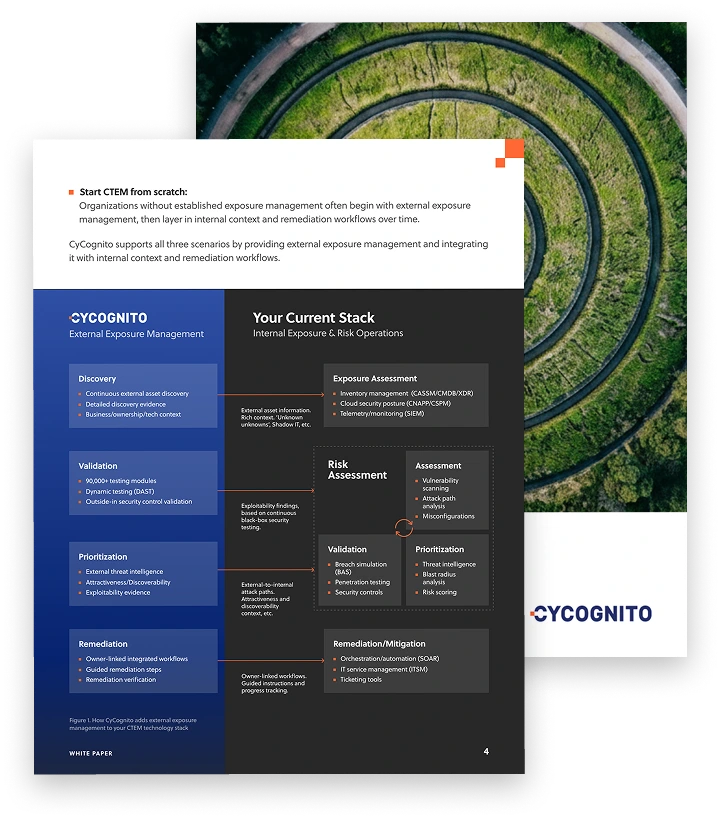
Operationalizing CTEM Through External Exposure Management
CTEM breaks when it turns into vulnerability chasing. Too many issues, weak proof, and constant escalation…
This whitepaper offers a practical starting point for operationalizing CTEM, covering what to measure, where to start, and what “good” looks like across the core steps.
AI pentesting vs. traditional pentesting
Although the major steps in the pentesting process are mostly the same with or without the use of AI tools, a variety of differences distinguish AI pentesting from traditional pentesting:
- Attack surface differences: Traditional pentests typically focus on discovering traditional types of vulnerabilities (like code injection or buffer overflow risks). AI pentsts can check for these issues, too, but they can also cover AI-specific attack surfaces (like prompt injection risks in AI models or vulnerabilities in Model Context Protocol servers).
- Ability to scale: The ability to simulate multi-step attack scenarios in parallel makes it possible for AI pentests to operate on a scale that traditional pentests could never achieve — a capability that is especially critical for testing AI systems. For instance, assessing prompt injection vulnerabilities requires running through enormous numbers of dynamic input scenarios. Human pentesters could not feasibly do this, but AI pentesting tools can.
- Periodic vs. continuous testing: Autonomous testing using AI also means that AI pentests can become a continuous and ongoing process, with tests performed repeatedly. In contrast, traditional pentesting typically occurs only periodically, often as rarely as once or twice per year. Continuous testing is valuable because it allows organizations to gain higher confidence in the security of software systems that constantly change. It also pairs continuous discovery with continuous validation processes.
- Deterministic vs. non-deterministic testing: Traditional pentests are deterministic. A given test will always check for the same risks in the same way, until someone modifies the test. AI pentests, in contrast, are non-deterministic, and may use varying approaches to evaluating the same types of risks. In a world where the behavior of actual threat actors is also unpredictable, non-deterministic testing is a key advantage.
- Test velocity: Tests can also run much faster when they are driven by AI tools. With traditional pentesting, it could take days for teams to work through attack simulations that require vulnerability discovery, exploitation, and escalation. AI can perform the same scenarios in minutes.
In short, AI pentesting is faster, more efficient, more effective and impactful, and more scalable than traditional pentests. It’s also capable of running more dynamic tests that cover broader attack surfaces and that check for vulnerabilities or attack paths that manual, deterministic tests might miss.
That doesn’t mean, however, that traditional pentests have no role to play in the AI era. They remain valuable for checking for certain types of risks that AI tools can’t assess as well. For example, traditional pentests could evaluate a system’s vulnerability to attacks that incorporate social engineering rather than the exploitation of technical vulnerabilities to initiate a breach.
Traditional penetration testing is also useful in scenarios where a very high degree of consistency is important, meaning a team wants to evaluate a narrow set of risks under a fixed, unchanging configuration. Doing so is easier with traditional, deterministic pentesting tools rather than using non-deterministic AI testing solutions.
Types of AI pentesting solutions
Like conventional penetration testing, AI penetration testing solutions include free and open source offerings, such as:
- PentestGPT: An open-source penetration testing framework that uses large language models to guide testers through reconnaissance, vulnerability analysis and exploitation. It maintains testing context and can interactively recommend and execute the next steps in a penetration test.
- CAI (Cybersecurity AI): An open-source framework (from the creators of PentestGPT) for building AI agents that perform real-world security testing. It supports multiple LLM providers and is designed to automate tasks across different stages of offensive security operations.
- HexStrike AI: An open-source AI security automation framework that connects AI agents with a broad collection of cybersecurity tools. It is designed to let AI agents orchestrate activities such as reconnaissance, vulnerability assessment, and penetration testing, with the project released under the MIT license.
Commercial options are also available, including:
- CyCognito: An AI-powered continuous penetration testing and exposure management platform that uses AI agents to simulate multi-step attacks across external assets, including applications, APIs, cloud infrastructure, and AI services. It combines broad automated testing with attacker-style reasoning to identify and validate complex attack paths.
- Horizon3.ai NodeZero: An autonomous penetration testing platform that uses AI to conduct real attacks against networks, applications, cloud environments, and identity systems. NodeZero can discover attack paths, validate exploitability, and provide evidence of how an attacker could compromise an environment.
- XBOW: An AI penetration testing platform designed to perform offensive security testing with AI agents. It automates activities such as reconnaissance, vulnerability discovery and exploitation to identify vulnerabilities that traditional automated scanners may miss.
While all of these solutions address AI pentesting needs, they differ in areas like the attack surfaces they focus on, how they integrate with external AI platforms, and which levels of AI and security expertise they require on the part of testing teams.
How AI pentesting helps security teams stay ahead of threats
Today, approximately 25 percent of successful cyberattacks leverage AI to help discover and exploit vulnerabilities, according to IBM. That figure has increased by 56 percent in a one-year period, and is likely to continue to grow as threat actors find ways to take even greater advantage of AI to accelerate attacks.
In the face of this challenge, AI pentesting has become a vital solution for organizations aiming to keep pace. Not only do AI pentests help businesses identify vulnerabilities faster, but they also greatly improve their ability to simulate real-world attack behavior at scale.
In addition, AI pentests can evaluate systems for risks continuously — which means that in applications and hosting environments where code and configurations are changing all of the time, AI pentesting offers a means of validating that updates haven’t introduced new security risks.
Going even further, AI pentesting can help organizations to adopt a more proactive security stance not just by discovering risks faster, but also by gaining more holistic, comprehensive insight into where their vulnerabilities are concentrated and how they can modify their software development and deployment practices to reduce risk.
Note, too, that while these capabilities are important for securing traditional software systems, they’re even more critical for adapting to the fast-evolving AI threat landscape. The types of AI systems and architectures that businesses are adopting continue to change rapidly, and pentesting those resources continuously using AI is one critical step toward keeping them secure.
In short, AI pentesting is not simply a way to make penetration testing more efficient or scalable. It’s a fundamental requirement for staying ahead of AI-assisted cyberattacks, which are poised to become increasingly prevalent and complex as threat actors get better and better at using AI for nefarious purposes.
The role of humans in AI pentesting
Although AI pentesting can significantly boost the effectiveness of human testers, it’s not a replacement for humans in the pentesting process. On the contrary, integrating humans into the testing loop remains critical for addressing such needs as:
- Planning and scoping: Humans with a keen understanding of business priorities and context must determine which systems to test and which types of risks to test for.
- Analyzing complex attack paths: Understanding particularly complex attack paths, such as those that involve moving between discrete systems, may require human insight.
- Verifying remediation effectiveness: AI can help validate whether remediations actually mitigate risks. Still, the task of definitively verifying that risks have fallen to a level acceptable to the business must fall to humans, since they alone have a full understanding of the organization’s risk tolerance levels.
- Innovating test strategies: AI systems excel at identifying and repeating patterns in their training data. When it comes to devising totally new testing techniques or identifying completely novel types of risks, however, human creativity and intuition are key.
Tips from the Expert

Dima Potekhin, CTO and Co-Founder of CyCognito, is an expert in mass-scale data analysis and security. He is an autodidact who has been coding since the age of nine and holds four patents that include processes for large content delivery networks (CDNs) and internet-scale infrastructure.
At CyCognito, we’ve been leveraging AI to accelerate and scale pentests since modern generative and agentic AI technology first emerged. Here are our tips for getting the most from the practice:
- Strive for continuous testing and coverage: Running AI pentests only on a periodic basis, or only across part of the attack surface, undercuts their effectiveness. To maximize the impact of AI in the pentesting process, strive to test continuously and across the entire attack surface.
- Monitor token costs: A potential downside of AI penetration testing is the high token costs associated with using AI tools. For this reason, it’s a best practice to track token costs and avoid unnecessary token expenditures by, for example, using traditional tools when non-deterministic testing capabilities are not a priority.
- Prioritize risks based on business value: AI can accelerate prioritization assessment based on technical factors like exploitability. Equally important, however, is considering the business value of vulnerable systems, and the level of harm that the organization would experience following a successful breach.
- Verify remediation: While teams can, and should, take advantage of AI to help devise and deploy remediations, it’s essential to follow up using human expertise and validation to confirm that risks have been successfully mitigated.
Continuous AI pentesting with Cycognito
CyCognito is an external exposure management platform that discovers every internet-facing asset from the outside in, tests each one continuously with 100,000+ deterministic checks, and runs AI agents on top to find the attack paths scripted tests cannot.
This platform approach provides several key benefits, as the pentesting agents inherit everything the platform already knows about an asset: its business and tech context, how it connects to other assets, and more. That context makes each run more economical and more accurate, which, in turn, translates into broader coverage.
The key benefits include:
- Plans testing runs automatically with the Target Graph™ orchestration engine, based on factors like asset importance, history, tech attribution, and external threat intelligence
- Starts each AI run with the asset’s stack, exposed services, and business context already mapped, so no tokens go to reconnaissance
- Skips known vulnerabilities and misconfigurations the deterministic layer has already confirmed or ruled out, and chains from the confirmed ones
- Reserves AI reasoning for complex work, such as business-logic flaws, AI-specific issues (e.g., prompt injection and agent hijacking), and more
- Delivers every confirmed finding with request, response, reproduction steps, and fix guidelines, routed to the asset’s owner
By keeping inventory and findings current with evidence, CyCognito cuts up to 90 percent of manual effort on reconnaissance and verification, and its AI agents inherit the same advantage.
Connecting near-real-time exposure intelligence with AI pentesting also means rapid response to shifts in the attack surface: new assets going live, config changes, emerging threats, and so on.
If you want to see CyCognito in action, click here to schedule a 1:1 demo.